
Dubai Port Rashid Transforms Gulf Cruise Tourism via Strategic Integration with DXB Aviation in 2026
Dubai is leveraging Port Rashid and Dubai International Airport to create a seamless fly-cruise gateway, handling millions of passengers and integrating with the expanded Cruise Arabia Alliance.

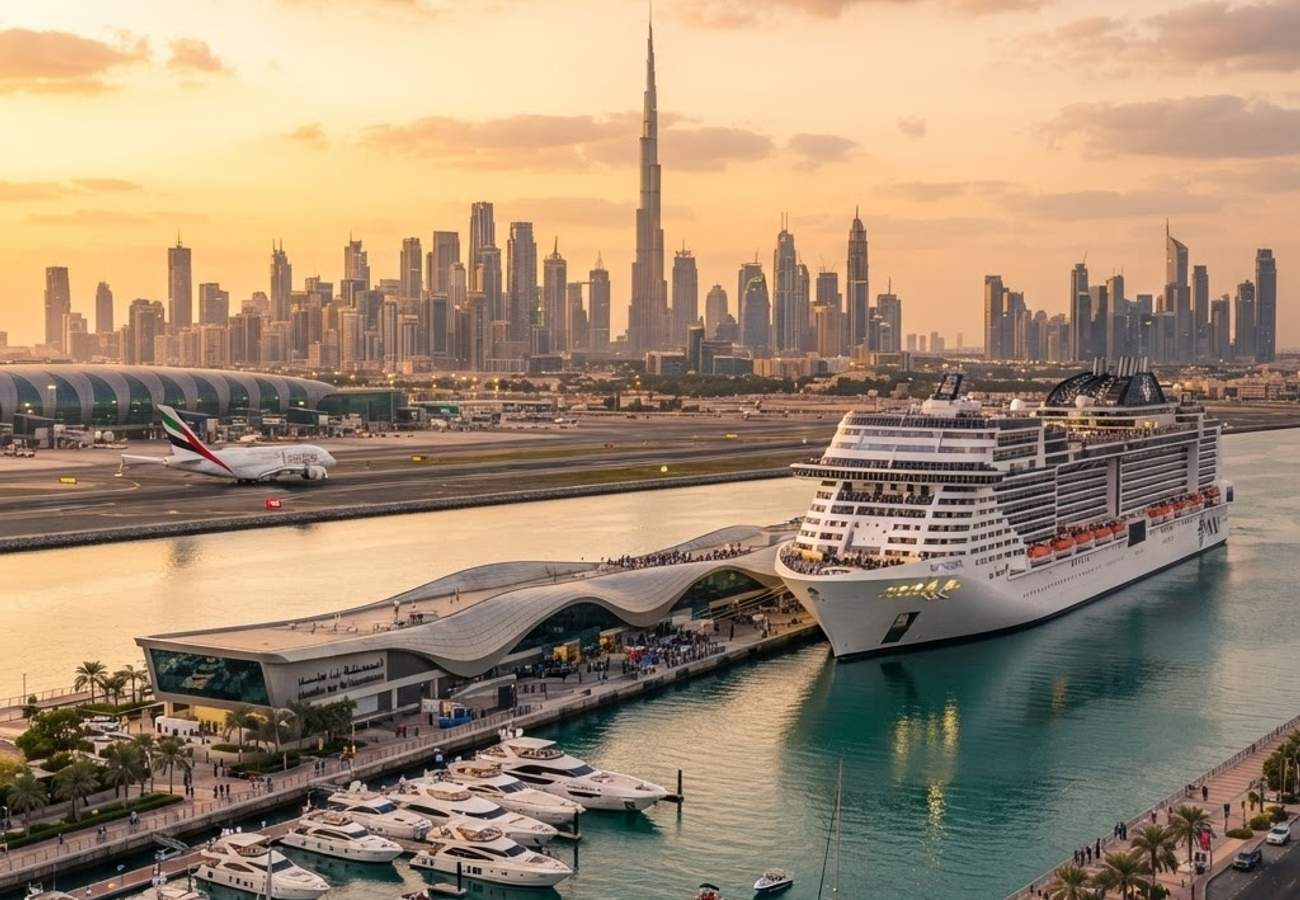
Image generated by AI
Dubai is redefining the regional maritime experience by transforming Port Rashid into a high-capacity bridge between global aviation and Gulf voyages. By synchronizing the operations of the Hamdan bin Mohammed Cruise Terminal with the record-breaking traffic at Dubai International Airport, the city is shifting from a simple port-of-call destination to a comprehensive global fly-cruise hub.
The strategic importance of this integration is underscored by the sheer scale of movement through the city's gateways. In 2025, Dubai International Airport (DXB) welcomed a record 95.2 million guests, while the city hosted 19.59 million international overnight visitors. This massive influx of air travelers provides a built-in customer base for cruise lines utilizing Mina Rashid, which can accommodate up to seven mega-cruise vessels and 27,000 passengers simultaneously.
Mina Rashid Evolution into a Tourism Powerhouse
Port Rashid, known locally as Mina Rashid, has undergone a significant functional shift to meet the demands of modern luxury travel. Originally established as Dubai's first commercial seaport in 1972, the facility once balanced industrial cargo with passenger traffic. However, as the emirate developed Jebel Ali in 1979 to handle larger industrial and logistics loads, Port Rashid was strategically repurposed.
According to industry reports, container operations were systematically migrated to Jebel Ali, allowing Mina Rashid to specialize in Ro-Ro (Roll-on/Roll-off) services and high-end cruise tourism. This transition enabled the development of the Hamdan bin Mohammed Cruise Terminal, which DP World identifies as the largest single covered cruise terminal globally.
Since the introduction of homeporting services in 2007, the port has become a cornerstone of the UAE's tourism economy, managing approximately one million cruise passengers every year. The facility does not merely provide a dock; it offers a full suite of operational support, including bunkering, provisioning, and specialized storage, ensuring that mega-ships can turn around efficiently.
Port Rashid Operational Specifications
| Feature | Detail |
|---|---|
| Commercial Port Establishment | 1972 |
| Homeporting Implementation | Since 2007 |
| Maximum Mega-Cruise Vessels | 7 simultaneously |
| Peak Passenger Capacity | 27,000 simultaneously |
| Average Annual Passengers | ~1 million |
| Primary Terminal | Hamdan bin Mohammed Cruise Terminal |
| Key Logistic Link | Dubai International Airport (DXB) |
The Synergy Between DXB Aviation and Maritime Logistics
The viability of Dubai's cruise sector is inextricably linked to its aviation dominance. The "fly-cruise" model relies on the ability of passengers from distant markets—such as North America, Asia, and Europe—to reach their embarkation point with minimal friction.
In 2025, DXB recorded a 3.1% annual increase in traffic, reaching 95.2 million guests. This network consists of 108 international carriers serving 291 different destinations. For cruise operators, this level of connectivity reduces the logistical burden on passengers, making Dubai a more attractive starting point than ports with limited long-haul air access.
The growth in overall visitor numbers further validates this strategy. Data indicates a steady climb in international overnight stays, moving from 18.72 million in 2024 to 19.59 million in 2025.
Dubai Tourism and Aviation Growth Metrics
| Metric | 2024 | 2025 |
|---|---|---|
| International Overnight Visitors | 18.72 million | 19.59 million |
| DXB Annual Guests | 92.3 million | 95.2 million |
| DXB Annual Growth | — | +3.1% |
| Total Visitor Growth | — | +5% |
Homeporting vs. Transit Calls: Economic Implications
From a logistical and financial perspective, there is a profound difference between a transit port call and homeporting. A transit call involves a ship stopping for a few hours, where passengers spend limited amounts on short excursions. In contrast, homeporting means the cruise begins or ends in Dubai.
Homeporting creates a "multiplier effect" for the local economy. Passengers arriving to start a voyage typically book several nights in local hotels, utilize airport transfers, and dine at city restaurants. Similarly, those ending their cruise often extend their stay to explore the city before flying home.
Comparison of Cruise Visit Types
| Feature | Transit Port Call | Homeporting at Dubai |
|---|---|---|
| Primary Purpose | Short destination visit | Voyage commencement or conclusion |
| Duration of Stay | Several hours | Multiple days |
| Hotel Demand | Low | High |
| Airport Reliance | Moderate | Critical |
| Logistics Flow | Ship-based | Airport $\rightarrow$ Hotel $\rightarrow$ Port |
| Local Spending | Limited window | Extended opportunity |
| Retail Impact | Brief visits | High engagement |
The scale of this recovery and growth is evident in recent seasonal data. During the 2022-23 season, Dubai anticipated 166 ship calls and approximately 900,000 passengers and crew. This followed a previous season that saw 98 ship calls and 338,697 passengers, demonstrating a rapid trajectory toward pre-pandemic levels and beyond.
Regional Integration via the Cruise Arabia Alliance
Dubai's ambitions extend beyond its own borders. The expansion of the Cruise Arabia Alliance in November 2025 has integrated Dubai, Abu Dhabi, Bahrain, Oman, Saudi Arabia, and Qatar into a unified regional network.
This alliance aims to standardize infrastructure and create seamless multi-destination itineraries. By positioning Port Rashid as a primary gateway, Dubai facilitates easier access to these other Gulf nations. For the traveler, this means the ability to combine a high-tech city break in Dubai with a cultural exploration of the wider Arabian Peninsula without the need for frequent hotel changes or complex transit arrangements.
Why This Matters: The Traveler's Perspective
For the modern traveler, the integration of Port Rashid and DXB removes the traditional "stress points" of cruise vacations. Traditionally, coordinating international flights with ship departures required precise timing and often expensive last-minute logistics.
From a logistical standpoint, the proximity of the world's busiest international airport to one of the world's largest cruise terminals means that the transition from air to sea is nearly seamless. This encourages "vacation stacking," where a traveler can experience a luxury urban stay in Dubai and a regional cruise as a single, cohesive itinerary.
Furthermore, the shift toward homeporting means travelers have more agency over their schedules. Instead of being tethered to a ship's strict 8-hour window in port, they can engage with the city's retail and cultural offerings on their own terms. This transforms the cruise from a mere transport mechanism into a comprehensive travel experience.
Dubai's ability to merge aviation giants with maritime infrastructure is setting a new global standard for transit-oriented tourism.
Related Travel Guides
Disclaimer
This article is for informational and educational purposes only. It does not constitute legal, financial, or professional advice. While we strive to provide accurate and up-to-date information, travel policies, regulations, and conditions change rapidly. Always verify information with official sources before making travel decisions. Nomad Lawyer makes no representations about the accuracy, reliability, completeness, or suitability of the information provided. Readers should consult qualified professionals for advice specific to their circumstances. The views expressed in this article are those of the author and do not necessarily reflect the views of Nomad Lawyer.
Raushan Kumar
Founder & Lead Developer
Full-stack developer with 11+ years of experience and a passionate traveller. Raushan built Nomad Lawyer from the ground up with a vision to create the best travel and law experience on the web.
Learn more about our team →