
Beyond Downtown Detroit: Exploring Hamtramck, Eastern Market, the Heidelberg Project, and Belle Isle
A comprehensive travel analysis of Detroit's historic neighborhoods, detailing multicultural dining in Hamtramck, grassroots public art, and greenway transit.

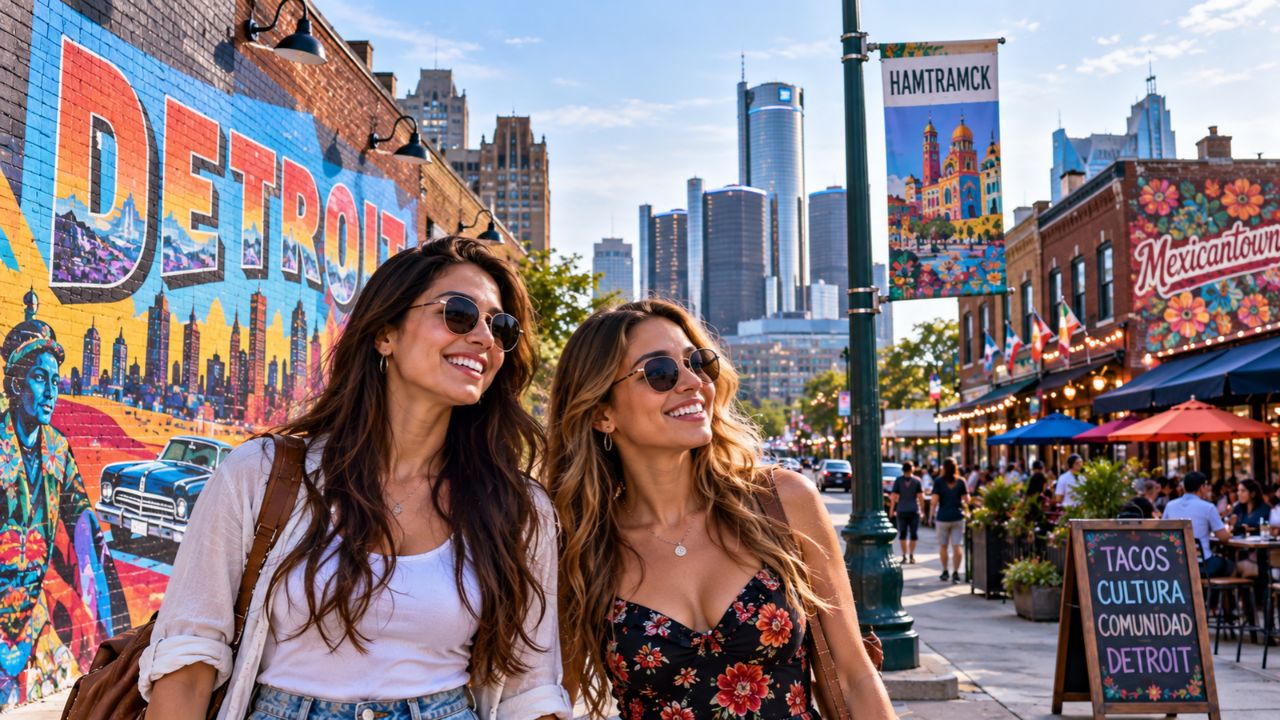
A 2-mile subterranean rail trail converted into a recreational greenway, a 40-year grassroots outdoor art installation dating to 1986, and a two-square-mile independent municipal enclave home to over thirty spoken dialects define Detroit’s cultural geography beyond its commercial downtown core. While conventional leisure travel marketing focuses almost exclusively on Woodward Avenue corporate towers, sports stadiums, and the riverfront skyline, municipal tourism tracking through Visit Detroit indicates that independent travelers increasingly gravitate toward historical neighborhoods that preserve distinct immigrant traditions, civil rights milestones, and industrial repurposing initiatives. Understanding this decentralized layout requires looking past glossy commercial centers to engage with neighborhoods shaped by decades of community preservation.
Enclave Autonomy, Public Murals, and Adaptive Infrastructure
Hamtramck stands out as one of North America’s most distinct urban anomalies: an entirely separate, self-governing city spanning roughly two square miles, completely surrounded by Detroit. Historically the industrial heart of Polish automotive migration anchored by the former Dodge Main plant, Hamtramck has evolved over the past three decades into a dense multicultural community integrating Yemeni, Bangladeshi, and southeastern European residents. Joseph Campau Avenue serves as its primary commercial spine, where century-old Polish bakeries and kielbasa smokehouses operate alongside halal Bangladeshi grocery markets and Yemeni spice merchants. Because the city rejected suburban commercial mall development, its pedestrian-scale storefronts offer an authentic food corridor that functions without corporate branding.
On Detroit’s near east side, the McDougall-Hunt neighborhood contains the Heidelberg Project, an open-air art environment conceived in 1986 by artist Tyree Guyton. Responding to structural urban abandonment, arson, and municipal disinvestment following the 1967 civil unrest, Guyton transformed discarded materials—including abandoned toys, clocks, vinyl records, and discarded shoes—into outdoor sculptures spanning entire vacant houses and trees. Operating as a free public site, the project challenges traditional museum conventions by treating urban demolition as a canvas for community resilience, requiring visitors to walk residential sidewalks respectfully without blocking neighborhood driveways.
Directly linking the city's commercial history with modern active transit, Eastern Market represents one of the oldest continuously operating open-air food hubs in the United States, having functioned as a wholesale regional market since 1891. While primary weekend retail markets draw thousands of agricultural shoppers, the surrounding district contains specialty coffee roasters, independent record shops, and large-scale commissioned murals. Extending southwest from the market sheds is the Dequindre Cut Greenway, a submerged railway corridor formerly operated by the Grand Trunk Western Railroad. The Detroit Riverfront Conservancy paved this 2-mile sunken right-of-way, creating a grade-separated pedestrian and cycling artery adorned with street art that delivers travelers directly onto the Detroit International Riverwalk.
| District or Cultural Landmark | Municipal Jurisdiction & Location | Primary Cultural Identity & History | Flagship Attractions & Architecture | Transit & Practical Traveler Guidance |
|---|---|---|---|---|
| Hamtramck | Independent Municipal City Enclave | Polish, Yemeni, and Bangladeshi heritage | Joseph Campau Avenue, bakery rows, immigrant markets | Walkable center; 15-min rideshare north of Downtown |
| Heidelberg Project | McDougall-Hunt (East Side Detroit) | Grassroots public art site established 1986 | Salvaged-object house installations by Tyree Guyton | Free outdoor access; respectful daylight walking only |
| Eastern Market | Core East District | Historic food market operational since 1891 | Six market sheds, regional craft food, public murals | Connected directly to the Riverwalk via Dequindre Cut |
| The Dequindre Cut | Connecting Eastern Market to Riverwalk | Converted 2-mile sunken freight rail corridor | Paved multi-use trail, freight bridge murals | Bicycle and pedestrian greenway with emergency kiosks |
| Belle Isle Park | Detroit River (MDNR State Park) | 982-acre island designed by Frederick Law Olmsted | Albert Kahn Aquarium, Conservatory, Oudolf Garden | Michigan Recreation Passport required for vehicles |
| Mexicantown | Southwest Detroit | Mexican, Central, and South American heritage | Vernor Highway bakeries, family restaurants, murals | Highly walkable culinary corridor; bus lines 1 and 2 |
Riverfront Ecological Reserves and Underground Railroad Heritage
Fronting the international maritime boundary where the United States looks directly south into Windsor, Ontario, the Detroit Riverfront offers a distinct vantage point over Great Lakes shipping traffic. The Riverwalk extends several miles along former industrial docks, guiding travelers toward Belle Isle Park. Encompassing 982 acres within the Detroit River under management by the Michigan Department of Natural Resources (MDNR), the island houses the Belle Isle Aquarium—the oldest continuously operating public aquarium in the United States, opened in 1904 under a distinctive green vaulted ceiling designed by Albert Kahn. Visitors can also explore the Anna Scripps Whitcomb Conservatory and the Oudolf Garden Detroit, an extensive naturalistic perennial garden planted by master landscape designer Piet Oudolf.
Southwest Detroit, centered on Mexicantown along West Vernor Highway and Bagley Street, showcases deep generational Latino roots. Settled by Mexican agricultural and automotive workers in the 1920s, the district supports multi-generational panaderías, artisanal tortillerias, and family-owned restaurants that draw regional food enthusiasts.
Beyond food and public art, Detroit’s urban geography preserves foundational civil rights history. During the nineteenth century, the city functioned as one of the final northern terminals on the Underground Railroad, operating under the clandestine code name "Midnight." The Second Baptist Church of Detroit, established in 1836 by thirteen formerly enslaved individuals, sheltered thousands of freedom seekers before they crossed the Detroit River into Canadian territory. These narratives are contextualized through permanent exhibits at the Charles H. Wright Museum of African American History in Midtown, while Hart Plaza hosts the Gateway to Freedom International Memorial. Nearby, Elmwood Cemetery, chartered in 1846, preserves historic monuments honoring prominent abolitionists, political reformers, and civic leaders who shaped the state's path through the Civil War and Industrial Era.
Expert Analysis: Post-Bankruptcy Urban Planning, De-Densification, and Neighborhood Equity
For travelers evaluating modern Detroit, visiting neighborhoods beyond Downtown highlights the realities of post-industrial urban planning. Following the municipality’s 2013 Chapter 9 municipal bankruptcy filing, private investment capital concentrated heavily along a narrow, 3-mile Woodward Avenue corridor between the Detroit River and the New Center district, supported by the QLine streetcar.
However, the geographic expanse of Detroit totals roughly 139 square miles—an area large enough to fit Boston, San Francisco, and Manhattan combined. Because this physical footprint was built to accommodate nearly two million manufacturing workers during the mid-twentieth century and now houses roughly 630,000 residents, the city functions as a collection of decentralized neighborhood nodes separated by vast open acreage.
The practical consequence for international travelers is that exploring districts like Hamtramck, the Heidelberg Project, or Southwest Detroit cannot be accomplished via a single transit spine. Municipal transit operators like the Detroit Department of Transportation (DDOT) and regional SMART buses operate fixed radial routes that make cross-neighborhood transit time-intensive. Independent visitors must rely on rented bicycles along greenways like the Dequindre Cut, personal vehicles, or rideshare services. Furthermore, visiting these neighborhoods directs tourism spending directly into family-owned businesses, preventing visitor capital from circulating exclusively within multinational hotel chains and concessionaires.
Key Takeaways
- Decentralized Urban Geography: Detroit’s historic cultural attractions span a 139-square-mile footprint, with key destinations operating far beyond the downtown commercial core.
- Hamtramck Enclave: An independent municipality surrounded by Detroit, Hamtramck offers authentic Polish, Yemeni, and Bangladeshi dining corridors along Joseph Campau Avenue.
- Repurposed Green Infrastructure: The 2-mile Dequindre Cut Greenway converts an abandoned rail trench into a safe pedestrian and cycling link between Eastern Market and the Riverwalk.
- Public Art Heritage: The Heidelberg Project continues to demonstrate grassroots neighborhood reclamation through salvaged-object installations on the city's east side.
- Historic Civil Rights Hub: Second Baptist Church, the Charles H. Wright Museum, and Hart Plaza preserve Detroit’s critical role as terminal "Midnight" on the Underground Railroad.
FAQ: Visiting Detroit Neighborhoods 2026
What makes Hamtramck unique from other Detroit neighborhoods?
Hamtramck is an autonomous, self-governing city completely surrounded by Detroit, renowned for its multicultural population, pedestrian-friendly streets, and diverse Polish, Yemeni, and Bangladeshi cuisine.
Is the Heidelberg Project open to the public daily?
Yes. The Heidelberg Project is a free, outdoor public art environment accessible daylight hours, but visitors must remain on public sidewalks and respect the privacy of local residents.
How can travelers travel between Eastern Market and the Detroit Riverfront?
Visitors can walk, run, or rent a bicycle to travel the 2-mile paved Dequindre Cut Greenway, which connects Eastern Market directly to the Riverwalk without vehicle traffic.
Do visitors need a pass to enter Belle Isle Park?
Pedestrians, cyclists, and transit riders enter Belle Isle Park for free. Non-resident motor vehicles must purchase a Michigan Recreation Passport at the bridge entrance booth.
Moving beyond corporate downtown corridors reveals a Detroit defined by grassroots creative defiance, multi-generational immigrant kitchens, and deep historical resilience.
Related Travel Guides
Detroit Motown Museum Expansion Music Heritage Tourism Economics 2026
Chicago Haunted Halsted Halloween Parade 30th Anniversary 2026
10 Best Historic Neighborhoods to Visit in Detroit, According to Reddit
Disclaimer
This article is for informational and educational purposes only. It does not constitute legal, financial, or professional advice. While we strive to provide accurate and up-to-date information, travel policies, regulations, and conditions change rapidly. Always verify information with official sources before making travel decisions. Nomad Lawyer makes no representations about the accuracy, reliability, completeness, or suitability of the information provided. Readers should consult qualified professionals for advice specific to their circumstances. The views expressed in this article are those of the author and do not necessarily reflect the views of Nomad Lawyer.
Naina Thakur
Contributor & Travel Specialist
Travel enthusiast and legal writer covering visa regulations, responsible tourism, and cultural journeys across global destinations.
Learn more about our team →