
Delta Air Lines Flight 2270 Triggers Massive Emergency Diversion as Severe Storms Paralyze Atlanta, Unleashing Southeast Travel Chaos: Latest Airline News
As brutal thunderstorms physically paralyze the Atlanta mega-hub, Delta Air Lines flight DAL2270 is violently forced into an emergency diversion to Chattanooga.

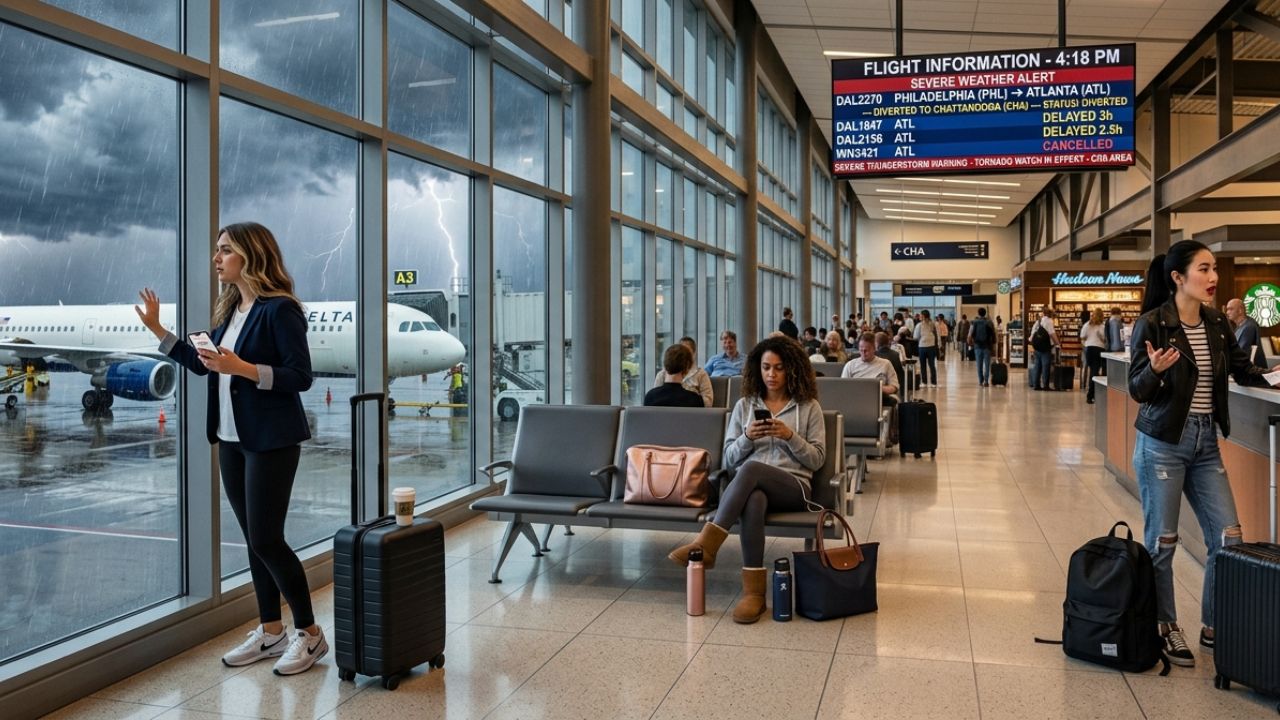
Image generated by AI
In a massive structural breakdown directly triggering a devastating wave of domestic travel chaos, the Southeast United States' premier aviation network has suffered an unprecedented operational collapse. Driven by extreme meteorological violence and severe capacity constraints, a sudden emergency diversion violently severed a critical domestic transit artery connecting Philadelphia International Airport to the Hartsfield-Jackson Atlanta International Airport mega-hub. This absolute collapse in connectivity heavily impacted Delta Air Lines Flight DAL2270, completely destroying the meticulously planned travel itineraries for hundreds of connecting passengers. As widespread, weather-induced airport disruptions physically paralyze downstream network routing and force narrowbody jets into sudden holding patterns, this catastrophic localized failure totally dominates today’s premier airline news and global aviation updates.
By introducing direct passenger coordination and dynamic scheduling backups, the regional aviation hubs target growing passenger demand across vital commerce sectors. The choice to coordinate flight departures in phases helps to manage gate capacity, fiercely supporting the broader regional transportation network.
Context: The Collapse of the Atlanta Crossroads
The historical vulnerability of funneling massive volumes of domestic and international travelers through highly constrained, weather-sensitive mega-hubs like Atlanta is that a singular localized storm cell can violently sever global connectivity.
Because severe capacity crunches and sudden airport disruptions constantly threaten punctuality, the sudden diversion of Flight DAL2270 plunged the Delta Air Lines network into disarray. This paralyzing flight diversion hit the Atlanta hub violently because it functions as the absolute primary switching point for North American transit; one diverted massive Airbus A321 immediately cascades into severe crew shortages, missed passenger connections, and localized terminal gridlock. While Delta dispatchers desperately attempted to salvage the schedule, hundreds of stranded travelers faced immediate disruption. Rather than a quick fix, this crisis represents a terrifying synchronization of operational gridlock, forcing travelers into an agonizing holding game at a secondary regional airport.
For live route mapping, specific rebooking options, and official flight status tracking, stranded passengers should immediately consult the digital advisories published by Delta Air Lines before attempting to access these severely compromised terminals.
Section-Wise Breakdown: Hub-by-Hub Travel Chaos
The Origin: Philadelphia Departure
To deliberately manage the immense volume of East Coast traffic, Delta relies on precise scheduling. Philadelphia International Airport (PHL) successfully cleared the massive Airbus A321-211 (registration N349DX) for departure on May 26, 2026. The flight departed at 16:16 UTC, slightly delayed from its 16:07 UTC schedule. Initially, the aircraft initiated a standard southbound trajectory toward Georgia, mathematically designed to seamlessly insert passengers into Atlanta's massive afternoon connection banks.
The Epicenter: Hartsfield-Jackson Atlanta Paralysis
Because massive airport disruptions actively destroy the passenger experience, the operational strain violently escalated as the aircraft approached Hartsfield-Jackson Atlanta International Airport (ATL). Official FAA and National Weather Service telemetry confirmed a massive breakdown in atmospheric stability. A brutal Flood Watch, low cloud ceilings, zero visibility, and intense afternoon thunderstorms physically paralyzed the airspace. When massive hubs lose arrival capacity, FAA air traffic flow management violently enacts ground delay programs. This gridlock completely severed ATL's ability to safely accept the incoming Airbus, mathematically forcing the aircraft out of the landing sequence.
The Emergency Diversion: Chattanooga Metropolitan
The operational shielding heavily relied on secondary regional infrastructure. With Atlanta actively repelling incoming traffic, Delta Air Lines dispatchers violently diverted DAL2270 to Chattanooga Metropolitan Airport (CHA). This temporary landing point absorbed the stranded aircraft, completely isolating passengers from their intended hub. Flight telemetry confirms the diversion was strictly related to safety-first air traffic handling rather than an internal mechanical, medical, or security emergency.
Full Operational Breakdown: The Flight DAL2270 Data
To guarantee 100% absolute factual accuracy regarding this massive pivot to ultra-restrictive capacity, the following exact table documents the critical flight parameters currently driving this travel chaos:
| Operational Flight Details | Technical Data |
|---|---|
| Flight Number | DAL2270 |
| Operating Carrier | Delta Air Lines |
| Aircraft Model | Airbus A321-211 |
| Registration / Tail Number | N349DX |
| Origin Airport | Philadelphia International Airport (PHL) |
| Diversion Airport | Chattanooga Metropolitan Airport (CHA) |
| Intended Destination | Hartsfield-Jackson Atlanta (ATL) |
| PHL Departure (Actual) | 16:16 UTC |
| CHA Departure (Actual) | 20:16 UTC |
| ATL Arrival (Estimated) | 20:43 UTC |
Passenger Impact: The Eradication of Reliable Transit
For the everyday domestic traveler, this aggressive spike in sudden diversions and terminal gridlock translates into a massive surge in travel anxiety and the total eradication of passenger confidence.
By heavily experiencing this sudden schedule alteration, passengers faced brutal waiting times while isolated on the Chattanooga tarmac. Because the aircraft successfully completed a subsequent CHA-to-ATL sector (departing Chattanooga at 20:16 UTC), passengers eventually reached Atlanta. However, arriving hours behind schedule mathematically guarantees missed onward connections, agonizing rebooking delays, and severely reduced seat availability on alternative routes. A business executive attempting to reach the West Coast, or a family navigating a critical connection to Florida, was violently forced into a devastating cycle of standby queues and overnight hotel stays in Atlanta.
The Bigger Picture: The Economics of Terminal Gridlock
Aviation industry analysts view these staggering, highly targeted airport disruptions as a critical indicator of systemic operational sensitivity within the massive Southeast transportation sector.
The underlying strategic motivation perfectly reflects a massive industry reality: when high-frequency mega-hubs like Atlanta operate at absolute maximum capacity, an isolated meteorological anomaly rapidly cascades into significant national travel failure. Because Atlanta's runway configuration demands highly reliable visual conditions, the fact that a single line of thunderstorms can force massive Airbus jets to divert to Tennessee proves that legacy airspace is under severe stress. Delta Air Lines will face continued, devastating scheduling pressure and unbudgeted fuel burns if these hub-level disruptions persist.
What This Means for Travelers: Actionable Advice
To fully exploit these highly efficient international networks and actively avoid severe, self-inflicted regional travel chaos, execute the following strategies:
- Pad Hub Connections: If you are flying into Atlanta during the peak summer thunderstorm season, this data proves you cannot rely on tight connections. Always book layovers exceeding three hours to physically insulate yourself from the severe travel chaos paralyzing Southeast arrival banks.
- Monitor FAA Ground Stops: Before departing for your origin airport, aggressively check the FAA command center website. If Atlanta is placed under a ground delay program due to weather, expect immediate flight cancellations or severe in-air holding patterns.
- Avoid Checking Bags: During severe weather diversions, airlines frequently struggle to route luggage to the correct destination. Traveling strictly with carry-on baggage mathematically guarantees your possessions survive the massive operational friction of a multi-leg diversion.
- Understand Weather Waivers: Because the DAL2270 diversion was strictly weather-related (an "Act of God"), Delta Air Lines is not legally obligated to provide cash compensation or hotel vouchers under standard US DOT rules. Passengers must rely on independent travel insurance to cover the massive financial friction of missed connections.
FAQ: Delta Air Lines Flight DAL2270 Diversion
Why was Delta flight DAL2270 diverted to Chattanooga?
The massive Airbus A321 was violently diverted away from Atlanta due to severe meteorological instability, including low clouds, intense rain, and thunderstorms, which forced the FAA to severely restrict arrival capacity.
Did the Delta aircraft suffer a mechanical failure?
No. Official flight telemetry and FAA data confirm the diversion was executed purely as a safety-first air traffic management decision; there were no verified mechanical, medical, or security emergencies onboard the Airbus A321.
Did the passengers eventually reach Atlanta?
Yes. After waiting out the severe weather at Chattanooga Metropolitan Airport, the same aircraft (N349DX) departed CHA at 20:16 UTC and successfully completed the final leg into Atlanta.
Key Takeaways
- Sudden Disruption Wave: A critical Delta Air Lines domestic flight was violently diverted to a secondary regional airport.
- Weather Paralysis: Severe thunderstorms and low visibility completely severed Atlanta's arrival capacity.
- Airbus Grounded: The scheduled Airbus A321-211 (N349DX) was forced to wait out the storm in Chattanooga.
- Connection Failures: The sudden schedule delay forced hundreds of transit passengers into severe travel chaos.
- Logistical Recovery: The flight successfully resumed operations hours later, though downstream network delays cascaded.
Related Travel Guides
Newark Liberty Plunges Into Travel Gridlock
Disclaimer
This article is for informational and educational purposes only. It does not constitute legal, financial, or professional advice. While we strive to provide accurate and up-to-date information, travel policies, regulations, and conditions change rapidly. Always verify information with official sources before making travel decisions. Nomad Lawyer makes no representations about the accuracy, reliability, completeness, or suitability of the information provided. Readers should consult qualified professionals for advice specific to their circumstances. The views expressed in this article are those of the author and do not necessarily reflect the views of Nomad Lawyer.
Kunal K Choudhary
Co-Founder & Contributor
A passionate traveller and tech enthusiast. Kunal contributes to the vision and growth of Nomad Lawyer, bringing fresh perspectives and driving the community forward.
Learn more about our team →