
Delhi IGI Airport Domestic to International Transfer Guide 2026: Terminal T1, T2, T3 Logistics
A comprehensive technical guide to navigating domestic to international transfers at Indira Gandhi International Airport (DEL) in 2026, covering T1, T2, and T3 shuttle logistics and minimum connection times.

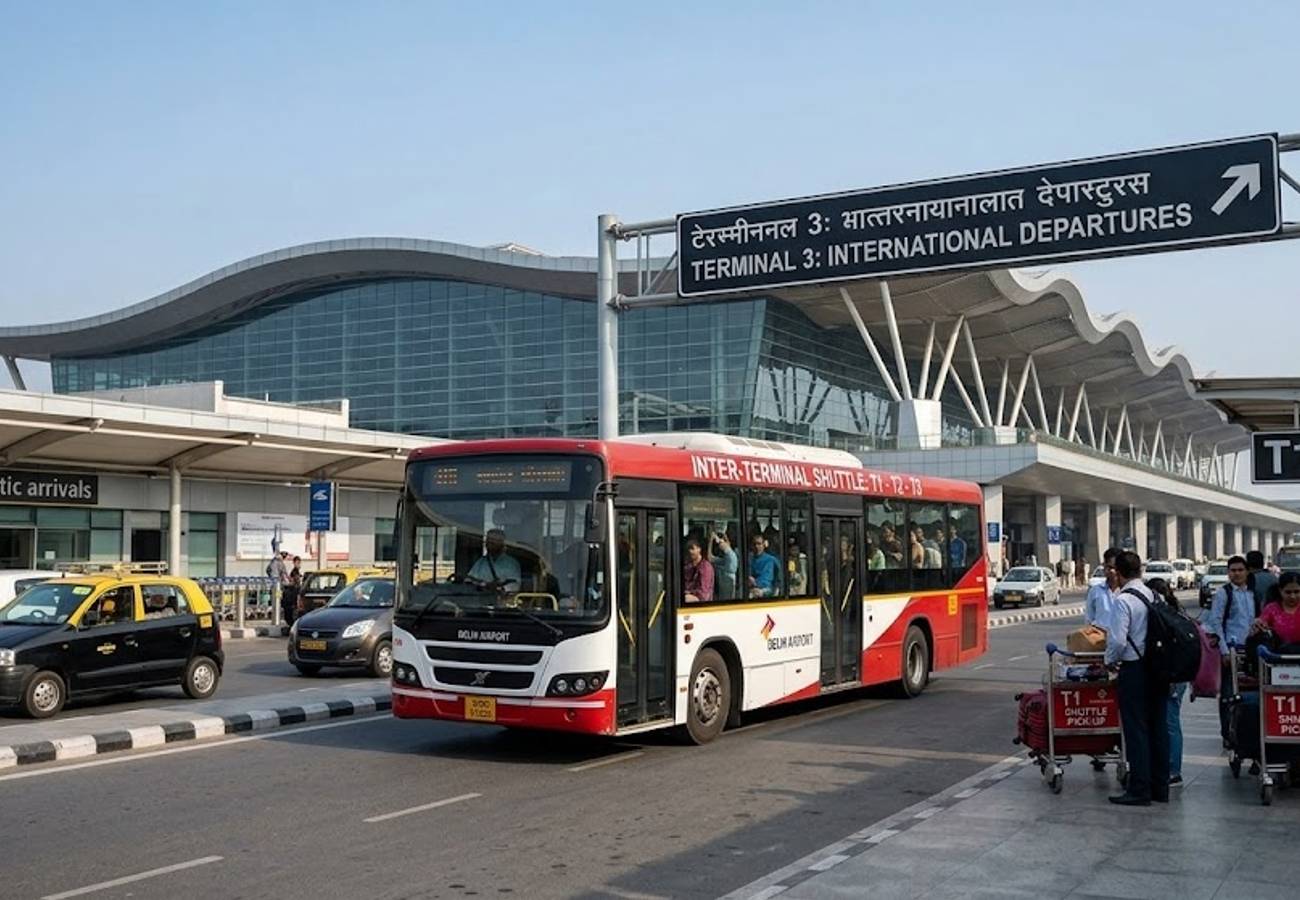
Image generated by AI
Indira Gandhi International Airport (DEL) remains India's primary aviation gateway, requiring precise logistical planning for passengers transitioning from domestic feeders to long-haul international flights.
The complexity of a Delhi transfer depends entirely on the terminal split. While all international flights operate out of Terminal 3 (T3), domestic operations are fragmented across T1, T2, and T3. For the modern traveler, the primary challenge is not the distance, but the "landside" requirement—the necessity to exit the secure area to move between terminals.
Terminal Distribution and Airline Logic
In 2026, the terminal layout follows a specific operational logic:
- Terminal 3 (T3): The flagship hub. It handles 100% of international departures and arrivals, alongside domestic flights from full-service carriers (e.g., Air India, Vistara).
- Terminal 1 (T1): Dedicated to domestic operations, primarily serving low-cost carriers (LCCs) such as IndiGo and SpiceJet.
- Terminal 2 (T2): A mid-point domestic terminal used for overflow and specific routes by Akasa, Air India, and selected IndiGo flights.
Because T1 is located approximately 7 to 8 kilometers from T3, any connection involving T1 necessitates a road transfer. There is no internal rail system connecting the terminals.
Inter-Terminal Transit Options
Passengers moving between terminals must utilize road transport. The most efficient methods are detailed below:
The Official Inter-Terminal Shuttle This service connects T1, T2, and T3. As of mid-2026, the shuttle is free for transit passengers providing a same-day boarding pass.
- Frequency: Every 10 to 20 minutes.
- Transit Time (T1 to T3): 15 to 25 minutes.
- Access: T3 passengers board near the arrivals forecourt; T1 and T2 passengers board under the terminal flyover.
Private Transport (Uber/Ola/Prepaid Taxis) While faster in light traffic (10 to 15 minutes), taxis incur an airport access fee and the standard fare. This is recommended only for passengers with significant luggage or mobility constraints.
Pedestrian Transfer (T2 to T3) Walking between T2 and T3 takes 10 to 15 minutes. However, this is an outdoor, non-climate-controlled route. Given Delhi's weather and the burden of carry-on luggage, this is generally discouraged.
Baggage and Security Protocols
The "Single Ticket" vs. "Separate Ticket" distinction is the most critical factor in determining transfer time.
Single Ticket / Through-Checked Bags If the journey is on one booking, bags may be transferred automatically within T3. However, if a terminal change (T1/T2 to T3) is required, passengers must typically collect their bags, clear customs, and re-check them at the T3 international counters.
Separate Tickets / Self-Transfer The process is manual and time-consuming:
- Land at T1/T2 $\rightarrow$ Collect baggage $\rightarrow$ Exit to landside.
- Board shuttle to T3 $\rightarrow$ Enter T3 Departures.
- Check-in at international counter $\rightarrow$ Drop bags $\rightarrow$ Clear Immigration $\rightarrow$ Clear Security.
Security and Immigration Security screening is mandatory every time a passenger enters a new secure zone. International departures at T3 involve both immigration and security checks. Peak evening hours for flights to North America and Europe frequently result in significant queues.
Connection Time Requirements
Our analysis of the route map and terminal logistics suggests the following minimum connection times (MCT) for 2026:
| Scenario | Connection Type | Recommended Min. Time | Risk Level |
|---|---|---|---|
| T3 $\rightarrow$ T3 | Single Ticket | 2 - 2.5 Hours | Low |
| T3 $\rightarrow$ T3 | Separate Tickets | 3 Hours | Medium |
| T2 $\rightarrow$ T3 | Any Ticket | 3 - 4 Hours | Medium |
| T1 $\rightarrow$ T3 | Any Ticket | 4 - 5 Hours | High |
Why This Matters: Industry Analysis
From a logistical perspective, the Delhi transfer is a "bottleneck" operation. Unlike hubs like Singapore Changi or Dubai (DXB), where airside transfers are seamless, DEL forces a landside break for a significant portion of its domestic-to-international traffic.
For the traveler, the real impact is the "hidden" time cost. A 3-hour layover on paper can be erased by a 20-minute shuttle wait, a 30-minute baggage reclaim, and a 60-minute immigration queue. In 2026, the reliance on LCCs (which predominantly use T1) means more passengers are facing the high-risk T1 $\rightarrow$ T3 transfer. Travelers booking separate tickets on IndiGo (T1) and a long-haul carrier (T3) are essentially performing a full "airport change" rather than a simple transfer.
Forward Outlook
As Delhi continues its expansion, the pressure on T3's immigration and security checkpoints will increase. We expect the airport to implement more biometric-led "DigiYatra" integration to reduce bottlenecks. However, until a physical airside connector or rail link is established between T1 and T3, the shuttle system remains the single point of failure for thousands of daily transit passengers. Travelers should prioritize booking domestic legs that arrive at T3 to eliminate landside transit risks.
Precision in terminal verification is the only way to avoid a missed international connection in Delhi.
Related Travel Guides
Disclaimer
This article is for informational and educational purposes only. It does not constitute legal, financial, or professional advice. While we strive to provide accurate and up-to-date information, travel policies, regulations, and conditions change rapidly. Always verify information with official sources before making travel decisions. Nomad Lawyer makes no representations about the accuracy, reliability, completeness, or suitability of the information provided. Readers should consult qualified professionals for advice specific to their circumstances. The views expressed in this article are those of the author and do not necessarily reflect the views of Nomad Lawyer.
Raushan Kumar
Founder & Lead Developer
Full-stack developer with 11+ years of experience and a passionate traveller. Raushan built Nomad Lawyer from the ground up with a vision to create the best travel and law experience on the web.
Learn more about our team →