
China Showcases Six Premier MICE Destinations at IMEX America 2026: 240-Hour Visa-Free Business Push

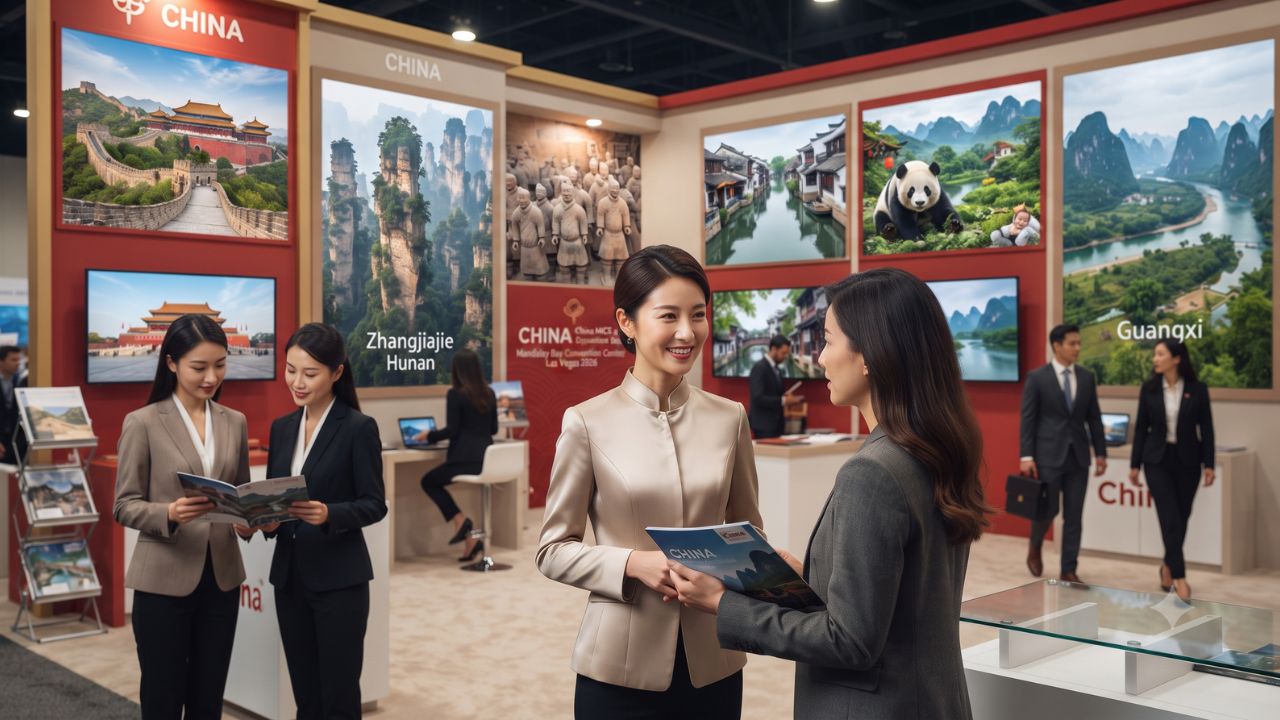
Anchored by a 240-hour visa-free transit framework and a 1,000-square-foot exhibition pavilion at IMEX America 2026 in Las Vegas, China initiated a coordinated corporate tourism offensive on 13–15 October 2026 to capture North American business travel across six regional provinces. Uniting Beijing, Hunan, Shaanxi, Jiangsu, Sichuan, and Guangxi under the commercial theme "Where Business Meets Extraordinary Experiences," the China National Tourist Office (CNTO) in Los Angeles is positioning the nation's high-speed rail grid, frictionless international digital payment links, and secondary provincial convention hubs as compelling alternatives to traditional Western meeting destinations.
Convening at Mandalay Bay in Las Vegas, the annual IMEX America trade exposition provided the platform for Chinese tourism authorities to engage North American meeting planners, corporate travel buyers, and incentive specialists. Rather than marketing solely through traditional tier-one gateways like Shanghai and Guangzhou, the presentation reflected a strategic diversification aimed at spreading high-yield corporate expenditure across inland cultural capitals and eco-tourism corridors.
The Six-Destination Portfolio: Cultural Heritage and Specialized Incentives
The delegation structured its presentation into two complementary operational tiers: established imperial and natural landmarks on one hand, and specialized regional incentive landscapes on the other.
Beijing, Hunan, and Shaanxi represent the core heritage and spectacle segment:
- Beijing: The capital anchors large-scale multilateral conventions with modern facilities, international five-star hotel clusters, and direct access to global landmarks such as the Forbidden City and the Mutianyu and Badaling sectors of the Great Wall, allowing corporate planners to integrate state banquets and private cultural viewings into executive summits.
- Hunan: Moving away from urban meeting rooms, Hunan markets Zhangjiajie, whose vertical quartz-sandstone pillars served as the visual blueprint for the floating mountains in James Cameron's Avatar. The province is targeting corporate team-building retreats centered on mountain trekking, canyon skywalks, and eco-conservation programs.
- Shaanxi: Centered around the ancient Silk Road terminus of Xi’an, Shaanxi offers historical immersion through the Terracotta Army and ancient city wall circuits, providing corporate delegations with private archaeological tours and banquets.
Complementing these cultural flagships, Jiangsu, Sichuan, and Guangxi provide targeted incentive and executive retreat capabilities:
- Jiangsu: Combining classical canal water towns like Suzhou and Wuzhen with advanced manufacturing hubs, Jiangsu allows corporate groups to blend industrial site visits with serene garden meetings and canal boat cruises.
- Sichuan: Anchored by Chengdu, Sichuan appeals to international delegates through UNESCO-recognized gastronomy, high-tech convention centers, and the Chengdu Research Base of Giant Panda Breeding.
- Guangxi: Known for the limestone karst peaks and emerald waterways of Guilin and Yangshuo, Guangxi focuses on boutique corporate escapes, bamboo rafting, and wellness retreats designed for executive boards.
Regional Infrastructure Matrix: Connectivity and MICE Capabilities
The commercial viability of hosting international conferences in secondary Chinese provinces depends directly on inter-city transportation and venue capacity:
| Destination / Province | Primary Airport & High-Speed Rail Hubs | Core MICE Infrastructure & Venues | Signature Cultural & Incentive Experiences | Optimal Event Profile |
|---|---|---|---|---|
| Beijing Municipality | Beijing Capital (PEK), Beijing Daxing (PKX); China National High-Speed Rail Hub | China National Convention Center; major international hotel complexes | Private Great Wall receptions; Forbidden City architectural tours | Tier-1 global summits, medical Congresses, multinational conventions |
| Hunan Province | Changsha Huanghua (CSX), Zhangjiajie Hehua (DYG); Beijing–Guangzhou High-Speed Rail | Modern convention facilities in Changsha; mountain resort event spaces | Zhangjiajie sandstone pillar exploration; Avatar-inspired canyon excursions | Executive incentive groups, adventure team-building, outdoor retreats |
| Shaanxi Province | Xi'an Xianyang International (XIY); Zhengzhou–Xi'an High-Speed Rail | Xi'an International Convention and Exhibition Center | Private viewings of the Terracotta Army; Tang Dynasty banquet experiences | Cultural diplomacy forums, academic symposiums, corporate incentives |
| Jiangsu Province | Nanjing Lukou (NKG), Sunan Shuofang (WUX); Shanghai–Nanjing Intercity Rail | Suzhou International Expo Centre; canal-side heritage pavilions | Classical Ming garden cocktail receptions; water town canal navigation | Tech industry symposiums, supply-chain forums, design workshops |
| Sichuan Province | Chengdu Tianfu (TFU), Chengdu Shuangliu (CTU); Chengdu–Chongqing High-Speed Rail | Western China International Expo City; Century City New International Convention Centre | Giant panda sanctuary private tours; authentic Sichuan culinary workshops | Innovation summits, culinary incentives, pharmaceutical conferences |
| Guangxi Region | Guilin Liangjiang (KWL), Nanning Wuxu (NNG); Guiyang–Guangzhou High-Speed Rail | Guilin International Conference & Exhibition Center; riverside boutique resorts | Li River bamboo rafting; limestone karst cliffside receptions | Executive retreats, sustainability forums, high-end leadership seminars |
Structural Enablers: Visa Flexibility and Digital Integration
Beyond scenic venues, China's MICE appeal relies on regulatory reforms implemented by the Ministry of Culture and Tourism of China and immigration authorities. Foremost among these is the expanded 240-hour (10-day) visa-free transit framework. Eligible travelers transiting through designated international gateways can enter China without securing a standard consular visa, provided they hold confirmed onward tickets to a third country or territory. This 10-day window is sufficient for corporate attendees to attend a three-day convention and participate in a week-long provincial incentive tour.
Furthermore, domestic authorities have eliminated a longstanding friction point for overseas business travelers: digital payment barriers. Leading mobile payment ecosystems WeChat Pay and Alipay now permit international credit and debit cards—including Visa, Mastercard, and American Express—to link directly to digital wallets without requiring a domestic Chinese bank account. This reform enables overseas delegates to purchase high-speed rail tickets, hail rides, dine at local restaurants, and shop without cash transaction hurdles.
Expert Analysis: The Economics of MICE Decentralization and Corporate Yield
The tactical pivot toward secondary provinces at IMEX America reflects a broader economic transformation within international corporate travel. Western corporate planners face severe budget constraints driven by hotel rate inflation in major European and North American gateway cities, prompting meeting organizers to seek destinations offering luxury infrastructure at competitive price points.
For travelers booking this route, the direct consequence is an immediate expansion of itinerary options that seamlessly merge tier-one urban conferences with provincial incentive travel via high-speed rail lines operating at 350 km/h. A delegate attending a two-day symposium in Beijing can reach the ancient city walls of Xi'an in four hours by train, eliminating domestic flight check-in delays and baggage transfers.
The pricing pressure this creates means established Asian convention hubs like Singapore, Tokyo, and Hong Kong face intensifying competition for long-haul North American association and corporate bookings. According to industry tracking by the Global Business Travel Association (GBTA), multinational organizations are actively re-evaluating destination ROI, seeking locations where foreign exchange advantages and municipal event subsidies yield superior delegate experiences.
However, geopolitical friction and corporate risk assessments remain notable considerations. North American corporate procurement officers evaluate international travel advisories, data privacy compliance, and flight routing stability before authorizing large-scale group bookings. While the 240-hour visa-free transit simplifies short trips, long-term market share recovery requires sustained commercial aviation seat capacity across trans-Pacific corridors.
Key Takeaways
- Targeted MICE Showcase: China National Tourist Office launched a major North American campaign at IMEX America 2026, presenting six diverse provinces at Mandalay Bay in Las Vegas.
- Diversified Destination Strategy: The initiative promotes secondary convention and incentive hubs—including Hunan, Shaanxi, Jiangsu, Sichuan, and Guangxi—alongside Beijing.
- 240-Hour Visa-Free Transit: An expanded 10-day visa-free transit window allows eligible international delegates to attend business events without standard visa processing.
- Frictionless Digital Payments: Direct linkage of international credit cards to Alipay and WeChat Pay eliminates payment barriers for foreign attendees.
- High-Speed Rail Connectivity: The world's largest high-speed rail network enables multi-province corporate itineraries without domestic flight reliance.
FAQ: China MICE Tourism and North American Business Travel 2026
What is China's 240-hour visa-free transit policy for business travelers?
The 240-hour policy allows eligible international citizens holding confirmed onward tickets to a third destination to enter designated Chinese cities for up to 10 days without applying for a visa.
How can international conference delegates pay for goods and transit in China?
Foreign travelers can link international Visa, Mastercard, or American Express cards directly to domestic Alipay and WeChat Pay apps, enabling cashless transactions across transport, dining, and retail.
Which six destinations were featured at IMEX America 2026?
The China National Tourist Office featured Beijing, Hunan (Zhangjiajie), Shaanxi (Xi'an), Jiangsu (Suzhou water towns), Sichuan (Chengdu), and Guangxi (Guilin karst scenery).
How do corporate groups travel between Chinese convention cities?
Delegations utilize China's extensive high-speed rail network operating at speeds up to 350 km/h, linking Beijing, Xi'an, and regional provincial capitals without the need for domestic flights.
[As global corporate travel evolves, China's business tourism proposition proves that the most memorable meetings occur where advanced infrastructure meets timeless heritage.]
Related Travel Guides
- New Haven Turns Free Yale Culture and Historic Apizza Into a Premier Northeast Escape for Mature Couples
- Breeze Airways Launches Tampa to St. Thomas Flights as USVI Targets 927,000 Air Arrivals in 2026
- Hollywood Burbank Airport Leaps Into 2027: New Terminal Opens as Airlines Expand Southern California Routes
Disclaimer
This article is for informational and educational purposes only. It does not constitute legal, financial, or professional advice. While we strive to provide accurate and up-to-date information, travel policies, regulations, and conditions change rapidly. Always verify information with official sources before making travel decisions. Nomad Lawyer makes no representations about the accuracy, reliability, completeness, or suitability of the information provided. Readers should consult qualified professionals for advice specific to their circumstances. The views expressed in this article are those of the author and do not necessarily reflect the views of Nomad Lawyer.
Raushan Kumar
Founder & Lead Developer
Full-stack developer with 11+ years of experience and a passionate traveller. Raushan built Nomad Lawyer from the ground up with a vision to create the best travel and law experience on the web.
Learn more about our team →