
China Airlines Leads Green Aviation Shift With Record SAF Use on Long-Haul Amsterdam Route
China Airlines Leads Green Aviation Shift With Record SAF Use on Long-Haul Amsterdam Route

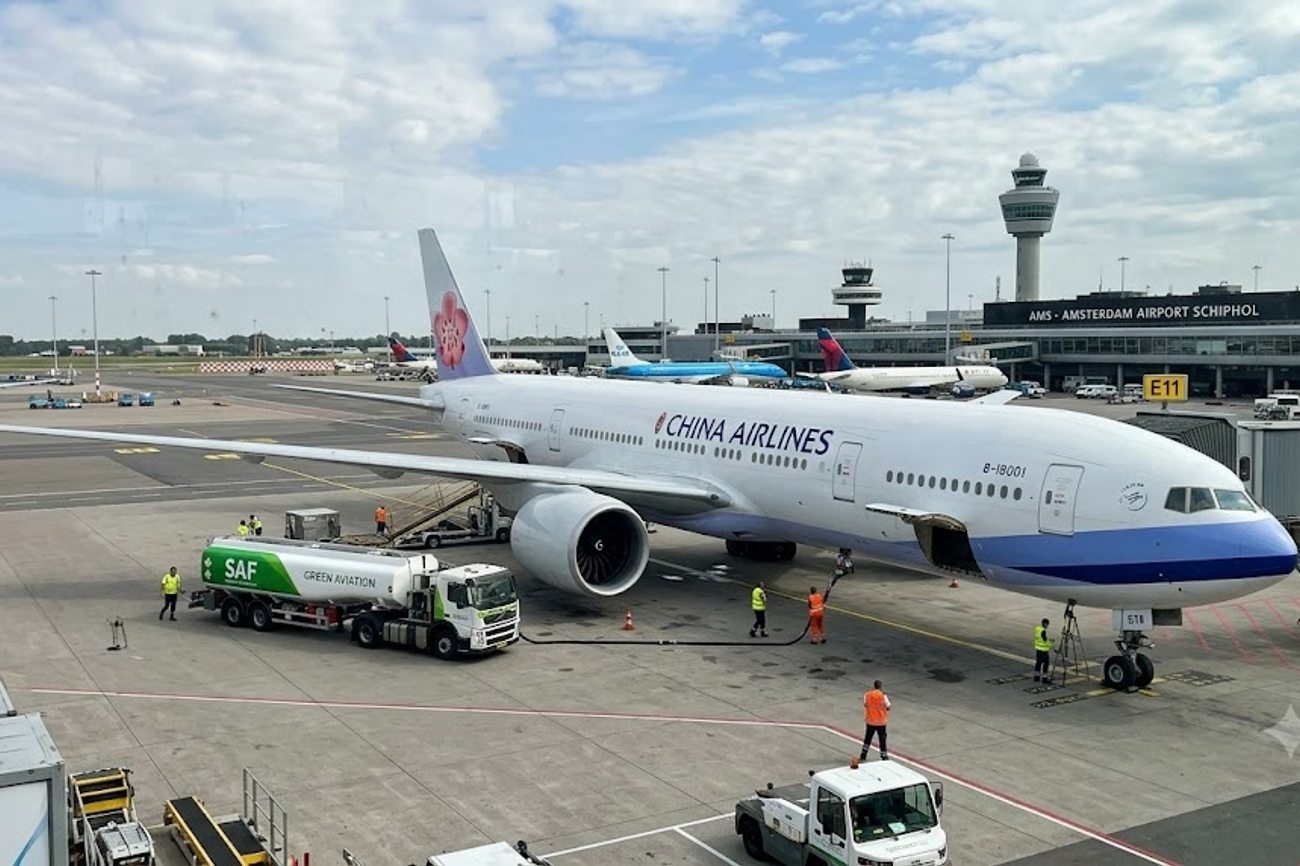
Image generated by AI
40% of total fuel consumption on a single long-haul route represents the new benchmark for China Airlines’ sustainability efforts, marking the largest application of Sustainable Aviation Fuel (SAF) in the carrier's history. By selecting flight CI073 from Taipei to Amsterdam for the latest iteration of SkyTeam’s The Aviation Challenge (TAC), the airline has moved beyond regional experiments to test the scalability of carbon reduction on one of its most demanding international corridors. This shift signals a strategic transition from symbolic "green" flights to the systemic integration of low-carbon logistics across an expansive global network.
The Mechanics of the Taipei-Amsterdam Corridor
The selection of the Taipei-Amsterdam route for the TAC initiative, which began on September 13, 2022, is not incidental. Long-haul flights are the primary drivers of aviation emissions due to the sheer volume of fuel required for sustained cruise altitudes over thousands of miles. By focusing on this specific route, China Airlines is attempting to prove that the "Book and Claim" system—a regulatory framework allowing airlines to purchase SAF attributes even if the fuel is not physically pumped into a specific aircraft at a specific airport—can function at a commercial scale.
For this demonstration, the airline allocated 36.3 tonnes of SAF. To put this in perspective, this follows a 2024 collaboration with CTBC Bank that focused on a more modest 20% SAF blend for regional hops. The leap to 40% on a long-haul flight demonstrates a significant increase in both financial commitment and logistical coordination. This effort is part of a broader alignment with the International Air Transport Association (IATA) goals to reach net-zero emissions by 2050.
Quantifying the Carbon Reduction Strategy
China Airlines is not treating sustainability as a singular fuel problem, but as a weight and waste problem. The airline has implemented a multi-layered reduction strategy that targets every gram of weight carried on the aircraft, as every kilogram removed directly reduces the fuel burn required for takeoff and cruise.
| Initiative | Metric/Data Point | Environmental Impact |
|---|---|---|
| SAF Deployment (CI073) | 36.3 tonnes | 40% fuel consumption equivalent |
| Cumulative TAC Flights | 8 demonstration flights | $\ge$ 600 tonnes $\text{CO}_2$ reduced |
| Tableware Redesign | 27% weight reduction | Lower fuel burn per passenger |
| Digital Reading Services | 4,300+ tonnes removed | Reduced aircraft takeoff weight |
| Material Shift | 100% recycled PET (rPET) | Elimination of virgin plastics |
The airline has expanded these measures beyond the Amsterdam route. New lightweight tableware is now appearing on flights to Prague, Frankfurt, and various Oceania destinations. By replacing heavy ceramics with lightweight alternatives and introducing carbonized bamboo chopsticks and FSC-certified paper, the carrier is attacking the "hidden" emissions found in the galley and cabin.
Expert Analysis: The Financialization of Green Aviation
The partnership between China Airlines and CTBC Bank reveals a critical shift in how aviation decarbonization is funded. We are seeing the emergence of "Sustainable Finance" as the primary engine for SAF adoption. Because SAF remains significantly more expensive than traditional Jet A-1 fuel, airlines cannot absorb the cost alone without risking ticket price spikes that would alienate passengers.
For travelers booking these routes, the direct consequence is a shift in who pays for the "green" premium. By bringing in a financial partner like CTBC Bank as an exclusive sponsor, the cost of the 36.3 tonnes of SAF is subsidized by corporate ESG (Environmental, Social, and Governance) budgets rather than passenger fares. This creates a blueprint for the industry: the "Book and Claim" model allows corporations to claim the carbon credits associated with the flight, while the airline gets the operational experience of managing SAF blends.
However, the pricing pressure remains. As these demonstration flights move toward permanent implementation, the industry will eventually have to decide if these costs will be passed to the consumer through "green surcharges" or if corporate sponsorships will remain the primary funding vehicle. The use of digital services, such as the Dynasty Sky Reading platform, which has stripped over 4,300 tonnes of physical weight from the fleet, shows that the airline is aggressively pursuing "passive" savings to offset the "active" costs of expensive fuels.
Furthermore, the integration of Michelin Green Star partners like Little Tree Food for plant-based meals suggests that China Airlines is targeting a specific high-net-worth, eco-conscious demographic. This is a branding play as much as an environmental one, positioning the carrier as a premium, responsible choice in the competitive Asian market.
Key Takeaways
- Scale of SAF: China Airlines achieved a record 40% SAF fuel equivalent on the Taipei-Amsterdam (CI073) route, utilizing 36.3 tonnes of sustainable fuel.
- Weight Reduction: A 27% reduction in tableware weight and the removal of 4,300 tonnes of physical reading materials are being used to lower fuel consumption.
- Corporate Funding: The use of the "Book and Claim" system and partnerships with CTBC Bank indicates that corporate ESG funding is currently driving SAF adoption.
- Operational History: Since 2022, the airline has conducted eight TAC demonstration flights, resulting in a total carbon reduction of at least 600 tonnes.
- Holistic ESG: Beyond fuel, the airline is utilizing rPET plastics, FSC-certified paper, and plant-based dining to meet SkyTeam sustainability standards.
FAQ: China Airlines Sustainability 2026
What is the "Book and Claim" system used on the Amsterdam flight? It is a mechanism where the environmental benefits of SAF are tracked and claimed separately from the physical fuel. This allows an airline to support SAF production in one location while applying the carbon reduction credit to a specific flight elsewhere.
How does lightweight tableware actually reduce carbon emissions? Aviation emissions are tied to aircraft weight. By reducing tableware weight by 27%, the aircraft requires less thrust and fuel to maintain lift and speed, leading to a direct decrease in $\text{CO}_2$ output per flight.
Are the plant-based meals available on all China Airlines flights? While they were featured across all cabin classes on the TAC demonstration flight to Amsterdam, the airline is progressively expanding these low-carbon dining options across its broader international network.
What is the goal of The Aviation Challenge (TAC)? TAC is a SkyTeam initiative designed to accelerate the industry's transition to net-zero emissions by 2050 through large-scale demonstration flights and collaborative corporate partnerships.
The transition to net-zero is no longer a laboratory experiment; it is now a weight-reduction race fought in the galleys and funded by the banks.
Tags: China Airlines, SkyTeam TAC, Taipei-Amsterdam Route, Sustainable Aviation Fuel, CTBC Bank, Aviation ESG 2026
Related Travel Guides
- Kenya Domestic Tourism Slows As High Living Costs Limit Local Holidays Despite Record Sector Growth
- Malaysia Transport Ministry and MAHB Initiate Aviation Contingency Planning as AirAsia Reports RM831 Million Loss Amid Domestic Market Shift
- EXPO Kraków Hosts KOMPOZYT-EXPO 2026 as European Composite Technology Firms Convene for International Trade Fair in October
Disclaimer
This article is for informational and educational purposes only. It does not constitute legal, financial, or professional advice. While we strive to provide accurate and up-to-date information, travel policies, regulations, and conditions change rapidly. Always verify information with official sources before making travel decisions. Nomad Lawyer makes no representations about the accuracy, reliability, completeness, or suitability of the information provided. Readers should consult qualified professionals for advice specific to their circumstances. The views expressed in this article are those of the author and do not necessarily reflect the views of Nomad Lawyer.
Kunal K Choudhary
Co-Founder & Contributor
A passionate traveller and tech enthusiast. Kunal contributes to the vision and growth of Nomad Lawyer, bringing fresh perspectives and driving the community forward.
Learn more about our team →