Chile's Most Striking Towns Reveal How One Country Changes From Desert to Patagonia

Official website of Chile travel
Spanning more than 4,300 kilometres along South America's western edge, Chile's extraordinary geography transitions across ten distinct destinations from 4,000-meter hyper-arid desert plateaus to subpolar Patagonian fjords.
[Santiago, Oct 6, 2026] — Chile presents one of the most geographically diverse travel corridors on Earth, allowing international travelers to navigate from hyper-arid salt flats to Andean glaciers without crossing a single international border. Stretching 4,300 kilometres from north to south with a narrow average width bounded by the Pacific Ocean and the Andes, ten key urban destinations reveal how dramatically climate, altitude, and terrain shift from region to region.
Geographical Breakdown of Chile's Leading Travel Destinations
Understanding Chile requires looking at how altitude, latitude, and coastal proximity dictate regional travel conditions. Northern regions feature extreme desert landscapes and high-altitude Altiplano reserves, while central provinces offer Mediterranean climate zones and Pacific ports. Farther south, active volcanic ranges dominate green lake districts before the terrain fragments into Patagonian fjords, channels, and subpolar steppe.
| Destination | Region | Main Landscape | Best Known For |
|---|---|---|---|
| Arica | Far North | Desert, coast, Altiplano | Beaches and highland nature |
| Iquique | North | Desert and Pacific | Cavancha Beach and heritage |
| San Pedro de Atacama | Atacama | Desert and high plateau | Salt flats, geysers, stars |
| La Serena | Norte Chico | Coast and inland valley | Beaches and astronomy |
| Valparaíso | Central Coast | Pacific hills | Street art and historic lifts |
| Santiago | Central Chile | Metropolitan basin and Andes | Culture, food and mountain access |
| Pucón | Araucanía | Volcano, lake and forest | Outdoor adventure |
| Puerto Varas | Los Lagos | Lakes and volcanoes | Scenic drives and nature |
| Puerto Natales | Patagonia | Fjords and mountains | Torres del Paine |
| Punta Arenas | Magallanes | Strait and steppe | Wildlife and southern exploration |
Arica: Far North Pacific Coast Meets 4,000-Meter Altiplano Plateau
Positioned at Chile's northern border, Arica combines a mild Pacific coastal climate with immediate access to high-altitude Andean terrain. Urban beaches such as Chinchorro Beach and Las Machas attract swimmers and watersport enthusiasts, while local coastal breaks draw experienced international surfers. High above the city, the historic landmark Morro de Arica delivers expansive views of the urban waterfront and surrounding desert environment.
Arica acts as the principal gateway for exploring the ancient Chinchorro culture, famous for creating the world's oldest known artificial mummies. Archaeological sites and local museums reveal human settlement stretching thousands of years before the modern city existed. Moving inland, travelers reach Lauca National Park in the high Altiplano, where volcanic peaks frame Lake Chungará at elevations exceeding 4,000 metres alongside Las Vicuñas National Reserve and the Salar de Surire Natural Monument.
Iquique: Coastal Dunes, Paragliding, and Atacama Nitrate History
Iquique showcases a dramatic physical setting where steep desert bluffs descend directly into the Pacific Ocean. Cavancha Beach serves as the recreational heart of the city, lined with palm trees, walking paths, and seafood dining venues. Thermal wind conditions generated by coastal escarpments allow paragliders to soar directly over the city, while Cerro Dragón stands as a massive urban sand dune rising adjacent to the urban center.
Industrial history defines the desert hinterland behind Iquique. During the late nineteenth and early twentieth centuries, nitrate extraction transformed northern Chile into an economic powerhouse. Today, the preserved ruins of the Humberstone and Santa Laura saltpetre works showcase old machinery, administrative buildings, and worker housing from that industrial era.
San Pedro de Atacama: High-Altitude Salt Flats, Geysers, and Deep-Space Astronomy
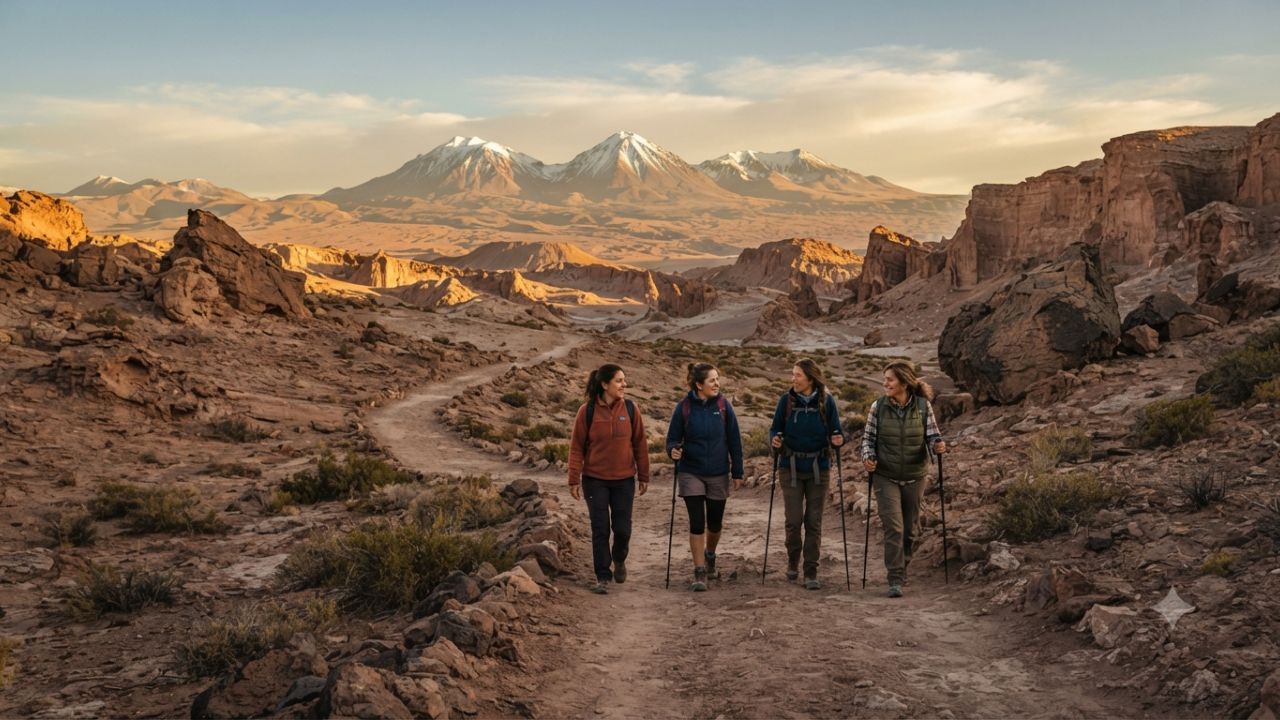
Located inside the Atacama Desert, San Pedro de Atacama operates as Chile's premiere desert exploration staging base. Characterized by unpaved streets and traditional adobe architecture, the interior town sits adjacent to hyper-arid terrain featuring salt pans, volcanic ridges, and eroded stone canyons. Nearby, Valle de la Luna displays salt-encrusted rock formations that shift color under late afternoon sunlight.
Early morning excursions from town climb toward El Tatio, an extensive geothermal field situated high in the Andes where steam vents erupt against freezing atmospheric temperatures. Across the Salar de Atacama salt flat, high-altitude saline lagoons support resident flamingo populations. At night, dry air and low light pollution provide ideal conditions for deep-space astronomy tours. Because many regional excursions reach altitudes between 3,000 and 4,000 metres, visitors must allow time for physical acclimatization.
La Serena: Elqui Valley Observatories, Coastal Beaches, and Pisco Distilleries
La Serena marks the transition zone into Chile's semi-arid Norte Chico region. Broad sandy beaches stretch along the Pacific waterfront connecting La Serena with the port city of Coquimbo. The city's center maintains historic colonial-style churches, stone plazas, and traditional courtyard architecture.
Heading inland into the Elqui Valley reveals an agricultural corridor framed by clear mountain skies. Famous for exceptional atmospheric transparency, the valley hosts world-class research observatories open for night stargazing. The region is equally recognized as the heartland of Chilean pisco production, where towns like Vicuña and Pisco Elqui offer tours of historic vineyards and grape distilleries.
Valparaíso: Vertical Pacific Hills, Funicular Lifts, and Bohemian Street Art
Valparaíso presents an urban layout dictated by steep coastal hillsides overlooking a major Pacific port. Historically built without a traditional grid layout, the city relies on historic funicular elevators, stone staircases, and narrow pathways to link hilltop residential zones with the harbor below. Hilltop districts like Cerro Alegre and Cerro Concepción feature brightly painted houses, street murals, independent cafés, and panoramic lookout points.
The city holds rich literary significance as the former home of Nobel laureate poet Pablo Neruda, whose residence, La Sebastiana, operates as a popular museum. Below the residential hills, Valparaíso's commercial harbor remains an active maritime shipping hub filled with naval vessels, cargo cranes, and ocean freight activity.
Santiago: Andean Skyline, Valley Vineyards, and Central Transport Hub
Santiago serves as Chile's capital city and main political, economic, and transportation center. Situated within a broad central valley, the metropolitan area features a dramatic backdrop of snow-capped Andean peaks rising behind modern high-rise districts. Distinct urban neighborhoods offer rich cultural experiences: Lastarria and Bellas Artes showcase fine art museums, Barrio Italia highlights artisan design shops, and Bellavista anchors the city's nightlife and dining scene.
Central lookout points such as Cerro San Cristóbal—accessible via cable car and historic funicular—deliver wide views across the urban valley floor. Santiago's central geographic location provides easy access to surrounding wine valleys producing international vintages, as well as high-altitude Andean ski resorts during the winter season.
Pucón: Volcanic Ascents, Araucaria Forests, and Lake District Rafting
Pucón anchors outdoor adventure travel within Chile's southern Araucanía region. The town sits along the shore of Lake Villarrica beneath the active, snow-capped cone of Villarrica Volcano. When volcanic alert conditions permit, guided mountaineering ascents attract experienced hikers seeking to reach the crater rim.
Surrounding protected wilderness areas like Huerquehue National Park feature hiking trails winding through native araucaria (monkey puzzle) tree forests, mountain lakes, and granite valleys. Regional river systems support class-three and class-four whitewater rafting trips, while underground geothermal activity feeds numerous natural hot springs across the lake district.
Puerto Varas: Lake Llanquihue, German Architectural Heritage, and National Parks
Puerto Varas lines the shore of Lake Llanquihue in the Los Lagos region, offering views of Osorno Volcano and Calbuco Volcano across the water. Nineteenth-century German settlement heavily influenced the town's timber architecture, church designs, and local bakery traditions.
The town serves as a primary access base for Vicente Pérez Rosales National Park, Chile's oldest protected area. Park routes lead to Petrohué Waterfalls and Lake Todos los Santos, where emerald waters reflect surrounding native rainforests. High annual rainfall across southern Chile requires visitors to carry waterproof gear during all travel seasons.
Puerto Natales: Fjord Coastlines and Torres del Paine Glacier Gateways
Puerto Natales rests beside the Última Esperanza Sound in southern Patagonia. The coastal town operates as the principal logistical hub for travelers entering Torres del Paine National Park. The national park draws global visitors with iconic granite towers, electric-blue lakes, massive ice fields, and multi-day trekking routes such as the W Trek.
Near Puerto Natales, the Milodon Cave Natural Monument preserves the historical site where prehistoric animal remains were discovered in the late nineteenth century. Local boat excursions navigate regional fjords to approach the Balmaceda and Serrano glaciers. Rapidly changing weather, strong polar winds, and sudden precipitation require technical outer layers regardless of the season.
Punta Arenas: Strait of Magellan Wildlife, Penguin Colonies, and Subpolar Steppe
Punta Arenas stands near the southern tip of mainland South America overlooking the Strait of Magellan. Before the Panama Canal transformed global maritime shipping, Punta Arenas played a vital strategic role for vessels navigating between the Atlantic and Pacific oceans. Today, the city serves as a regional center for Antarctic scientific expeditions and Tierra del Fuego transport.
Within the city, visitors explore maritime history at the Nao Victoria Museum and stroll through the grand Municipal Cemetery. Boat tours across the Strait of Magellan take travelers to Isla Magdalena and Isla Marta to observe large Magellanic penguin colonies, sea lions, and marine bird species amidst subpolar coastal conditions.
Strategic Regional Itinerary Models & Climate Logistics
Because Chile spans immense physical distances, travelers should avoid attempting to cover all ten places in a single short trip. Dividing the country into focused regional itineraries yields better travel experiences:
- Northern Desert Route: Combine Arica, Iquique, San Pedro de Atacama, and La Serena using domestic flights to experience desert salt flats, astronomy observatories, and coastal dunes.
- Central Cultural Corridor: Pair Santiago and Valparaíso via a short two-hour road journey to experience urban capital sights alongside historic Pacific hill art.
- Southern Lake & Volcano Circuit: Route between Pucón and Puerto Varas through temperate rainforests, volcanic parks, and natural hot springs.
- Patagonian Expedition: Link Puerto Natales and Punta Arenas by road to combine Torres del Paine mountain trekking with Strait of Magellan wildlife cruises.
Chile experiences widely varied climate patterns. Northern desert destinations can be visited throughout the year, although high-altitude night temperatures drop significantly. Central Chile experiences dry, warm weather from December to March. Southern lake districts and Patagonia reach peak activity during the southern summer (December to February), offering up to 17 hours of daylight despite persistent winds.
Practical Experience & Logistical Reality for South American Travelers
For international travelers planning South American itineraries, Chile's distinct geography requires a shift from standard destination planning. Instead of offering uniform cultural or resort experiences across its territory, the country presents radical environmental transitions every few hundred kilometres. A single domestic flight can transfer a traveler from the driest desert environment on Earth to a subpolar rainforest or a glacial fjord.
From a practical planning standpoint, this environmental range demands strict attention to transport connections and clothing packing strategy. Domestic air routes act as essential connectors over long north-south distances, while high-altitude desert excursions in San Pedro de Atacama require intentional rest schedules to mitigate altitude sickness. For outdoor enthusiasts, matching specific equipment to regional microclimates—ranging from UV-blocking desert gear in the north to windproof, waterproof shell layers in Patagonia—is the key to a safe and successful journey.
Frequently Asked Questions About Traveling in Chile
Which Chilean city is best for a first-time visitor?
Santiago is the easiest starting point for first-time visitors because it houses the country's main international airport, extensive transit systems, and easy access to Valparaíso, wine regions, and the Andes.
What is the primary base for exploring the Atacama Desert?
San Pedro de Atacama serves as the main tourism hub for visiting Valle de la Luna, high-altitude salt flats, El Tatio geysers, mountain lagoons, and stargazing observatories.
Which destination is best for outdoor adventure in southern Chile?
Pucón is recognized as Chile's outdoor adventure capital, offering volcano ascents, whitewater rafting, kayaking, hiking trails, and natural thermal hot springs.
What is the gateway town for visiting Torres del Paine National Park?
Puerto Natales is the primary gateway town for Torres del Paine National Park, offering accommodation, equipment rentals, guided tour operators, and direct shuttle transport into the park.
Related Travel Guides
Argentina and Brazil Tourism Boom: International Visitors Drive Latin America Travel Growth 2026
Peru and Ecuador Establish Single-Window Border Control for Seamless Andes Tourism Corridor 2026
Costa Rica Hotel Deals and Room Discounts Offer Travel Savings in Late 2026
This article is for informational purposes. Flight routes, passenger regulations, visa rules, and transit advisories are subject to change by airlines and aviation authorities. Readers are advised to verify schedules and travel documentation with relevant carriers and border agencies before departure.
Related Stories

Morocco and Albania Lead Global Tourism Surge as Budget Travelers Avoid European Over-Tourism in 2026
Mexico Tourism Reaches Record 51.1 Million Entries in H1 2026 as US and UK Travelers Drive Aviation and Cruise Surge