
Chicago O'Hare Paralyzed by Midwest Thunderstorms FAA Flow Restrictions July 4th 2026 Holiday Travel Chaos
Chicago O'Hare International Airport faces severe delays and cancellations as violent Midwest thunderstorms and FAA flow restrictions collide with record Fourth of July 2026 holiday travel surge.

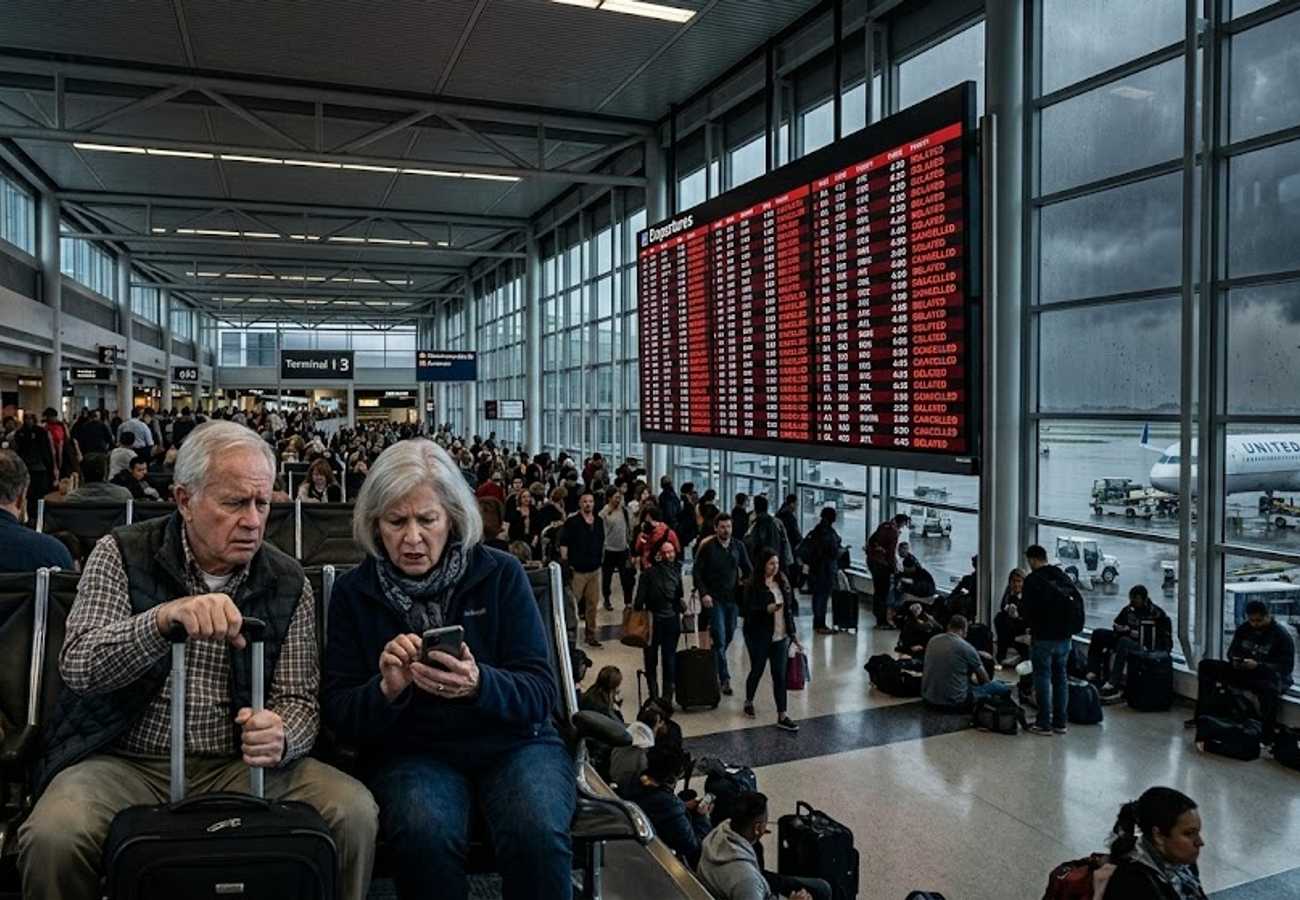
Image generated by AI
I have spent enough time navigating Chicago O'Hare to know that when the Midwest sky turns dark in July, you brace for impact. This Fourth of July weekend, the impact was brutal.
Standing in Terminal 1 on the afternoon of July 4th, I watched departure boards flip from green to red faster than I could track them. United's hub operations were grinding to a halt as a violent thunderstorm cell parked itself over the western suburbs, stretching from Schiller Park toward Bolingbrook.
The FAA activated a Traffic Management Program at ORD, throttling arrival rates to a fraction of normal capacity. Aircraft approaching from the east were stacking into holding patterns over Lake Michigan, burning fuel while waiting for gaps between storm cells.
When I checked FlightAware's live delay map, the delay numbers at O'Hare were climbing past the three-hour mark for inbound flights. The FAA's Air Traffic Control System Command Center was showing ground stops and ground delay programs cycling throughout the afternoon.
Terminal 3, where American Airlines operates its primary hub operations, was equally chaotic. The CTA Blue Line was still running on its normal schedule, but travelers arriving at the O'Hare station were stepping into a wall of confused passengers staring at cancellation notices on the monitors near the baggage claim escalators.
The numbers tell the story. Nearly two million travelers were expected to move through Chicago's aviation system during the extended holiday window. That volume, colliding with severe weather, created a critical capacity imbalance that rippled outward across the entire country.
What the Thunderstorms Did to O'Hare's Runway System
O'Hare's complex runway configuration — eight active runways designed to handle simultaneous parallel approaches — became a liability when the storm system settled over the airfield. Lightning proximity alerts forced repeated ground stops, meaning ramp crews could not service aircraft on the tarmac.
I spoke with a United ramp worker on a smoke break near Gate B11 who told me they had been sent to the break room three times in two hours due to lightning warnings. Each ground stop lasted between 20 and 45 minutes, and the cascading effect on aircraft turnaround times was immediate.
Wind variability added another layer of complexity. O'Hare typically operates with a specific runway configuration based on wind direction, but the storm system kept shifting. Air traffic controllers had to reconfigure arrival and departure runways multiple times within a single hour, further reducing throughput.
The Chicago Department of Aviation's real-time flight tracker showed departure delays averaging 90 to 120 minutes during peak disruption windows. Some international departures from Terminal 5 were pushed by more than four hours, creating knock-on effects for connecting passengers arriving from Europe and Asia.
FAA Flow Restrictions and the Chain Reaction
The FAA's Traffic Management Program is not a single switch — it is a layered system of controls designed to regulate traffic into constrained airspace. At O'Hare, this meant arrival rates were cut to roughly 40 percent of normal capacity during the worst of the storm activity.
Aircraft approaching Chicago from the east and south were required to enter holding patterns over designated fixes in Michigan and Indiana airspace. I tracked one United flight from Newark that circled over Kalamazoo for nearly 45 minutes before receiving clearance to descend toward ORD.
Departure operations suffered equally. Airlines could not launch outbound flights on schedule because inbound aircraft were arriving late, which meant gates were occupied beyond their planned turnaround windows. Crew rotations were thrown into disarray as pilots and flight attendants timed out of their legal duty periods.
The ripple effects extended far beyond Chicago. Since O'Hare serves as a primary interchange point for east-west and north-south air traffic corridors, delays there propagated to connected airports across the United States. Aircraft scheduled to operate flights out of Denver, Los Angeles, and New York were stuck in Chicago, leaving passengers at those airports staring at delayed departure times.
Terminal Congestion and Passenger Reality
Walking through Terminal 1 during the peak disruption period, I saw security checkpoint queues extending past the United Club lounge near Concourse C. TSA was operating all available lanes, but the volume of rebooked passengers trying to reach new gates overwhelmed the system.
Food and beverage outlets were running low on basics. The Tortas Frontera outpost near Gate B5 had sold out of its most popular menu items by early afternoon, and the line at the Starbucks in Concourse C stretched past the moving walkway entrance.
"If you're stuck at O'Hare during a weather event, head to Terminal 2. It always has the shortest lines and the most available seating during irregular ops. Most people cluster around Terminals 1 and 3 because that is where United and American operate, but Terminal 2 has quiet zones near the E concourse that are practically empty during chaos." — r/travel
I followed this advice myself during a previous delay event at ORD, and it holds up. Terminal 2's concourse E gates, primarily used by smaller regional carriers and some Delta operations, become a refuge when the main terminals are packed.
International Connections and Long-Haul Impact
Terminal 5, O'Hare's international terminal, faced its own set of challenges. Long-haul flights from Lufthansa, British Airways, and ANA experienced revised departure times as airlines attempted to stabilize their network integrity.
The problem for international travelers was particularly acute because missed connections at ORD often meant waiting 24 hours or more for the next available long-haul departure. I watched a family traveling to Frankfurt miss their Lufthansa connection by 12 minutes, only to learn the next available seat was two days later.
Airlines were continuously adjusting flight timings, reassigning aircraft, and modifying crew schedules throughout the day. The operational complexity of managing these changes during peak holiday demand was visible on every gate agent's face I encountered.
Recovery Timeline and What Comes Next
The recovery trajectory at O'Hare remains closely tied to the progression of the Midwest storm system. Even after weather conditions improve, residual disruption will persist due to accumulated delays, aircraft repositioning, and passenger backlogs.
Airlines will need extended recovery periods to restore normal scheduling consistency across affected routes. Until full weather stabilization occurs, Chicago O'Hare is expected to remain under partial operational constraint with intermittent delays continuing to impact both arrivals and departures.
When the Midwest throws its summer tantrums, O'Hare takes the hit — and the rest of the country feels it within hours.
Practical Visitor Guide
Best Times to Navigate O'Hare During Weather Events
If you are traveling through ORD during thunderstorm season (June through August), schedule morning departures before 11 AM whenever possible. Storm systems typically build in the afternoon and peak between 2 PM and 8 PM. Early morning flights have the highest on-time performance rate during summer months.
Ground Transportation Alternatives
The CTA Blue Line runs directly from downtown Chicago to O'Hare in approximately 45 minutes for $5. During weather disruptions, it remains the most reliable ground connection. Ride-share services surge-price heavily during airport delays, and taxi queues can exceed 90 minutes. If you need to get to Midway as a rebooking alternative, the Orange Line CTA route takes about 30 minutes from downtown.
Terminal Strategy for Delays
Terminal 2 offers the most breathing room during irregular operations. The United Club in Terminal 1 and the American Airlines Admirals Club in Terminal 3 reach capacity quickly during weather events. The USO in Terminal 2 is available for military personnel and their families.
Safety Considerations
Lightning proximity alerts at O'Hare trigger automatic ground stops for ramp operations. If you are on an aircraft waiting to deplane, these stops can last 30 minutes or longer. Stay seated and follow crew instructions. Inside the terminals, be aware that crowded conditions during delays create opportunities for pickpocketing — keep bags zipped and in front of you in queues.
Budget Expectations During Disruptions
Airport food prices at ORD run 30 to 40 percent higher than off-airport equivalents. A basic meal at Terminal 1 will cost $15 to $25 per person. If you anticipate a long delay, grab food before heading through security at one of the restaurants in the main parking garage area. Hotel rooms near O'Hare in Rosemont typically run $120 to $200 per night, but during holiday disruptions, rates can double. The Holiday Inn Express on River Road is a reliable mid-range option with a 24-hour shuttle.
Rebooking and Compensation
Under DOT rules, airlines are not required to compensate passengers for weather-related delays. However, most major carriers will rebook you on the next available flight at no charge. Use the airline's mobile app rather than waiting in line at customer service desks — app-based rebooking is typically faster during high-volume disruptions.
Related Travel Guides
Disclaimer
This article is for informational and educational purposes only. It does not constitute legal, financial, or professional advice. While we strive to provide accurate and up-to-date information, travel policies, regulations, and conditions change rapidly. Always verify information with official sources before making travel decisions. Nomad Lawyer makes no representations about the accuracy, reliability, completeness, or suitability of the information provided. Readers should consult qualified professionals for advice specific to their circumstances. The views expressed in this article are those of the author and do not necessarily reflect the views of Nomad Lawyer.
Raushan Kumar
Founder & Lead Developer
Full-stack developer with 11+ years of experience and a passionate traveller. Raushan built Nomad Lawyer from the ground up with a vision to create the best travel and law experience on the web.
Learn more about our team →