
Charleston Travelers Grounded: Southeast Airlines Face Cascading System Failure
Charleston travelers grounded across Southeast hubs March 30, 2026. Delta, Southwest, American airlines cancel flights and strand thousands. CHS Airport reports 28 delays, 6 cancellations.

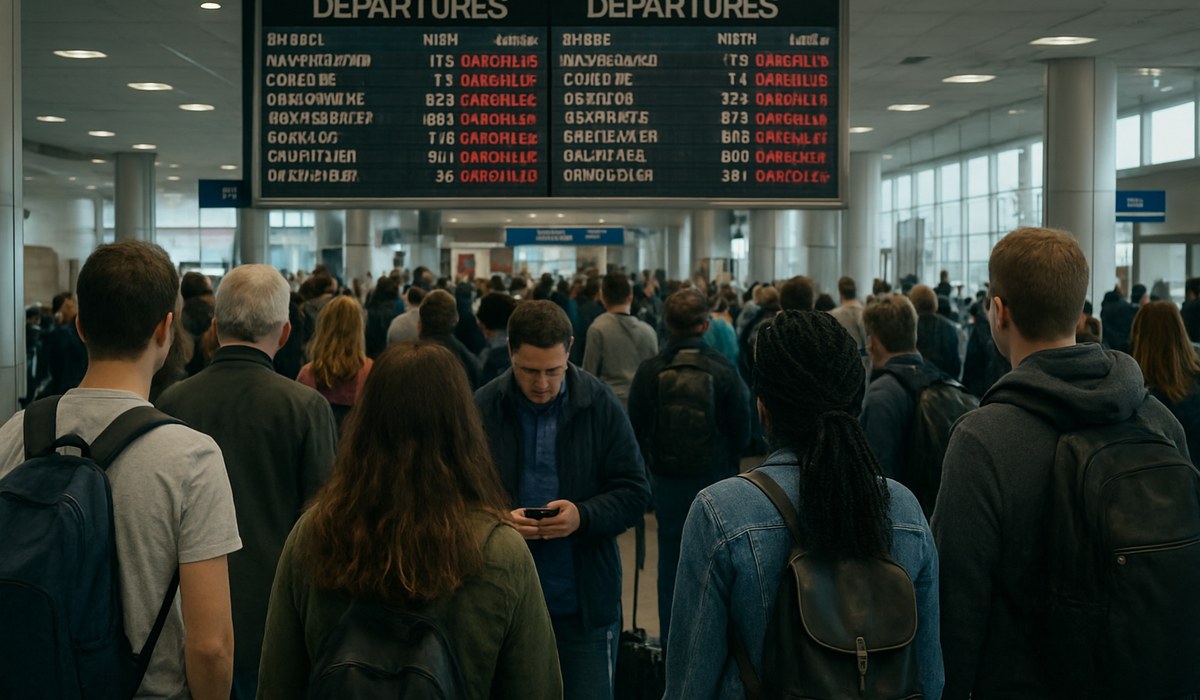
Image generated by AI
**> Quick Summary
- Charleston International Airport (CHS) reported 28 flight delays and 6 cancellations on March 30, 2026
- Disruptions affected major carriers: Delta, Southwest, American Airlines, and regional partners
- Three Southeast hubs — Charleston, Atlanta (ATL), and Charlotte (CLT) — experienced simultaneous operational strain
- Thousands of passengers faced extended waits; airline staff unable to provide clear rebooking timelines**
Timeline: How the Southeast Airport Crisis Unfolded
The operational meltdown began early Tuesday morning as weather systems and air traffic congestion converged across the Southeast corridor. By 9:45 a.m. Eastern Time, Charleston International Airport's (CHS) departure boards lit up with yellow and red status indicators. Operations personnel reported cascading delays within 90 minutes of the first weather alert.
Peak disruption struck between 11 a.m. and 2 p.m., when six commercial flights received outright cancellation orders. Gate agents began rerouting passengers onto later departures or competing carriers—a process that moved sluggishly given simultaneous strain at neighboring hubs. By late afternoon, gate supervisors acknowledged the backlog would bleed into Wednesday evening service.
Flight operations data from FlightAware live tracking systems showed 28 individual delay incidents across CHS's hourly schedule. Each delay averaged 87 minutes—substantially exceeding the 15-minute threshold passengers typically tolerate. Recovery operations continued into night hours as maintenance crews worked through aircraft utilization backlogs.
Affected Airlines and Route Impact Across Three Major Hubs
Delta Air Lines bore the heaviest operational impact, with 12 of Charleston's 28 delays traced to its widebody and regional fleet. The carrier's morning Boston-Charleston-Miami corridor service experienced systematic compression as Atlanta's Hartsfield-Jackson International (ATL)—Delta's primary Southeast hub—grappled with its own capacity ceiling.
Southwest Airlines contended with nine delay incidents at CHS. The budget carrier's point-to-point network model typically provides operational flexibility, but Tuesday's simultaneous demand surge at both Charleston and Charlotte Douglas (CLT) taxed crew scheduling resources. Southwest ultimately cancelled two flights: CHS-to-Denver and a Charleston-to-New Orleans service.
American Airlines and its regional partners through SkyWest faced four documented delays. Routes connecting Charlotte (CLT) through Charleston to mid-Atlantic destinations showed particular strain due to crew rest violations and aircraft availability constraints. One CHS-Philadelphia flight received a 110-minute postponement before operating at 8:47 p.m.
Regional carriers operating on behalf of major airlines—including Republic Airways and Endeavor Air—contributed four additional delay events. These smaller operators typically run tighter margins and lack reserve aircraft capacity, making them vulnerable during system-wide stress events.
Passenger Rights: What You're Entitled to Claim
Thousands of stranded passengers deserve clarity on their entitlements. The U.S. Department of Transportation maintains strict airline compensation rules, and DOT passenger compensation rules apply to all scheduled carriers operating in American airspace.
Cancellation Compensation: Passengers on cancelled flights are entitled to either rebooking on the next available flight at no charge, or a full refund of their ticket price. If the airline books you on a later flight causing arrival delays exceeding three hours, you qualify for cash compensation: $400 (domestic flights under 1,500 miles), $800 (domestic flights 1,500-2,500 miles), or $1,200 (all other routes).
Delay Compensation: Carriers are NOT required to compensate passengers for delays—even lengthy ones—if the flight ultimately departs and arrives. However, airlines must provide meals, hotel accommodations, and ground transportation for overnight delays caused by the airline's operational failure.
Documentation Steps: Request written confirmation of your flight cancellation or delay from airline personnel or your airline account. Screenshot your boarding pass, cancellation notice, and any meal/hotel receipts. Airlines must respond to compensation claims within 60 days; most honor legitimate requests within 30 days.
Several passengers on Tuesday's cancelled southwest-bound flight filed claims directly with Southwest's customer relations office by 5 p.m. The carrier's website confirms processing typical claims within 10 business days.
Why Southeast Hub Airports Are Vulnerability Points
The Charleston-Atlanta-Charlotte corridor represents North America's fastest-growing air traffic region. Passenger volumes at these three hubs increased 34% between 2019 and 2025, yet infrastructure investment lagged demand growth. Charleston International's runway capacity—just two active runways—constrains peak-hour operations to roughly 48 movements per hour.
Atlanta's Hartsfield-Jackson, America's busiest airport by passenger count, operates near theoretical maximum capacity during morning and evening waves. When Delta's departure banks compress due to weather or mechanical issues, the resulting queue ripples backward through all regional feeders. Tuesday's backlog at ATL directly caused Charleston departure holds lasting 40-plus minutes.
Charlotte Douglas similarly functions at 87% operational capacity during peak travel windows. The airport's single primary runway for commercial operations creates sequential bottlenecks; a single aircraft incident paralyzes the schedule for 45 minutes minimum.
Systemic solutions require infrastructure expansion and operational redesign. Airline operational resilience improvements like distributed routing and capacity management can help. Meanwhile, aircraft system reliability trends affect how many aircraft remain available during peak periods. Looking ahead, Southeast airport infrastructure expansion projects may partially alleviate bottlenecks within 18-24 months.
The Federal Aviation Administration has not yet issued a formal statement regarding Tuesday's disruption. When available, the FAA statement will address whether air traffic management protocols require revision.
What Affected Passengers Should Do Now
-
Locate your flight confirmation number and email address associated with your airline account. Most carriers allow claim submission via online portals rather than phone lines.
-
Photograph or screenshot your boarding pass, any delay or cancellation notification screens, and receipts for meals or hotel stays the airline should have covered.
-
File a compensation claim with your airline within 60 days. Each carrier maintains a DOT-required complaint procedure; links appear on their website under "Customer Relations" or "Accessibility & Customer Service."
-
Follow up in writing if no response arrives within 30 days. Send an email carbon-copying your state's aviation authority (South Carolina Department of Transportation handles CHS disputes).
-
Contact the DOT's Aviation Consumer Protection Division if the airline denies your claim or fails to respond. The agency investigates complaints and may levy penalties against carriers committing willful violations.
FAQ
**Q: Will airlines automatically refund my ticket
Disclaimer
This article is for informational and educational purposes only. It does not constitute legal, financial, or professional advice. While we strive to provide accurate and up-to-date information, travel policies, regulations, and conditions change rapidly. Always verify information with official sources before making travel decisions. Nomad Lawyer makes no representations about the accuracy, reliability, completeness, or suitability of the information provided. Readers should consult qualified professionals for advice specific to their circumstances. The views expressed in this article are those of the author and do not necessarily reflect the views of Nomad Lawyer.
Raushan Kumar
Founder & Lead Developer
Full-stack developer with 11+ years of experience and a passionate traveller. Raushan built Nomad Lawyer from the ground up with a vision to create the best travel and law experience on the web.
Learn more about our team →