
Carmel's Roundabouts Cut Fatal Crashes. They Did Not Eliminate Injury Claims.
Carmel operates more roundabouts than any US city. Severe crashes dropped sharply, but yield disputes and concussion injuries still generate claims.

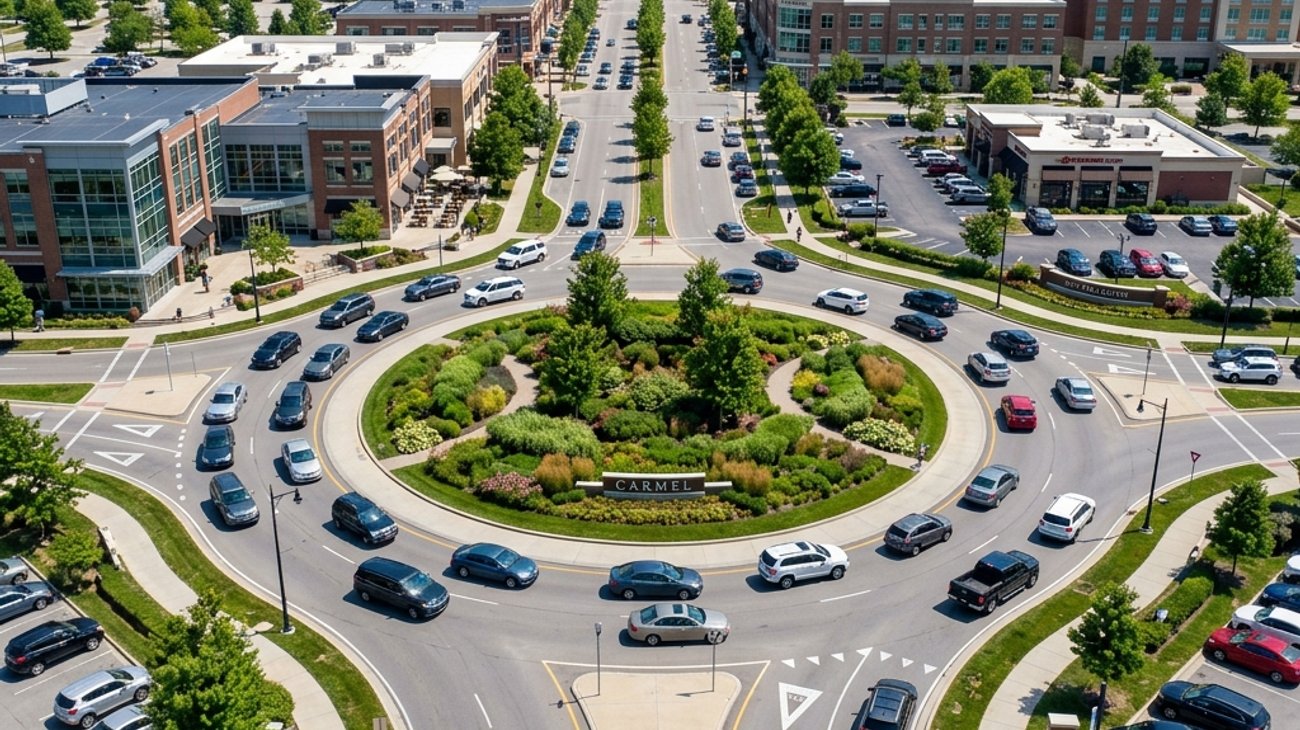
Image generated by AI
Carmel, Indiana has spent three decades doing something no other American city has done at the same scale. Beginning in the late 1990s, the city began systematically replacing signalized intersections with roundabouts. It now operates more than 140 of them—more than any other city in the United States—and the network has become a genuine civic identity along with a steady source of confusion for visitors.
The safety case is strong. City and state data have consistently shown large reductions in injury crashes at converted intersections, with the steepest declines in the categories that kill people. That outcome is not an accident of design. It is the design.
Why the Geometry of Roundabouts Reduces Severe Collisions
A traditional four-way signalized intersection creates 32 vehicle conflict points, including the head-on and right-angle geometries responsible for the most severe outcomes. A single-lane roundabout reduces that to eight, and none of them involve vehicles meeting at 90 degrees or head-on.
Speed does the rest. Entry deflection forces drivers to slow to roughly 15 to 25 miles per hour. A collision at 20 miles per hour transfers a fraction of the energy of the same collision at 45. Roundabouts also remove the incentive to accelerate through a yellow light, which is the behavior behind a large share of catastrophic intersection crashes.
The result across Carmel has been a meaningful reduction in fatal and incapacitating crashes at converted intersections. That is a real public health outcome, and it deserves the attention it has received.
The Types of Crashes That Still Occur in Roundabouts
Roundabouts change the crash mix rather than eliminating it. What remains tends to be lower speed and higher volume, which means more property damage claims, more soft tissue injuries, and more disputes about fault.
Failure to yield on entry is the most common. A driver approaching the yield line misjudges the gap or does not see a vehicle already circulating, and the entering vehicle strikes the circulating vehicle's side. Multi-lane roundabouts, common along Keystone Parkway and the 116th Street corridor, add lane-choice conflicts, where a driver in the outer lane continues past their exit or a driver in the inner lane cuts across an exiting vehicle.
Then there are the users who are not in vehicles at all. The Monon Greenway crosses streets in and around the Arts and Design District, and Carmel's sidewalk and trail network puts pedestrians and cyclists at roundabout crosswalks throughout the day. A driver watching left for a gap in circulating traffic is by definition not watching right for someone stepping into the crosswalk.
Why Fault Is Genuinely Contested in Roundabout Accidents
In a rear-end collision on a straight road, fault is usually obvious. In a roundabout, it frequently is not.
The governing rule sounds simple: traffic already circulating has the right of way, and entering traffic must yield. Applying it to a specific collision is harder. Was the other vehicle actually circulating, or was it entering simultaneously from the adjacent approach? Did the striking vehicle enter too early, or did the circulating vehicle change lanes inside the roundabout? In multi-lane designs, was either driver in the correct lane for their intended exit?
Indiana's modified comparative fault rule under Indiana Code 34-51-2-6 makes those questions financially consequential. Fault is assigned as a percentage, damages are reduced accordingly, and recovery disappears entirely at 51 percent. A roundabout crash where both drivers share responsibility can turn on a 10-point difference in how a factfinder splits it.
Evidence resolves what argument cannot. Carmel operates traffic cameras at many locations, nearby businesses along Range Line Road and City Center Drive frequently have exterior cameras, and dashcams have become common. That footage tends to be retained for days or weeks rather than months, so requesting it quickly matters. A Carmel personal injury lawyer who knows which approaches are covered can send preservation requests before the footage cycles.
Recognizing Concussions and Soft Tissue Injuries After a Collision
Because roundabout collisions happen at lower speeds, they are routinely dismissed as minor. The vehicles are drivable. The crash report lists no injuries. Everyone exchanges information and goes to work.
Concussions do not require high speed or a direct blow to the head. A rapid change in direction is sufficient to cause the brain to move within the skull, and a side-impact collision at 20 miles per hour produces exactly that kind of rotational force. Symptoms frequently do not appear for 24 to 72 hours, and when they do, they look like ordinary life stress: headaches, difficulty concentrating at work, irritability, trouble sleeping, or sensitivity to fluorescent office lighting along the Meridian corridor.
By the time someone connects those symptoms to a crash they described as minor, they have often gone weeks without treatment, and that gap becomes the insurer's central argument. Understanding how brain injury claims in Indiana are documented and valued matters well before a claim is filed, because the medical record built in the first month largely determines what is provable later. This article is general information and not medical advice. Anyone experiencing symptoms after a collision should be evaluated by a physician.
Key Steps to Take After a Roundabout Collision in Carmel
Call it in even when the damage looks cosmetic, so an official report exists. Photograph the final resting positions before moving the vehicles, along with the yield markings, lane arrows, and overhead signage, because lane assignment is often the disputed fact. Get the names of anyone who stopped, and note whether any nearby business faces the intersection.
Then pay attention over the following week. Symptoms that emerge on day three are still crash-related, and a physician visit that documents them is worth more than a perfect memory of the collision itself. Hamilton County cases are generally handled in Noblesville, and both the medical providers and the courts are local, which tends to make these claims move more predictably than people expect.
Frequently Asked Questions
Who is at fault in a roundabout accident in Indiana?
The general rule is that vehicles already circulating in the roundabout have the right of way and entering vehicles must yield. Applying that rule to a specific crash often requires evidence about lane position, timing of entry, and whether either driver changed lanes inside the circle. Because Indiana assigns fault as a percentage, these cases frequently result in a split rather than a clean assignment to one driver.
Are roundabouts safer than traffic lights?
For severe and fatal crashes, substantially so. Roundabouts eliminate the head-on and right-angle conflict points that produce the deadliest outcomes and force entry speeds down to roughly 15 to 25 miles per hour. Total crash counts fall less dramatically than injury counts, because low-speed sideswipes and failure-to-yield contacts still occur.
How many roundabouts does Carmel Indiana have?
Carmel operates more than 140 roundabouts, the largest network of any city in the United States. The conversion program began in the late 1990s and has continued through major corridor projects including Keystone Parkway and the US 31 upgrade.
Can I get compensation for a low speed car accident?
Yes. Compensation depends on documented injury and loss rather than on the amount of visible vehicle damage. Soft tissue injuries and concussions occur regularly in collisions that leave both cars drivable. Insurers routinely argue that minor property damage means minor injury, which is why prompt medical evaluation and consistent treatment records carry so much weight.
How long do I have to file a car accident claim in Indiana?
Two years from the date of the crash for most personal injury claims under Indiana Code 34-11-2-4. If a government entity is involved, including a claim based on road design or maintenance, the Indiana Tort Claims Act requires written notice within a far shorter period, so those situations need attention immediately.
Related Travel Guides
Disclaimer
This article is for informational and educational purposes only. It does not constitute legal, financial, or professional advice. While we strive to provide accurate and up-to-date information, travel policies, regulations, and conditions change rapidly. Always verify information with official sources before making travel decisions. Nomad Lawyer makes no representations about the accuracy, reliability, completeness, or suitability of the information provided. Readers should consult qualified professionals for advice specific to their circumstances. The views expressed in this article are those of the author and do not necessarily reflect the views of Nomad Lawyer.
Kunal K Choudhary
Co-Founder & Contributor
A passionate traveller and tech enthusiast. Kunal contributes to the vision and growth of Nomad Lawyer, bringing fresh perspectives and driving the community forward.
Learn more about our team →