Bolivia's Salar de Uyuni Welcomes Samkani Camp: A Five-Suite Luxury Airstream Sanctuary on the Salt Flats

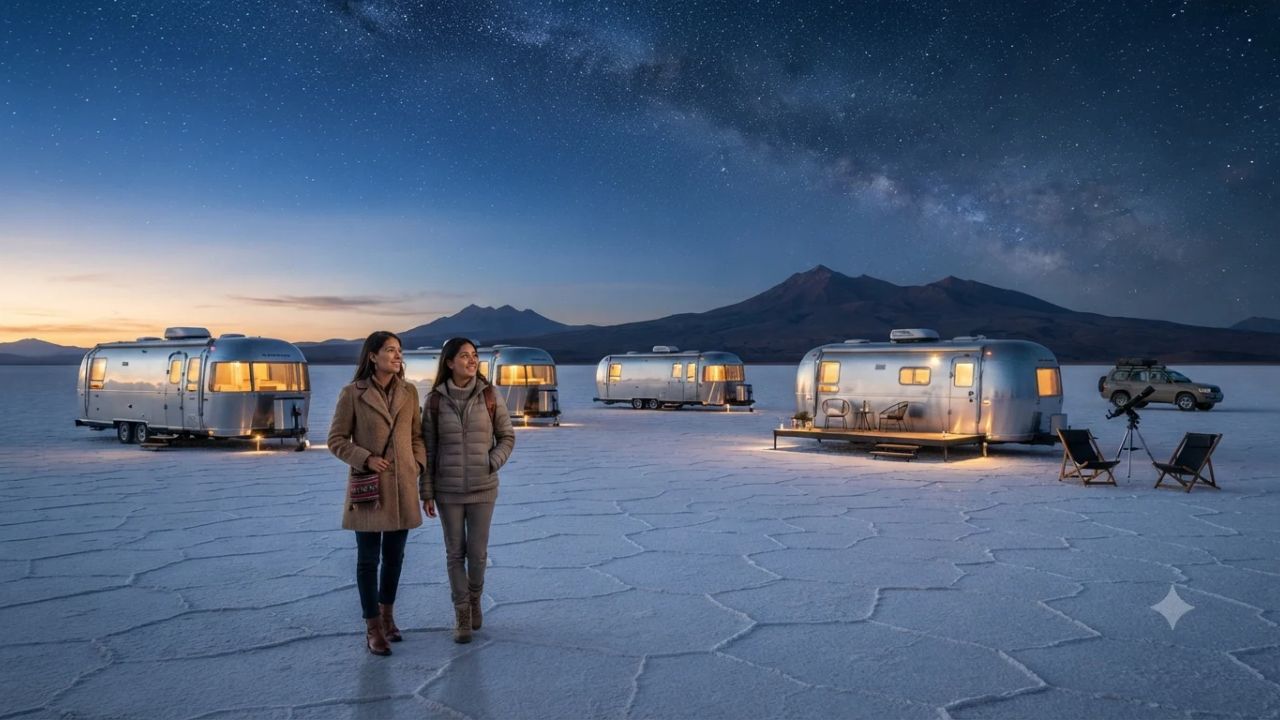
At 3,656 meters above sea level across more than 10,000 square kilometers of blinding white mineral crust, overnight travelers on Bolivia's Salar de Uyuni have historically had to retreat to peripheral towns before sundown. That isolation barrier changes with the debut of Samkani Camp, an ultra-exclusive retreat placing five custom Airstream suites directly onto the open expanse of the world's largest salt pan. Slated to open in late 2027 under the high-end A&K Sanctuary portfolio, the property marks a defining moment for experiential South American hospitality by turning the salt wilderness itself into a nocturnal sanctuary.
The initiative by Abercrombie & Kent introduces an architect-engineered outpost designed to vanish into its surroundings while granting uninhibited access to the Southern Hemisphere's clearest celestial displays. Rather than building static concrete foundations that scar delicate geothermal crusts, the camp deploys six mobile aluminum structures—five dedicated guest suites and a central dining and lounge hub—engineered to sit lightly on the terrain. For intrepid high-altitude explorers, this evolution translates to private astronomy sessions, volcanic cave journeys, and silent dawn reflections far beyond the reach of day-trip safari convoys.
Direct Salt Crust Immersion on the Bolivian Altiplano
For decades, exploring the southwest highlands of Bolivia required travelers to stay in salt-brick hotels along the outer shoreline or endure basic shared refuges while transiting toward the Eduardo Avaroa Andean Fauna National Reserve. Samkani Camp redefines that geography by establishing its base directly on the central salt surface. Named after the Aymara term meaning "the one who dreams," the outpost honors the indigenous linguistic heritage of the Andean plateau while bringing refined comfort to one of the planet's most austere wildernesses.
Each of the five guest suites utilizes an aerodynamically refined Airstream chassis customized with reflective metal exteriors that mirror the changing light from pink dawn to blinding midday brilliance. Inside, the living spaces integrate indigenous mineral accents, including deep blue Bolivian sodalite marble paired with polished chrome and thermal climate control built to withstand sub-zero Altiplano nights. A sixth dedicated Airstream functions as the social heart of the camp, housing a full dining salon and cocktail lounge where regional Andean gastronomy takes center stage.
To ensure deep immersion, every booking includes a dedicated Bolivian guide and private four-wheel-drive vehicle. Guests can select from a curated portfolio of more than 30 bespoke excursions, ranging from visits to isolated cactus islands and ancient volcanic caverns to custom photography treks and night sky observation sessions. Because the retreat hosts a maximum of ten to twelve guests at any given time, stays offer unprecedented solitude in a destination where standard tourism frequently crowds around predictable daylight photo stops.
What Makes Salar de Uyuni Different
The Salar de Uyuni is not merely an expansive salt basin; it is the prehistoric remnant of Lake Minchin, a massive body of water that dried up roughly 40,000 years ago, leaving behind billions of tons of salt and the world's single largest lithium reserve. The geography shifts dramatically across two distinct climatic phases. During the dry winter season from May to November, the surface hardens into crisp, geometric hexagonal salt tiles that crunch beneath hiking boots and stretch unbroken to the distant horizon.
When summer rains arrive between December and April, shallow mineral runoff pools across the plateau, turning the entire basin into a mirror where the boundary between sky and earth dissolves. Under starlight, this reflective water creates the sensation of standing inside an open galaxy, an astronomical spectacle documented by scientific observers and preservationists at the UNESCO World Heritage Centre.
Beyond the flat white expanse, the surrounding Altiplano features geological wonders that few travelers explore thoroughly. Ancient coral islands like Incahuasi rise abruptly from the salt crust, covered in giant trichocereus cacti that grow just one centimeter per year and date back over a thousand years. Nearby volcanic vents, petrified coral caverns, and multi-hued high-altitude lagoons host three species of native flamingos: Chilean, Andean, and the rare James's flamingo. Staying on the flats overnight allows visitors to witness these phenomena during dawn and dusk, when the low-angled sun turns the surrounding volcanic peaks shades of violet, ochre, and burnished gold.
Visitor Insider Tips
Planning an expedition across the Bolivian Altiplano requires careful logistical preparation and physiological awareness:
- Master the Altitude Curve: Sitting at nearly 3,700 meters, Uyuni demands prior acclimatization. Spend at least two full days in La Paz or Sucre before flying into Uyuni's Joya Andina Airport. Drink plenty of coca leaf tea (mate de coca) and consult your physician about acetazolamide before ascending.
- Pack for Extreme Temperature Swings: Solar radiation on the white salt during daylight hours can cause rapid sunburn and heat, while evening temperatures regularly drop to -15°C (5°F) between June and August. Pack polarized UV400 sunglasses, high-SPF mineral sunscreen, thermal merino base layers, and windproof outer shells.
- Time Your Season Intentionally: If you want sharp hexagonal salt crust patterns, easy driving access across the entire salar, and unhindered stargazing, visit during the dry winter months of June through October. If your goal is to experience the famous giant sky-mirror reflection, book between late January and early March.
- Savor High-Andean Cuisine: Look beyond standard tourist menus and ask your private camp chef to prepare dishes featuring native red and black royal quinoa (quinoa real), pasture-fed llama tenderloin, and slow-roasted Andean tubers (oca and papalisa) paired with high-altitude Bolivian wines from the Tarija Valley.
- Respect Sacred Topography: Local Aymara and Quechua communities revere Mount Tunupa, the dormant volcano towering over the northern rim of the salar, as an ancestral mother figure. Always seek permission before photographing sacred burial chullpas or village ceremonies, and adhere to local environmental guidelines promoted by the Bolivian Vice Ministry of Tourism.
Cultural and Environmental Context
The emergence of high-value, small-footprint hospitality on the Salar de Uyuni represents a vital pivot for sustainable conservation in southwestern Bolivia. The Altiplano is an ecologically fragile environment vulnerable to water scarcity, litter accumulation, and vehicle erosion. Traditional budget safari circuits often operate with high vehicle density, creating concentrated tire tracks and stress on local sanitation infrastructure around village outposts like Colchani.
Mobile, architect-designed structures offer an alternative model by minimizing permanent physical intrusion. Because the Airstreams operate with self-contained waste management and renewable solar power arrays, the camp leaves no lasting scars on the mineral salt crust. Furthermore, A&K's commitment to staffing Samkani Camp entirely with Bolivian expedition guides, private drivers, and culinary artisans ensures that tourism revenues directly support indigenous highland communities rather than bypassing them.
Simultaneously, the region faces evolving industrial dynamics surrounding Bolivia's vast lithium deposits beneath the salt brine. By demonstrating that low-impact, high-yield cultural and astronomical tourism can generate significant sustainable revenue, projects like Samkani help establish a compelling economic argument for preserving the pristine visual and ecological integrity of the salar. Responsible tourism here acts as a protective shield, honoring ancestral Aymara traditions while introducing discerning travelers to one of South America's most revered natural marvels.
FAQ: Visiting Salar de Uyuni 2026
When does Samkani Camp open for guest stays?
Samkani Camp is scheduled to welcome its first guests in late 2027. Abercrombie & Kent has opened advance registration for travelers planning future Bolivian tailor-made journeys.
How do travelers reach the Salar de Uyuni from abroad?
Fly into El Alto International Airport in La Paz, connect via a 45-minute domestic flight on Boliviana de Aviacion to Joya Andina Airport in Uyuni, and meet your private guide for a 30-minute vehicle transfer onto the salt flats.
What is the best month to photograph the salt mirror effect?
The optimal mirror reflection occurs during the wet summer rainy season between mid-January and early March, when shallow rainwater blankets the salt crust.
How severe is altitude sickness on the salt flats?
The salar sits at 3,656 meters. While most travelers experience mild shortness of breath or light headaches, prior acclimatization in La Paz, ample hydration, and paced physical activity ensure a comfortable stay.
The true magic of the world's grandest salt pan awakens only after the day-trippers depart, when silent starlight turns the frozen mineral sea into an infinite cosmic mirror.
Related Travel Guides
This article is for informational purposes. Flight routes, passenger regulations, visa rules, and transit advisories are subject to change by airlines and aviation authorities. Readers are advised to verify schedules and travel documentation with relevant carriers and border agencies before departure.
Related Stories
Ayodhya Deepotsav 2026 Logistics Guide: Attending the 30 Lakh Lamp Festival in India

WTM London 2026: AI Booking Shifts and Global Tourism Growth Forecasts for 1.57 Billion Arrivals