Inside Beijing’s 280,000 Sq Km Airspace Restriction: What Travelers Need to Know About Flights and Drones

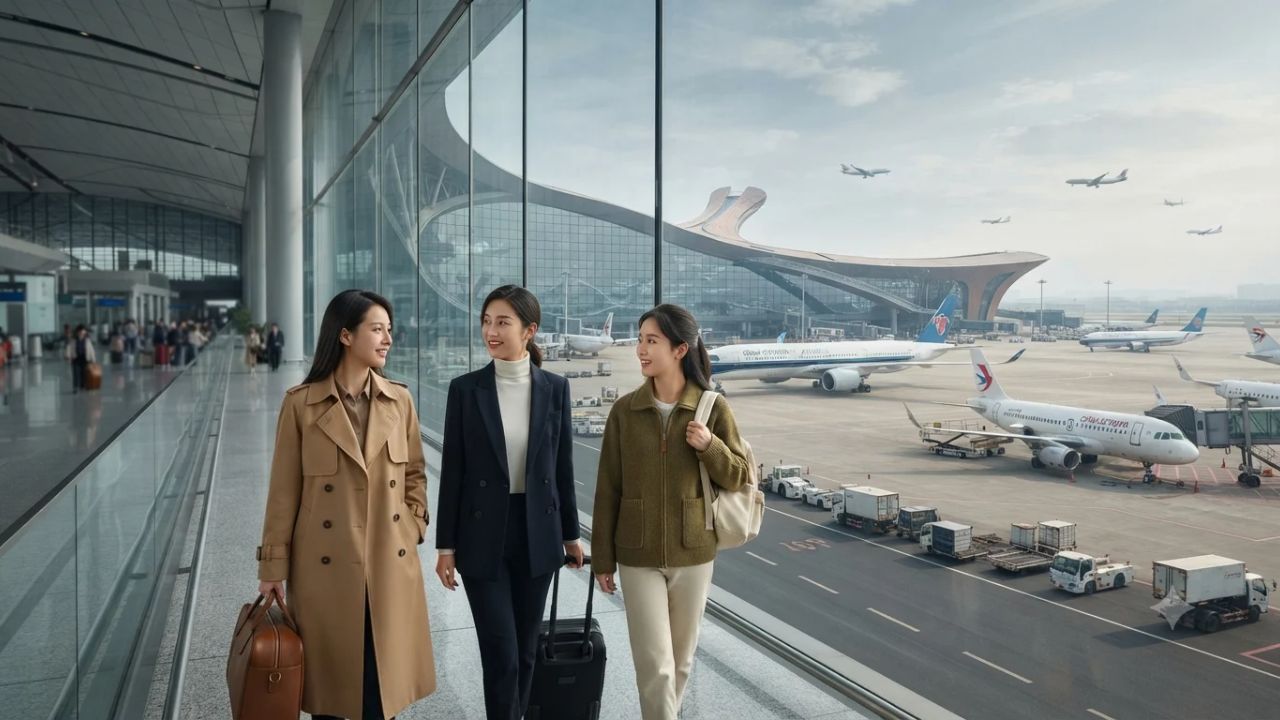
Image generated by AI
While China enacted a massive Special Restricted Area spanning 280,000 square kilometres across the capital region on September 20, 2026, commercial airline operations at both Beijing Capital and Beijing Daxing International Airports remain completely exempt and fully operational. Forming a 600-kilometre-wide circular perimeter extending from the surface upward, the newly designated zone covers Beijing, Tianjin, vast swathes of Hebei, and portions of Inner Mongolia, Shanxi, Shandong, and Liaoning, reaching outward over the Bohai Sea. For international leisure and business visitors landing in the Chinese capital, understanding the precise boundary between non-commercial general aviation controls and standard scheduled airline transit is key to navigating the country's booming travel market.
The Capital Airspace Perimeter: Separating Commercial Flights From Low-Altitude Bans
The establishment of the Special Restricted Area, published through official aviation NOTAM channels, is designed to regulate low-altitude flight paths, private charters, and uncoordinated general aviation. Scheduled commercial passenger airliners, approved business flights, and designated state emergency missions (including police, customs, and fire-rescue services) are specifically exempted from the flight prohibitions.
The scale of Beijing’s commercial aviation infrastructure illustrates why regular passenger transit remains protected. Official municipal statistics confirm that Beijing Capital International Airport (PEK) and Beijing Daxing International Airport (PKX) handled a combined 124 million passenger movements during 2025, marking a 6.5 percent year-on-year increase. Breaking down the figures:
- Beijing Capital International Airport: Processed 70.76 million passengers in 2025, expanding by 5.0 percent.
- Beijing Daxing International Airport: Welcomed 53.61 million passengers (a rise of 8.4 percent) across 345,800 arriving and departing flights, with international and regional passenger traffic surging 24.56 percent to 5.89 million.
This strong momentum carried directly into 2026. During the 40-day Spring Festival rush, Daxing alone processed roughly 6.52 million travelers, including approximately 656,700 international fliers. The new airspace regulation does not curtail scheduled passenger flights, but it completely closes high-volume non-commercial flight paths across the northern corridor.
What Makes Beijing's Aviation and Tourism Network Different
Beijing serves as both an ancient imperial capital and a hyper-modern global gateway. Beyond its massive aviation terminals, the city offers seamless high-speed rail connections that ferry travelers directly from Daxing Airport to central West Railway Station in under 20 minutes.
The city’s tourism economy is experiencing an unprecedented international resurgence. Municipal data recorded 390 million total tourist visits in 2025 (a 4.8 percent increase), generating CNY 715.93 billion in visitor spending. Domestic travelers accounted for 380 million trips, while inbound foreign tourism jumped by 39.0 percent to 5.48 million international visitors, generating US$ 7.08 billion in inbound foreign exchange spending (up 44.3 percent).
This rapid recovery accelerated through 2026. Official Beijing Statistics Bureau records confirm that the capital welcomed 3.86 million inbound international visitors between January and July 2026—a 32.4 percent year-on-year surge. Across China, national domestic tourism reached 6.522 billion trips in 2025, with domestic expenditure climbing 9.5 percent to CNY 6.30 trillion.
Visitors traveling to Beijing arrive to explore centuries of dynastic heritage, including UNESCO World Heritage landmarks like the Forbidden City, the Summer Palace, the Temple of Heaven, and the rugged mountain ramparts of the Great Wall at Mutianyu and Jinshanling.
Visitor Insider Tips for Navigating Beijing and Avoiding Drone Pitfalls
Travelers planning an itinerary to Beijing should keep these essential local rules in mind:
- Leave Recreational Drones at Home: The Beijing Municipal Government declared the entire administrative municipality controlled airspace for unmanned aircraft in August 2025, reinforced by strict guidance issued ahead of the May Day holiday. Launching any drone outdoors without prior formal approval from air traffic authorities is strictly illegal across all urban districts, public parks, and remote mountain sections of the Great Wall. Revised municipal drone enforcement rules take effect on November 15, 2026.
- Understand Civil Aviation Law Compliance: Under Article 82 of China’s revised Civil Aviation Law, effective since July 1, 2026, civil aircraft and unmanned aerial vehicles entering restricted airspace without authorization face strict statutory penalties enforced by the Civil Aviation Administration of China.
- Utilize the Daxing and Capital Airport Express Lines: Skip highway traffic by boarding dedicated airport express trains. The Capital Airport Express connects Terminals 2 and 3 to Dongzhimen in 20 to 30 minutes, while Daxing Airport Express connects directly to Caoqiao subway interchange on Line 10 and Line 19.
- Base Yourself Near Historic Central Hutongs: Stay in Dongcheng or Xicheng boutique courtyard hotels near Shichahai, Nanluoguxiang, or the historic Drum and Bell Towers to experience authentic local life, traditional tea houses, and street gastronomy on foot.
Cultural, Economic, and Environmental Context of the Capital Region
The implementation of unified airspace controls reflects China's ongoing efforts to balance rapid economic connectivity with airspace safety. As urban centers expand and low-altitude commercial logistics (such as medical transport and automated package delivery) develop across East Asia, managing shared skies requires rigorous administrative boundaries.
In Beijing, tourism is deeply intertwined with cultural preservation. The revenue generated by CNY 715 billion in annual visitor spending directly funds the meticulous restoration of ancient timber architecture, imperial waterways, and historical residential neighborhoods.
At the same time, Beijing has made strides in urban environmental sustainability. The shift toward high-speed intercity rail networks, electric municipal bus fleets, and strict industrial air quality standards has cleared the capital's skies, offering visiting travelers blue horizons over the Western Hills. Preserving orderly airspace allows the city to welcome millions of overseas travelers while maintaining public safety across China's political and cultural heartland.
FAQ: Visiting Beijing and Flight Operations in 2026
Are commercial airline flights to Beijing affected by the 280,000 sq km restricted zone?
No. Scheduled commercial airline services and passenger flights at Beijing Capital (PEK) and Beijing Daxing (PKX) are specifically exempted from the restrictions and operate normally.
Can tourists fly a camera drone at the Great Wall or in Beijing parks?
No. The entire municipality of Beijing is designated as controlled airspace. Flying any unmanned aerial vehicle outdoors without formal air traffic management approval is prohibited.
What is the fastest way to get from Daxing Airport to downtown Beijing?
The Daxing Airport Express subway reaches Caoqiao station in approximately 19 minutes, while intercity high-speed trains connect Daxing Airport directly to Beijing West Railway Station.
How many international visitors traveled to Beijing in recent months?
Beijing welcomed 5.48 million foreign visitors in 2025 and recorded 3.86 million inbound international arrivals between January and July 2026 alone.
Related Travel Guides
This article is for informational purposes. Flight routes, passenger regulations, visa rules, and transit advisories are subject to change by airlines and aviation authorities. Readers are advised to verify schedules and travel documentation with relevant carriers and border agencies before departure.
Related Stories

US State Department Adds Wrongful Detention Warning to China Travel Advisory in 2026

Ayodhya Deepotsav 2026 Logistics Guide: Attending the 30 Lakh Lamp Festival in India