
Azerbaijan Plans Three New Tourism and Recreation Zones by 2030 Under National Tourism Development Programme
Azerbaijan has announced plans to develop three new tourism and recreation zones between 2027 and 2030 as part of its national 2026-2030 tourism development plan, with each zone to include at least three fully equipped tourism centres, state-owned highway connections, and a public-private partnership framework coordinated by the State Tourism Agency across multiple government bodies.

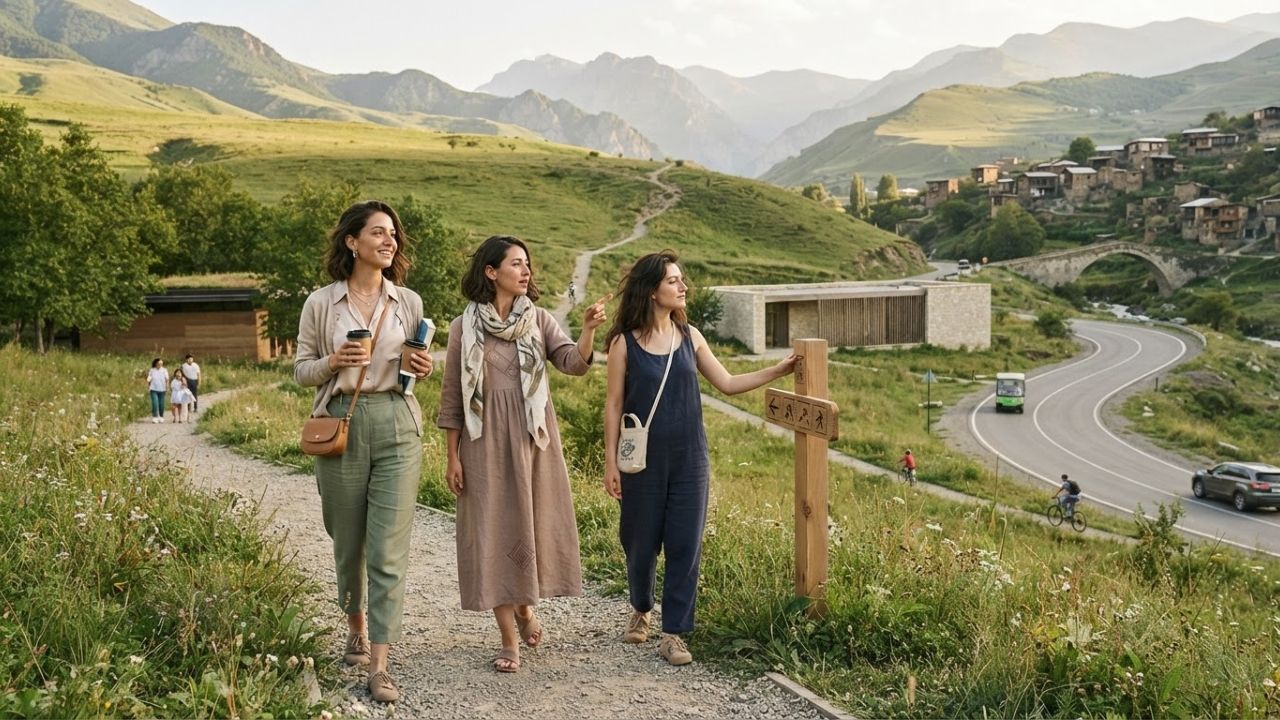
Image generated by AI
BAKU, August 21, 2026 — Azerbaijan is creating three new designated tourism and recreation zones between 2027 and 2030 under its national 2026-2030 tourism development plan, with each zone to contain a minimum of three fully equipped tourism centres supported by state-owned highway infrastructure, social and cultural facilities, and a structured public-private partnership framework — all coordinated by the State Tourism Agency in cooperation with authorities spanning economic development, environmental protection, urban planning, transport, water resources management, and regional administration. The programme is designed to redirect tourist activity toward under-served regions, reduce dependence on the capital, and create employment opportunities that slow population migration from rural areas to urban centres.
Azerbaijan's 2026-2030 Tourism Plan: Three Zones, Nine Tourism Centres, and a Multi-Ministry Delivery Framework
The structural centrepiece of the programme is its minimum scale commitment. Each of the three planned tourism and recreation zones must include at least three tourism centres — meaning the government has committed to a floor of nine operational tourism centres by 2030, each equipped with the facilities required to receive domestic and international visitors at competitive standards.
The decision to anchor each zone to multiple centres rather than a single large development reflects a deliberate planning philosophy: tourism ecosystems perform more resiliently when demand is distributed across complementary facilities within a zone rather than concentrated in a single site that can become overcrowded or underperform if one attraction fails to generate expected visitor volumes.
The State Tourism Agency holds primary coordination responsibility across the programme. Supporting ministries and government bodies span a wide spectrum — economic development, environmental protection, urban planning, transport infrastructure, water resources management, and regional administration — a configuration that signals the programme is being treated as a cross-governmental economic development intervention rather than a narrowly scoped infrastructure project.
What Each Tourism and Recreation Zone Must Deliver: Infrastructure, Culture, and Accessibility
Azerbaijan's zone specifications go substantially beyond accommodation and attractions. Each designated area under the programme is required to develop a complete tourism ecosystem that includes social infrastructure, cultural facilities, administrative services, engineering systems, and digital communication networks — the enabling layer without which hospitality and recreational investment cannot function effectively.
The cultural dimension is explicit in the planning framework. Zones are intended to support cultural tourism experiences alongside nature-based recreation and leisure activities, connecting visitors with Azerbaijan's landscape, heritage, and regional traditions. This dual orientation — recreational and cultural — positions the new zones within a tourism model that targets travellers seeking depth of experience, not simply resort-style amenity.
Accessibility is treated as a foundational requirement rather than an add-on. State-owned highways and road transport infrastructure connecting each tourism centre with surrounding regions are included in the programme's scope. The road connectivity component reflects a practical reality: new tourism destinations in regions that lack reliable transport access cannot attract consistent visitor volumes regardless of the quality of their facilities.
The programme's emphasis on complete infrastructure provision before private investment follows a sequenced model: government establishes the physical and administrative platform, then private businesses — hospitality operators, recreation facility providers, entertainment companies, and service businesses — are invited to build on that foundation with targeted offerings. This approach reduces the risk profile for private investors who might otherwise hesitate to commit capital to regions with incomplete enabling infrastructure.
Public-Private Partnerships and Regional Economic Development as Twin Objectives
The Azerbaijan programme is explicitly designed to generate two categories of outcome simultaneously: visitor-facing tourism development and regional economic development for communities hosting the new zones.
The public-private partnership framework is structured to activate private investment at the point where government-funded infrastructure reaches operational readiness. Entrepreneurs and investors will be encouraged to develop tourism-related services across the full spectrum of visitor needs — accommodation, food and beverage, recreational facilities, entertainment operations, and support services — with the government-built infrastructure providing the physical and regulatory platform for those investments.
Regional economic impact through employment creation is the social objective running alongside the commercial one. Tourism investments in regional zones create jobs in construction during development phases, and operational jobs in hospitality, guiding, transport, retail, and services once zones open. The programme's stated aim of creating economic opportunities outside major urban centres directly addresses the migration dynamic that has concentrated population and economic activity in Baku and other cities while rural regions have lost working-age residents.
The multi-agency coordination structure — spanning environmental protection, water resources management, and urban planning alongside transport and economic development — also reflects an awareness that sustainable regional tourism development requires environmental safeguards to be built into the design from the beginning rather than retrofitted after infrastructure decisions have been made.
Where Recreation Zones Fit in Azerbaijan's Wider Tourism Strategy
Azerbaijan occupies an intersection of tourism assets that few countries in the Caucasus and wider region can match: Caspian Sea coastline, Greater and Lesser Caucasus mountain systems, semi-arid landscapes, dense forests, UNESCO-listed historic sites, and a capital city that has become an established short-break and business events destination.
The country has been systematically expanding its tourism proposition beyond Baku — which received the majority of international arrivals in prior years — to leverage the broader geographic diversity of its territory. Established regional destinations such as Sheki, Gabala, and the Nakhchivan Autonomous Republic already attract domestic and regional visitors, but the infrastructure serving them has historically been inconsistent.
The 2027-2030 zone programme extends this regional diversification agenda with a structured multi-year commitment rather than project-by-project development. Three zones, each with at minimum three centres, connected by state-built highways, and opened to private investment — creates a replicable, scalable model for regional tourism that Azerbaijan can apply beyond the 2030 horizon if the initial zones perform to expectations.
Why This Matters for Travellers Considering Azerbaijan Between 2027 and 2030
For the international traveller, Azerbaijan's 2027-2030 zone programme is relevant in a practical sense: it signals that tourism infrastructure in regions currently underserved by hospitality and transport will improve materially before the end of the decade.
Travellers who have visited Azerbaijan primarily through Baku will find that the availability of quality accommodation, accessible road connections, and organised tourism services in regional zones expands the viable itinerary significantly. Nature-based experiences in the Caucasus foothills, cultural heritage sites outside the capital, and recreational facilities built to international standards become accessible without the infrastructure compromises that currently characterise travel outside the main tourism circuits.
From a booking standpoint, the 2027 start date for zone development means early-adopter travellers visiting these regions in 2027 and 2028 will encounter zones that are partially developed — some centres complete, others still under construction. By 2029 and 2030, the completed zone infrastructure will support more consistent visitor experiences. Travellers planning an Azerbaijan itinerary for 2030 or beyond will be working from a substantially more developed regional offering than exists today.
FAQ: Azerbaijan Tourism and Recreation Zones 2027-2030
How many tourism zones is Azerbaijan planning to develop? Azerbaijan plans to develop three new tourism and recreation zones between 2027 and 2030 as part of the national 2026-2030 tourism development plan.
What facilities will each tourism zone include? Each designated zone will include at least three fully equipped tourism centres alongside social infrastructure, cultural facilities, administrative services, engineering systems, digital communication networks, and state-owned highway connections to surrounding regions.
Which government body is coordinating Azerbaijan's tourism zone programme? The State Tourism Agency holds primary responsibility for coordinating the programme's implementation, supported by government bodies responsible for economic development, environmental protection, urban planning, transport infrastructure, water resources management, and regional administration.
How does the public-private partnership model work in Azerbaijan's tourism zones? The government builds enabling infrastructure — roads, utilities, administrative systems — first, then opens the zones to private investors and entrepreneurs to develop hospitality, recreation, entertainment, and service businesses on that government-established platform.
Related Travel Guides
Disclaimer
This article is for informational and educational purposes only. It does not constitute legal, financial, or professional advice. While we strive to provide accurate and up-to-date information, travel policies, regulations, and conditions change rapidly. Always verify information with official sources before making travel decisions. Nomad Lawyer makes no representations about the accuracy, reliability, completeness, or suitability of the information provided. Readers should consult qualified professionals for advice specific to their circumstances. The views expressed in this article are those of the author and do not necessarily reflect the views of Nomad Lawyer.
Raushan Kumar
Founder & Lead Developer
Full-stack developer with 11+ years of experience and a passionate traveller. Raushan built Nomad Lawyer from the ground up with a vision to create the best travel and law experience on the web.
Learn more about our team →