
Azerbaijan Targets 3.8 Million Arrivals by 2030: Decentralizing Tourism Beyond Baku
Azerbaijan's State Tourism Development Programme targets 3.8 million foreign arrivals and 6.3 billion manats in receipts by 2030 through regional airport hubs and rural heritage corridors.

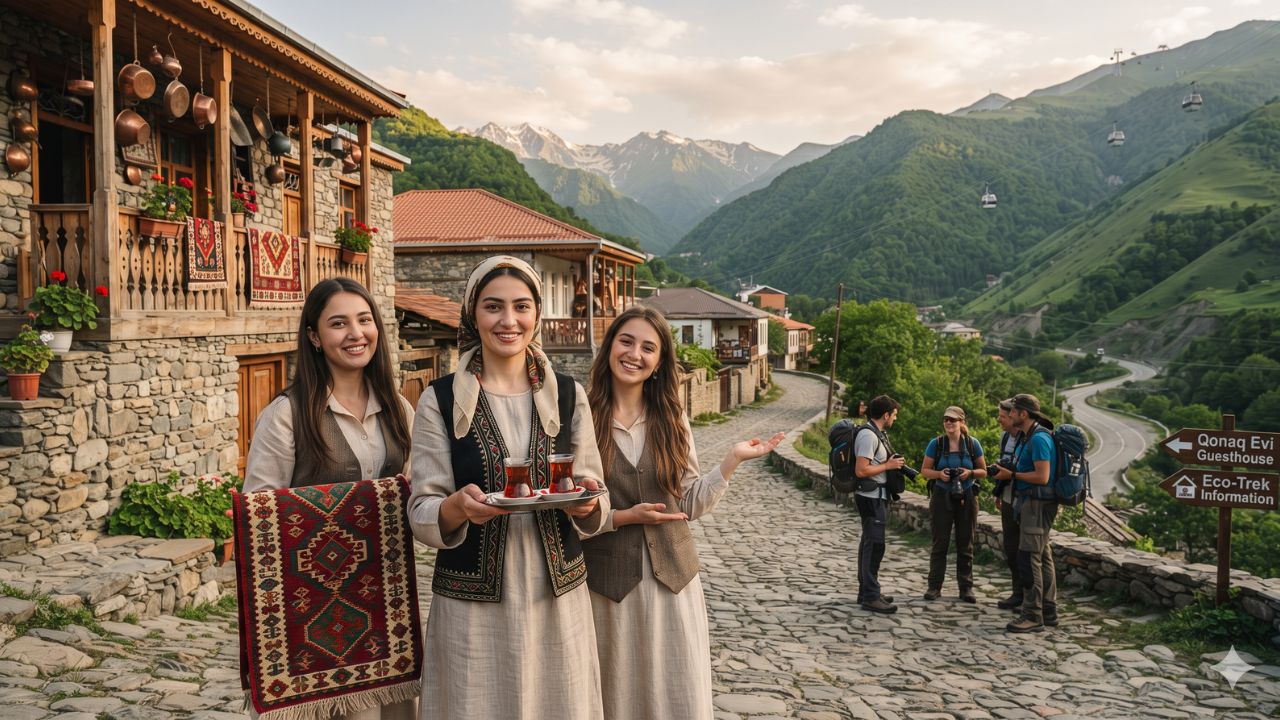
Image generated by AI
Projecting international arrivals to surge from 2.57 million to 3.8 million annually by 2030, Azerbaijan has initiated a comprehensive structural reallocation of tourism capital to channel global travelers beyond the capital of Baku. Backed by macroeconomic forecasts from the State Tourism Development Programme anticipating inbound foreign receipts to nearly double from 3.3 billion manats to 6.3 billion manats ($3.7 billion USD), the national blueprint targets a sustainable 5% to 7% annual revenue expansion across provincial districts. This initiative marks a definitive transition away from brief 3-to-4-day urban weekend breaks toward high-yield, multi-day regional cultural circuits, alpine sports hubs, and therapeutic health sanatoriums.
Decentralizing Infrastructure: Provincial Air Gateways and Digital Nomad Protocols
While Baku established global event credentials through high-capacity gatherings—including the 2011 Eurovision Song Contest, the Formula 1 Azerbaijan Grand Prix, and the COP29 climate conference in 2024—provincial connectivity has historically lagged. To rectify this operational imbalance, the State Tourism Agency of Azerbaijan is deploying route-development incentives to position secondary aviation facilities in Ganja, Gabala, Fuzuli, and Lankaran as direct international transit gateways. Accommodating scheduled low-cost carriers and foreign charter operations, these provincial hubs curtail domestic overland transfer journeys by 30% to 50%, allowing travelers arriving from Europe, Central Asia, and the Middle East to access the Greater Caucasus mountains without entering Baku.
In parallel, administrative access has been overhauled to lengthen visitor stay durations. Through the Official Azerbaijan e-Visa Portal, foreign travelers secure electronic travel authorizations via a standard 3-day turnaround for a $26 USD processing fee, or an expedited 3-hour processing channel for last-minute business and leisure itineraries. To capture location-independent professionals, authorities launched a dedicated Digital Nomad Visa framework. This policy allows remote workers to maintain residency in historical regional centers such as Shaki, Quba, and Lankaran, channeling foreign capital directly into local real estate and regional municipal service sectors.
These administrative reforms are paired with aviation route growth. Direct scheduled flight connections linking Brussels and Baku will commence four times weekly on May 8, 2027, unlocking a vital Western European feeder corridor.
Regional Asset Allocation and 2026–2030 Macroeconomic Growth Targets
The national master plan directs targeted funding into specialized geographic niches, ensuring that provincial investments correspond to distinct traveler demographics.
The table below outlines the core economic pillars, regional development corridors, and projected performance targets governing Azerbaijan's travel sector through 2030.
| Development Sector | Target Geographic Hubs | Key Infrastructure & Policy Assets | Baseline Metric (2026) | 2030 Projected Milestone |
|---|---|---|---|---|
| Inbound Tourism Volume | Nationwide / Provincial Gateways | Ganja, Gabala, Fuzuli, Lankaran airports | 2.57 million annual arrivals | 3.80 million annual arrivals |
| Foreign Exchange Receipts | National Economy / Rural Supply Chains | Digital Nomad Visas & extended stays | 3.3 billion manats | 6.3 billion manats ($3.7B USD) |
| Alpine & Winter Sports | Shahdag & Tufandag Resorts | 5-Year FIS World Cup accord; 4,000m peaks | Seasonal winter ski traffic | Year-round four-season eco-hub |
| Cultural & Heritage Tourism | Quba (Red Settlement), Helenendorf, Basgal | 2-star & 3-star micro-grants; homestay codes | 3 to 4-day urban stopovers | 60% revenue retention in villages |
| Viticulture & Agro-Tourism | Ismayilli, Gabala, Ganja Valleys | Madrasa & Bayanshira native grape routes | Standard dining spend | +20% to +35% daily spend lift |
| Therapeutic Medical Travel | Naftalan, Galaalti, Lankaran Springs | Naphthalene crude oil clinics & thermal spas | Regional CIS medical travel | 10 to 14-day average stays |
| Trans-Caucasus Corridors | Silk Road routes via Georgia & Armenia | Coordinated borders; joint Caucasus circuits | Fragmented single-country trips | 12 to 14-day multi-nation packages |
In high-altitude alpine zones, a five-year international agreement executed with the International Ski and Snowboard Federation (FIS) brings top-tier competitions to Shahdag Mountain Resort, highlighted by the FIS World Cup freestyle mogul finals scheduled for March. By expanding snow-making installations, modernizing lift networks, and constructing downhill trails across peaks reaching 4,000 meters, Shahdag and Tufandag are actively positioning themselves as reliable four-season outdoor recreational centers offering mountain biking, paragliding, and guided trekking throughout summer.
Expert Analysis: Supply Chain Localization, Yield Dynamics, and Cross-Border Caucasian Circuits
For travelers booking this route, the direct consequence of regional decentralization is a substantial reduction in internal transit friction and access to authentic provincial accommodations. Historically, international itineraries were heavily centralized: tourists stayed in five-star Baku hotel towers and embarked on arduous, single-day overland excursions to Shaki or Quba before returning to the capital. The expansion of regional airport gateways combined with state-backed 2-star and 3-star hotel investments establishes viable overnight nodes, enabling tour operators to craft comprehensive point-to-point itineraries.
The pricing pressure this creates means commercial tour operators can deliver competitive pricing by sourcing services directly from regional suppliers. Under grassroots hospitality programmes implemented in mountain villages like Basgal and Sim, state micro-grants assist local homeowners in converting ancestral stone dwellings into certified guesthouses. This decentralized operational structure guarantees that up to 60% of total tourist expenditure remains directly within host communities, preventing economic leakage back into capital conglomerates while shielding rural communities from seasonal income volatility.
In the agricultural valleys of Ismayilli and Gabala, viticulture trails celebrating native Madrasa and Bayanshira grape cultivars—cultivated alongside 19th-century German winemaking traditions rooted in settlements like Helenendorf—are linked directly to artisan silk workshops and regional apiaries. This integrated experiential framework increases average daily tourist expenditure by 20% to 35% across rural districts.
Concurrently, specialized medical tourism anchored by Naftalan’s therapeutic crude oil clinics provides extraordinary economic stability. Guests seeking treatment for complex dermatological and musculoskeletal disorders maintain extended average stays of 10 to 14 days, generating consistent lodging occupancy and high per-capita spending that insulates the national tourism balance sheet against seasonal leisure dips.
On a broader geopolitical scale, regional normalization across the South Caucasus is facilitating joint 12-to-14-day multi-country itineraries encompassing Azerbaijan, Georgia, and Armenia. By integrating shared Silk Road architectural landmarks, ancient places of worship—such as Quba’s historic red-roofed Jewish settlement of Krasnaya Sloboda alongside regional mosques and churches—and varied mountain topographies into a unified booking flow, regional operators are dramatically increasing destination competitiveness across long-haul markets in North America, East Asia, and Western Europe.
Key Takeaways
- 3.8 Million Visitor Goal by 2030: The State Tourism Development Programme projects international arrivals to rise from 2.57 million to 3.8 million, generating 6.3 billion manats ($3.7B USD) in foreign receipts.
- Provincial Air Hub Modernization: Direct international charter and budget carrier routes through Ganja, Gabala, Fuzuli, and Lankaran reduce ground travel times by 30% to 50%.
- Simplified Administrative Access: The standard e-Visa costs $26 USD with a 3-day turnaround, while urgent 3-hour e-Visas and a dedicated Digital Nomad Visa accommodate remote workers.
- Winter Sports Global Alignment: A five-year partnership with FIS secures elite winter events at Shahdag, including the World Cup freestyle mogul finals in March across peaks reaching 4,000 meters.
- Grassroots Community Revenue Model: Targeted micro-grant assistance for rural homestays ensures up to 60% of foreign traveler spending remains within local village economies.
FAQ: Azerbaijan Regional Travel 2026
How much does the official Azerbaijan e-Visa cost and how long does it take?
The standard electronic visa costs $26 USD and processes within three business days. An expedited urgent e-Visa option is available for last-minute travelers with a guaranteed 3-hour turnaround.
What are the main regional airports for direct international flights?
In addition to Baku's Heydar Aliyev International Airport, international travelers can utilize regional gateways in Ganja, Gabala, Fuzuli, and Lankaran to reach provincial destinations directly.
What unique treatments are offered in Naftalan?
Naftalan specializes in therapeutic treatments using natural, locally extracted crude naphthalene oil, medically supervised to treat chronic musculoskeletal, dermatological, and rheumatic conditions across 10-to-14-day courses.
Can tourists visit Georgia and Azerbaijan on the same trip?
Yes, international tour operators regularly offer unified 12-to-14-day South Caucasus itineraries combining cultural and mountain destinations across Azerbaijan, Georgia, and Armenia under streamlined regional travel arrangements.
International travelers exploring the Caucasus should look beyond capital city breaks to experience the rich regional corridors, thermal spas, and alpine resorts transforming Azerbaijan.
Related Travel Guides
The 10 Best Silk Road Destinations in the Caucasus, According To Reddit
Disclaimer
This article is for informational and educational purposes only. It does not constitute legal, financial, or professional advice. While we strive to provide accurate and up-to-date information, travel policies, regulations, and conditions change rapidly. Always verify information with official sources before making travel decisions. Nomad Lawyer makes no representations about the accuracy, reliability, completeness, or suitability of the information provided. Readers should consult qualified professionals for advice specific to their circumstances. The views expressed in this article are those of the author and do not necessarily reflect the views of Nomad Lawyer.
Raushan Kumar
Founder & Lead Developer
Full-stack developer with 11+ years of experience and a passionate traveller. Raushan built Nomad Lawyer from the ground up with a vision to create the best travel and law experience on the web.
Learn more about our team →