
Austria and Kyrgyzstan Forge Alpine Tourism Alliance to Elevate Central Asian Hospitality

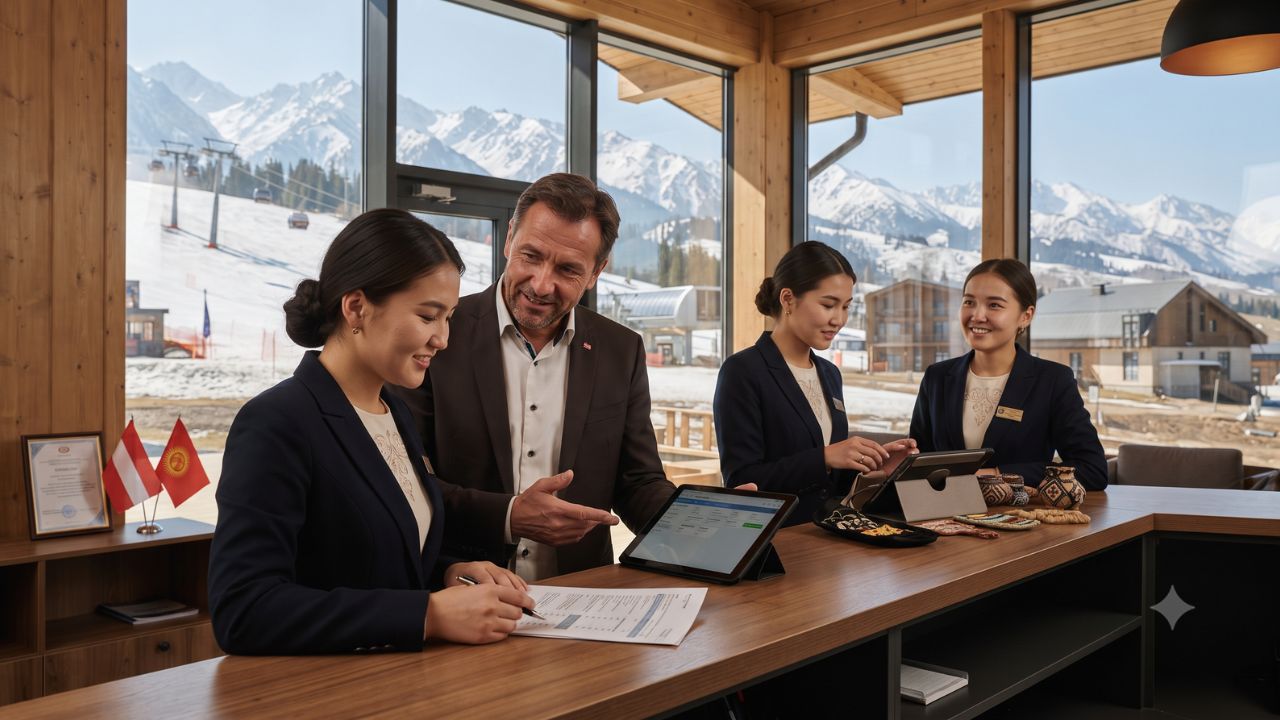
Adapting Austria’s dual vocational education framework—which trains 7,150 apprentices and 7,230 students across 26 specialized tourism colleges through an 80-to-20 workplace-to-classroom ratio—Kyrgyzstan is overhauling its hospitality and mountain resort workforce to anchor major alpine developments across Central Asia. On 13 October 2026, Kyrgyzstan’s Minister of Education, Dogdurkul Kendirbaeva, met with senior delegates from the Austrian Agency for Economic Cooperation and Development to formalize curriculum standards, technical instructor exchanges, and employer demand assessments. As the Central Asian republic transitions from seasonal summer trekking toward year-round winter sports tourism, the bilateral initiative aims to address a long-standing structural deficit: the gap between capital-intensive resort construction and the shortage of certified hospitality, ropeway, and mountain rescue personnel.
The educational partnership represents the culmination of a multi-stage diplomatic engagement throughout 2026. Following preliminary technical talks in January, a high-level Kyrgyz delegation visited Austrian alpine centers in April to study ropeway mechanics, ski school administration, and professional certification frameworks. By 1 October 2026, an Austrian parliamentary friendship delegation finalized a bilateral agreement establishing a dedicated joint working group to coordinate institutional projects. These milestones set the stage for systemic workforce reforms, positioning the Issyk-Kul lake and mountain basin as a primary testbed for European-standard hospitality delivery.
Institutional Architecture: The Austrian Dual Model and Ak-Suu Lyceum
The operational cornerstone of Kyrgyzstan's hospitality modernization is the Ak-Suu Republican Innovative Tourism Vocational Lyceum, situated in the Ak-Suu district of the Issyk-Kul region. Having inaugurated its first academic year on 16 September 2026, the lyceum delivers practical vocational tracks tailored directly to alpine operations: international hotel front-office administration, culinary management, ski resort logistics, mechanical lift maintenance, and alpine rescue protocols.
To upgrade instructional rigor, education authorities selected Austria's prestigious Klessheim Tourism College (Tourismusschule Klessheim) near Salzburg as the primary institutional benchmark. Recognized by UN Tourism for vocational excellence, Klessheim’s pedagogical model balances classroom theory with immersive industry apprenticeships. Under the proposed adaptation, Kyrgyz students will spend up to 80 percent of their educational cycle embedded in active resort properties, guest houses, and mountain facilities, returning to the classroom for focused 20 percent theoretical blocks covering guest psychology, foreign languages, and administrative finance.
| Cooperative Pillar | Austrian Benchmark System | Kyrgyz Implementation Target | Core Operational Discipline | Strategic Horizon & Status |
|---|---|---|---|---|
| Vocational Model | Dual Education (80% Work / 20% School) | Ak-Suu Republican Tourism Lyceum | Practical hospitality, culinary, guest logistics | Academic year launched 16 September 2026 |
| Institutional Standard | Klessheim Tourism College (Salzburg) | Curriculum benchmarking & teacher training | Hotel operations, front-desk management | Working group established 1 October 2026 |
| Winter Sports & Safety | Austria Snowsports Academy | Issyk-Kul regional ski schools | Ski instruction, mountain rescue, avalanche control | Bilateral technical review on 13 October 2026 |
| Ropeway Operations | Doppelmayr alpine engineering standards | Ala-Too Resort cableway infrastructure | Gondola maintenance, aerial lift inspection | Technical exchange initiated in April 2026 |
| Aviation Connectivity | Vienna International Airport (VIE) Hub | Manas International Airport (FRU), Bishkek | Direct scheduled bilateral passenger flights | Intergovernmental air agreement drafting |
The curriculum modernization also addresses winter sports safety. Concurrently on 13 October 2026, Kyrgyz sports authorities held targeted negotiations with the Austria Snowsports Academy. Austrian winter sports specialists were commissioned to inspect terrain and facilities in Issyk-Kul, laying the groundwork for standardized ski instructor licensing and technical certifications that align with international alpine safety codes.
Resort Infrastructure and Air Access: From Ala-Too to Vienna Flights
The urgency driving this educational alliance stems from extensive infrastructure investments in the Tian Shan mountain range, headlined by the flagship Ala-Too Resort development in Ak-Suu. Engineered to rival established regional winter hubs, Ala-Too Resort requires hundreds of technicians trained in computerized ropeway management, groomer fleet operations, slope safety, and luxury lodging management. Without localized technical talent, resort operators would remain dependent on expensive foreign expatriate contractors, driving up operating overheads.
Recognizing that international tourism viability depends on transport access, bilateral talks expanded into civil aviation. On 1 October 2026, transport officials from both nations initiated formal drafting sessions for an intergovernmental air services agreement. The treaty will establish the legal architecture required to launch direct commercial flights between Vienna International Airport (VIE) and Bishkek’s Manas International Airport (FRU).
Connecting the two capital cities via scheduled air services provides a direct gateway for Austrian mountain technology providers, resort investors, and European travelers seeking backcountry skiing in Central Asia. By linking mountain training with direct air service negotiations, the two governments are creating a synchronized commercial pipeline designed to attract European tourists to Issyk-Kul while sending Kyrgyz trainees to Austrian alpine establishments.
Expert Analysis: Overcoming the Central Asian Infrastructure-Service Asymmetry
Central Asia’s emerging adventure tourism sector has long suffered from a glaring operational contradiction: modern physical infrastructure undermined by inconsistent ground service. Governments and private developers across the region have successfully secured sovereign loans and private equity to build multi-million-dollar gondolas, contemporary alpine chalets, and international-standard ski runs. Yet, international visitor satisfaction frequently falters due to untrained service personnel, lack of multi-lingual concierge support, and unreliable emergency medical response systems.
For travelers booking this route, the direct consequence is a transition from unpredictable frontier travel to regulated, safety-certified alpine adventure. In mountain tourism, service delivery is directly tied to life safety: certified avalanche mitigation, professional ski patrol evacuation, and rigorous daily lift maintenance are non-negotiable requirements for travelers visiting from Western Europe, North America, and East Asia. By adopting Austrian ski school certifications and ropeway operating manuals, Kyrgyz resorts reduce liability risks and offer visitors verifiable safety assurances.
The pricing pressure this creates means that regional resort operators can command higher revenue yields per available room (RevPAR) while reducing operational waste. Properties in Issyk-Kul currently experience significant seasonal revenue swings, closing during winter months due to a lack of cold-weather offerings. By developing winter sports capabilities through the Ala-Too project, operators establish year-round cash flows. As service quality meets international luxury thresholds, resorts can justify premium winter pricing tiers, elevating overall tourism receipts without over-saturating delicate alpine ecosystems.
However, bilateral negotiators must resolve outstanding regulatory hurdles. Establishing the Ak-Suu Lyceum is only the opening step; formal mutual recognition of vocational diplomas between Austria and Kyrgyzstan remains pending. Without accredited certification recognized across the European Union, Kyrgyz graduates cannot easily access seasonal training placements in Austria. Ensuring that curricula comply with European educational frameworks will determine whether this initiative creates a sustainable talent pipeline or remains an isolated regional project.
Key Takeaways
- Austrian Dual Model Adoption: Kyrgyzstan is restructuring its tourism training on Austria’s 80/20 vocational framework, which supports 7,150 apprentices and 7,230 students across 26 Austrian colleges.
- Ak-Suu Lyceum Milestone: The Ak-Suu Republican Innovative Tourism Vocational Lyceum launched its first academic year on 16 September 2026, specializing in hotel management, ropeway maintenance, and mountain rescue.
- Ala-Too Resort Anchor: Educational reforms are designed to staff the massive Ala-Too Resort development in the Ak-Suu district of the Issyk-Kul region.
- Direct Air Service Treaty: On 1 October 2026, officials advanced preparations for an intergovernmental air services agreement to enable future direct flights between Bishkek (FRU) and Vienna (VIE).
- Snowsports Safety Integration: Kyrgyz sports authorities met with Austria's Snowsports Academy on 13 October 2026 to standardize ski instructor certification and slope safety.
FAQ: Austria-Kyrgyzstan Tourism and Hospitality Partnership 2026
What is the Austrian dual education system being introduced in Kyrgyzstan?
The Austrian model combines approximately 80 percent practical on-the-job training in hotels and resorts with 20 percent theoretical classroom study in vocational schools.
What subjects does the Ak-Suu Tourism Lyceum teach?
The lyceum trains students in hotel operations, culinary arts, ski resort logistics, ropeway mechanical maintenance, avalanche safety, and mountain rescue.
Will there be direct flights between Vienna and Bishkek?
Austrian and Kyrgyz officials are preparing an intergovernmental air services agreement to provide the legal basis for future non-stop commercial flights connecting Vienna and Bishkek.
Why is Austria partnering with Kyrgyzstan on winter sports?
Both nations possess mountainous topographies; Austria shares its world-leading alpine expertise in ski instruction, lift engineering, and hospitality management to help develop Kyrgyzstan’s winter resort economy.
[By fusing Austrian alpine discipline with Central Asian mountain potential, Kyrgyzstan is building the professional foundation needed to welcome the world to its peaks.]
Related Travel Guides
Disclaimer
This article is for informational and educational purposes only. It does not constitute legal, financial, or professional advice. While we strive to provide accurate and up-to-date information, travel policies, regulations, and conditions change rapidly. Always verify information with official sources before making travel decisions. Nomad Lawyer makes no representations about the accuracy, reliability, completeness, or suitability of the information provided. Readers should consult qualified professionals for advice specific to their circumstances. The views expressed in this article are those of the author and do not necessarily reflect the views of Nomad Lawyer.
Raushan Kumar
Founder & Lead Developer
Full-stack developer with 11+ years of experience and a passionate traveller. Raushan built Nomad Lawyer from the ground up with a vision to create the best travel and law experience on the web.
Learn more about our team →