
Austria and Germany Lead Alpine Tourism Revival with Royal Castles, Scenic Lakes, and Cross-Border Trails in 2026
Bavaria and Austria recorded over 159 million collective overnight stays through August 2026 as UNESCO-listed royal castles, electric lake fleets, and direct Munich-Innsbruck rail links drive an integrated Alpine travel corridor.

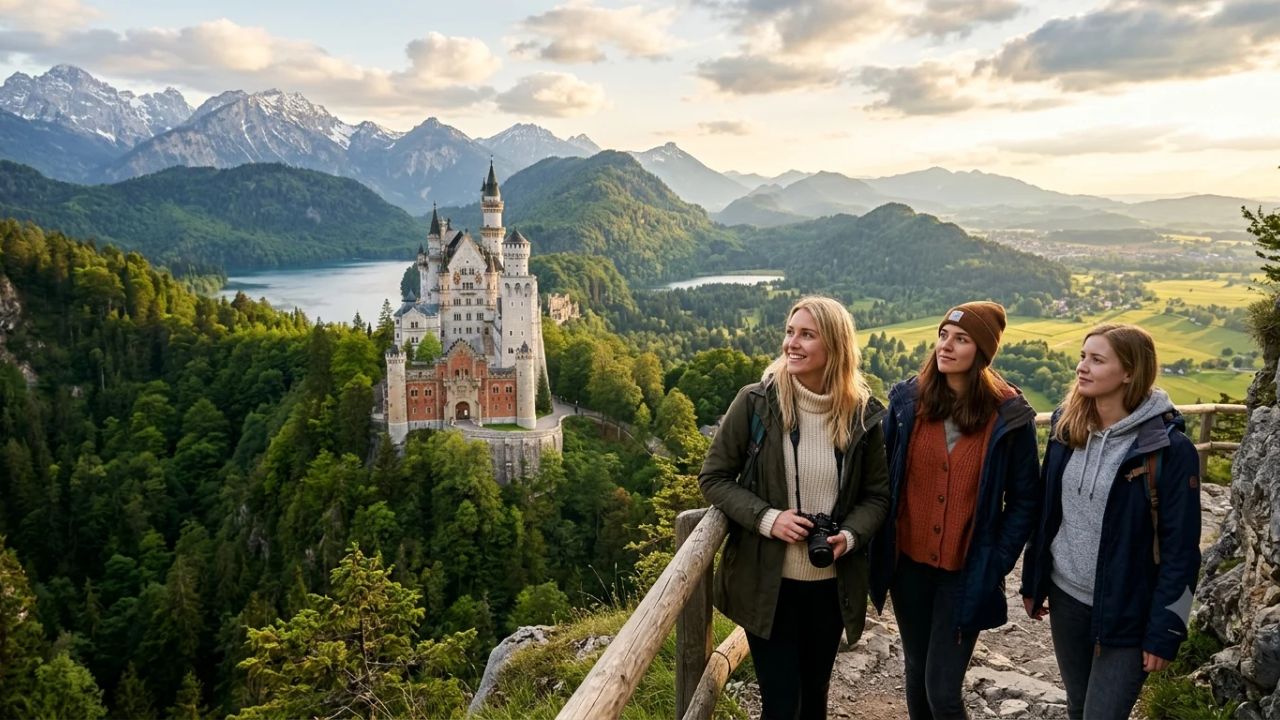
Cross-border Alpine tourism across southern Germany and western Austria surged through the summer of 2026, generating more than 159 million collective overnight stays as international travelers increasingly combined Bavaria’s newly inscribed UNESCO royal palaces with the high-altitude trails, pristine lakes, and alpine villages of Tyrol.
Official figures compiled by national and provincial statistical agencies reveal an integrated European mountain corridor operating at peak demand. Non-resident visitors logged 88.79 million overnight stays in Austria between January and August 2026, while the German federal state of Bavaria registered 70.7 million total overnights across the same eight-month stretch. Bolstered by direct high-speed rail corridors linking Munich with Innsbruck in under two hours, regional travel is transcending national borders, creating a unified itinerary model that blends cultural heritage, clean-mobility lake navigation, and mountain adventure.
The Dual Alpine Engine: 2026 Overnight Stays and Regional Scale
The Alpine tourism economies of Germany and Austria represent two of Europe’s most durable outdoor travel markets. Rather than competing directly, the two territories increasingly function as mutual feeders, with cross-border transit reaching historic highs.
                     CENTRAL ALPINE TOURISM METRICS (JANUARY–AUGUST 2026)
  ========================================================================================
  Destination / Metric             Total Volume         YoY Trend       Primary Driver
  ----------------------------------------------------------------------------------------
  Austria Inbound Overnights          88.79M              +1.9%         Germany, NL, Czechia
  Austria Total Overnights           117.89M              +1.5%         75% Foreign Share
  Austria Inbound Arrivals            24.74M              +3.2%         Strong Summer Peaks
  Bavaria Total Overnights            70.70M              +1.4%         Domestic + Alpine Trips
  Bavaria Total Guest Arrivals        28.20M              +1.8%         Heritage & Lakes
  Germany Nationwide Foreign Stays    47.10M (Jan-Jul)    +1.0%         Urban + Southern Alps
  Tyrol Peak August Overnights         6.47M              +0.1%         Peak Hiking Season
  ========================================================================================
Data from Statistics Austria (Statistik Austria) highlights that non-resident travelers accounted for nearly three-quarters of all accommodation bookings nationwide. Germany cemented its position as Austria's single largest international source market, generating 43.89 million overnight stays—nearly half of all foreign nights spent in Austrian hotels, chalets, and alpine huts.
The Netherlands followed with 9.40 million nights, while the Czech Republic emerged as Austria's fastest-growing European market, surging 10.6% year-on-year to 3.59 million nights. Switzerland and Liechtenstein contributed a steady 3.05 million overnights.
Across the northern border, the Bavarian State Office for Statistics (Bayerisches Landesamt für Statistik) reported that Bavaria welcomed 28.2 million guest arrivals through August. Notably, August camping arrivals climbed 4.1% and camping overnight stays jumped 4.4% year-on-year, illustrating a discernible structural shift toward nature-immersed, outdoor-centric accommodations.
Royal Heritage: King Ludwig II’s UNESCO Castles Reshape Bavarian Travel
A primary catalyst for international interest in the Bavarian Alps has been the formal inscription of King Ludwig II's royal palaces onto the UNESCO World Heritage Centre list. Inscribed under the title of The Palaces of King Ludwig II of Bavaria: Neuschwanstein, Linderhof, Schachen and Herrenchiemsee, this collection represents a masterpiece of 19th-century romantic historicism seamlessly embedded into jagged mountain topographies.
THE FOUR UNESCO ROYAL PALACES OF KING LUDWIG II
| Column 1 |
|---|
| 1. Neuschwanstein Castle (Schwangau) |
| * Dramatic cliffside fairytale fortress overlooking the Alpsee and Allgäu plains |
| 2. Linderhof Palace & Park (Graswang Valley, Ettal) |
| * Intricate Rococo jewel with formal baroque gardens and the Venus Grotto |
| 3. King's House on Schachen (Wetterstein Massif, 1,866m) |
| * Alpine retreat accessible only via a three-to-four-hour high-altitude hike |
| 4. Herrenchiemsee New Palace (Lake Chiemsee Island) |
| * Monumental island residence modeled directly after the Palace of Versailles |
Travelers visiting the royal circuit frequently pair these UNESCO sites with neighboring cultural landmarks, including the childhood seat of Hohenschwangau Castle, the UNESCO-recognized Rococo Wies Church (Wieskirche) in Steingaden, and the 14th-century Benedictine Ettal Abbey.
Glacial Panoramas and Clean Lakes: Germany's High-Altitude Nature Corridor
Complementing royal architecture is Germany's natural playground, stretching from the Wetterstein Range to the limestone massifs of Berchtesgaden National Park.
| Outdoor Destination | Elevation / Geographic Feature | Signature Experience | Practical Access Note |
|---|---|---|---|
| Zugspitze | 2,962 m (Germany’s Highest Peak) | 360° panoramic view spanning 400 Alpine peaks | Zugspitze Cable Car & rack railway from Eibsee |
| Lake Eibsee | 973 m (Foot of Zugspitze) | 7.1 km turquoise lakeshore walking circuit | Heavy mid-day parking demand; rail recommended |
| Lake Königssee | 603 m (Berchtesgaden Alps) | Fjord-like waters flanked by Watzmann cliffs | Quiet electric passenger boat transit to St. Bartholomä |
| Lake Obersee | 613 m (Enclosed Alpine Cirque) | Mirror reflections and Röthbach Waterfall trek | Seasonal boat connection via Salet dock |
| Hintersee & Zauberwald | 789 m (Ramsau bei Berchtesgaden) | Romantic painter's trail through ancient rockfall forest | Year-round accessible circular trail |
| Jenner Mountain | 1,874 m (Overlooking Königssee) | High-angle bird’s-eye vistas of Königssee fjord | Modern 10-seater panoramic gondola system |
A benchmark of ecological stewardship is evident at Lake Königssee, where a fleet of 18 quiet, all-electric passenger boats has operated since 1909, preserving water clarity and acoustic tranquility within Germany’s only Alpine national park.
Tyrol’s Outdoor Dominance: Historic Towns and Valleys
Directly across the Austrian frontier, the province of Tyrol solidified its reputation as the summer capital of the Eastern Alps. During August 2026 alone, Tyrol registered 6,473,672 overnight stays and over 1.7 million guest arrivals, according to final tallies from Statistics Austria.
Tyrol’s appeal centers on the interplay between sophisticated alpine urbanism and preserved rural architecture:
- Innsbruck and the Nordkette: The Tyrolean capital combines imperial Habsburg landmarks—such as the Golden Roof (Goldenes Dachl) and the Hofburg—with the Zaha Hadid–designed Hungerburgbahn funicular, which carries passengers from the historic city center to the 2,256-meter Hafelekar ridge in under 30 minutes.
- Alpbach Valley: Celebrated as one of Austria's most picturesque settlements, Alpbach enforces strict traditional building codes requiring all multi-story homes and guesthouses to feature traditional wooden upper facades and carved balconies, safeguarding cultural identity.
- Reutte and the Zugspitze Arena: Providing immediate access to the Austrian side of the Zugspitze via the Tyrolean Zugspitze Cable Car in Ehrwald, this region offers deep-blue aquatic escapes at Plansee and the forested shores of Blindsee near Biberwier.
- Seefeld and Leutasch: Positioned on an expansive high plateau, this area caters to long-distance hikers and gravel cyclists navigating the Wetterstein and Karwendel nature reserves.
Seamless Connectivity: Railways and Regional Aviation
The fluidity of modern Alpine travel rests on synchronized cross-border infrastructure managed cooperatively by Germany's Deutsche Bahn (DB) and Austria's Federal Railways (ÖBB).
Direct EuroCity (EC) and InterCity (IC) trains run between Munich Central Station (München Hbf) and Innsbruck Central Station (Innsbruck Hbf) with scheduled journey times of approximately 1 hour and 54 minutes. Bypassing congested Alpine highway passes such as the A8 motorway and the Fern Pass, these rail corridors allow travelers to breakfast overlooking Bavarian castles and hike Tyrolean ridges before late afternoon.
Regional aviation data across July and August 2026 further illustrates how travelers tailored their arrivals to specific mountain gateways:
  AIRPORT TRAFFIC COMPARISON: EASTERN & TYROLEAN GATEWAYS (JULY–AUGUST 2026)
  ========================================================================================
  Airport Gateway             Summer 2026 Passengers     YoY Growth Rate    Strategic Role
  ----------------------------------------------------------------------------------------
  Innsbruck Airport (INN)            78,979                  +5.6%          Tyrol Direct Hub
  Salzburg Airport (SZG)            ~400,000                 +8.9%          Salzkammergut Hub
  Austria's Top 6 Airports            ~7.00M                 −5.1%          National System
  ========================================================================================
While Austria's overall commercial aviation throughput dipped by 5.1% due to carrier adjustments at Vienna (VIE), dedicated Alpine hubs bucked the trend. Innsbruck Airport grew 5.6% and Salzburg Airport rose 8.9%, underscoring strong summer demand for point-to-point seasonal flights from Britain, Scandinavia, and the Low Countries.
Sustainable Cross-Border Itinerary Design for Travelers
As sustainability and extended-stay travel gain traction across Europe, destination marketing bodies coordinated by the German National Tourist Board (GNTB) recommend multi-stop, low-carbon itineraries that integrate public transit:
- The Royal Rail Route (5 to 7 Days): Munich $\rightarrow$ Murnau $\rightarrow$ Garmisch-Partenkirchen (Zugspitze and King's House on Schachen) $\rightarrow$ Mittenwald $\rightarrow$ Innsbruck $\rightarrow$ Alpbach.
- The Lakes and Fjord Loop (4 to 6 Days): Salzburg $\rightarrow$ Berchtesgaden (Königssee and Jenner) $\rightarrow$ Bad Reichenhall $\rightarrow$ Lake Chiemsee (Herrenchiemsee Palace) $\rightarrow$ Munich.
- The High-Pass Trekker Circuit (7 to 10 Days): Ehrwald (Zugspitze Arena) $\rightarrow$ Plansee $\rightarrow$ Reutte $\rightarrow$ Füssen (Neuschwanstein and Hohenschwangau) $\rightarrow$ Pfronten.
By linking world-class architectural preservation with protected mountain ecosystems, Germany and Austria have established an Alpine tourism model that distributes visitor flow, supports independent hospitality operators, and offers travelers an enriching European mountain holiday.
Frequently Asked Questions
How many overnight stays did Austria and Bavaria record in 2026?
Between January and August 2026, Austria registered 117.89 million total overnight stays (including 88.79 million by international guests), while Bavaria recorded 70.7 million total overnights.
Which Bavarian royal castles received UNESCO World Heritage status?
Inscribed in 2025, the UNESCO property includes King Ludwig II's Neuschwanstein Castle, Linderhof Palace, Herrenchiemsee New Palace, and the King's House on Schachen.
How fast is the train between Munich and Innsbruck?
Direct EuroCity and InterCity train connections between Munich Central Station and Innsbruck Central Station take approximately 1 hour and 54 minutes.
Which country is Austria's largest international tourism source market?
Germany is Austria's top foreign market by a wide margin, contributing 43.89 million overnight stays during the first eight months of 2026.
Related Travel Guides
- Germany Alongside Argentina and US Propels Spain's Off-Peak Tourism Through Luxury, Culture and Wellness
- France and Spain Outpace Global Tourism with Nearly 200 Million Visitors and All-Season Magnetism
- German Holiday Revenue Soars as Greece, Egypt, and Türkiye Lead Mediterranean Summer Tourism Surge
Disclaimer
This article is for informational and educational purposes only. It does not constitute legal, financial, or professional advice. While we strive to provide accurate and up-to-date information, travel policies, regulations, and conditions change rapidly. Always verify information with official sources before making travel decisions. Nomad Lawyer makes no representations about the accuracy, reliability, completeness, or suitability of the information provided. Readers should consult qualified professionals for advice specific to their circumstances. The views expressed in this article are those of the author and do not necessarily reflect the views of Nomad Lawyer.
Naina Thakur
Contributor & Travel Specialist
Travel enthusiast and legal writer covering visa regulations, responsible tourism, and cultural journeys across global destinations.
Learn more about our team →