
Asia Aviation Network Crippled: Massive Delays Hit Transit Hubs from Tokyo to Jakarta
The Asian aviation super-grid faces a massive operational meltdown as severe weather and overcapacity trigger thousands of flight delays across Japan, Thailand, China, and Singapore.

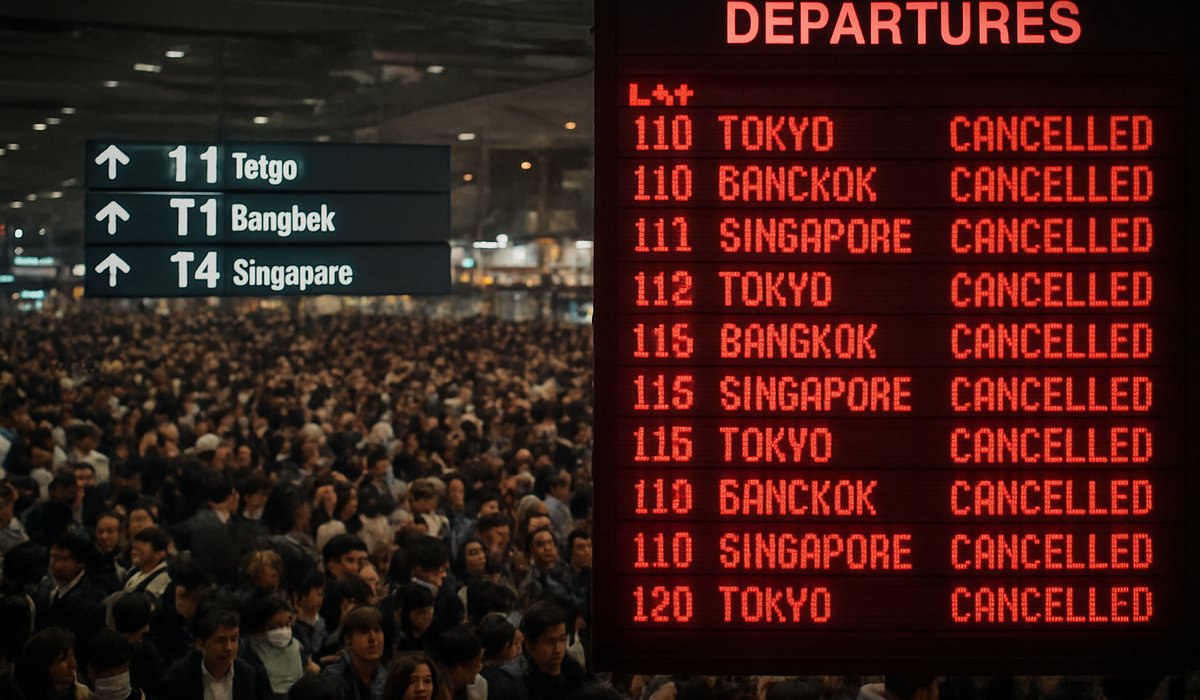
Image generated by AI
Severe Hub Compression Traps Trans-Pacific Travelers
Exposing critical vulnerabilities in the rapidly expanding trans-continental aviation network, the primary aerospace hubs radiating across Eastern and Southeastern Asia have suffered a colossal operational breakdown, registering over 3,250 immediate delays and localized cancellations in a single 36-hour operational window. Heavily choking critical international gateways in Japan, Thailand, Singapore, China, Hong Kong, and Indonesia, the friction has forcefully trapped hundreds of thousands of international tourists and corporate commuters on the tarmac.
The disruption acts as a violent equalizer, completely sparing no legacy carrier. Aviation titans including Japan Airlines (JAL), Cathay Pacific, Air China, and Air India are currently battling deeply compounded delays. When a massive super-hub like Singapore Changi or Tokyo Haneda suffers a capacity compression—driven by severe seasonal monsoons clashing with historically high post-pandemic flight scheduling—the cascading ripple effect instantly destroys international connecting itineraries from London to Los Angeles.
The Domino Effect on Legacy Carriers
Unlike the American domestic market where a stranded passenger can conceptually rent a car or take a train to reach an alternative hub, the Asian aviation map relies heavily on deep, oceanic wide-body routes.
When a massive Cathay Pacific Boeing 777 is delayed departing Hong Kong due to a localized typhoon cell, it subsequently misses its highly restrictive landing slot in Tokyo. Passengers connecting onto Air India or Japan Airlines to traverse the Pacific are subsequently stranded in the transit terminal overnight, as these carriers simply do not possess spare multi-million dollar wide-body aircraft to execute rapid recovery flights.
Analyzing the Asian Aviation Shockwave
| Affected Mega-Hub | Primary Factor | Critical Consequence |
|---|---|---|
| Tokyo (HND/NRT) | Pacific jet-stream friction | Total gridlock on North American trans-Pacific routing |
| Hong Kong (HKG) | Cathay Pacific rotation delays | Severe regional mainland China connection failures |
| Singapore (SIN) | Equatorial storm compression | European-Australian "Kangaroo Route" heavily severed |
What Guests Get
- Global transit awareness — understanding that a localized thunderstorm over Jakarta can mathematically cause your flight from London to Sydney to be delayed by twelve hours in Singapore.
- Aircraft limitation reality — realizing that while short-haul budget flights can be easily recovered, a broken long-haul wide-body route often takes 48 hours to financially correct.
- Airport survival mechanics — establishing that being trapped in a premium Asian mega-hub (like Changi) is vastly superior to being trapped in typical Western airports due to extreme infrastructure.
What This Means for Travelers
If you possess an upcoming itinerary routing through Asia: You must violently maximize your layover padding. If you booked a "legal" 50-minute connection through Tokyo Narita or Hong Kong, you are mathematically doomed to miss your subsequent flight under the current delay grid. Proactively contact your airline immediately and negotiate a much longer, safer two-to-three-hour layover to absorb the inevitable delays radiating across the continent.
Understand Asian Passenger Rights: Do not expect the same consumer protections found in the EU. While the European Union enforces strict cash compensation (EU261) for delayed flights, Asian aviation law is highly fragmented by specific sovereign nations. If your flight is delayed due to weather, Cathay Pacific or Japan Airlines will generally provide hotel accommodations and meal vouchers for elite-status members, but fundamental cash reparations are exceedingly rare unless the failure was explicitly a localized mechanical error within the airline's total control.
FAQ: Navigating Asian Airport Delays
Is it safe to sleep in these major Asian airports if I miss my flight? Absolutely. Airports like Singapore Changi and Tokyo Haneda are globally celebrated as some of the safest, most luxurious transit hubs on earth, featuring free movie theaters, deep transit hotels, and massive secure zones explicitly designed for stranded global travelers.
Will I lose my baggage if my connection is severed? If you are flying on a single, unified ticket (e.g., London to Sydney via Singapore on a partner airline like KLM), your deeply delayed luggage will definitively be forwarded to your final destination automatically. Do not attempt to exit security in Tokyo to retrieve your bags.
Why are delays in Asia worse than in Europe? Asia relies predominantly on massive wide-body (twin-aisle) aircraft to cover the immense geographic distances between hubs. Moving 350 passengers onto a backup aircraft is vastly more complex and time-consuming than rebooking a 150-seat narrow-body jet in Europe.
Related Travel Guides
Disclaimer
This article is for informational and educational purposes only. It does not constitute legal, financial, or professional advice. While we strive to provide accurate and up-to-date information, travel policies, regulations, and conditions change rapidly. Always verify information with official sources before making travel decisions. Nomad Lawyer makes no representations about the accuracy, reliability, completeness, or suitability of the information provided. Readers should consult qualified professionals for advice specific to their circumstances. The views expressed in this article are those of the author and do not necessarily reflect the views of Nomad Lawyer.
Raushan Kumar
Founder & Lead Developer
Full-stack developer with 11+ years of experience and a passionate traveller. Raushan built Nomad Lawyer from the ground up with a vision to create the best travel and law experience on the web.
Learn more about our team →