
Grand Canyon North Rim Tourism Collapses 54%: Wildfire Destruction, Flooding, and the $1.5M Gateway Crisis
Grand Canyon North Rim vehicle traffic plummeted 54% through August 2026 as the destruction of Grand Canyon Lodge and deadly August floods paralyzed tourism across northern Arizona.

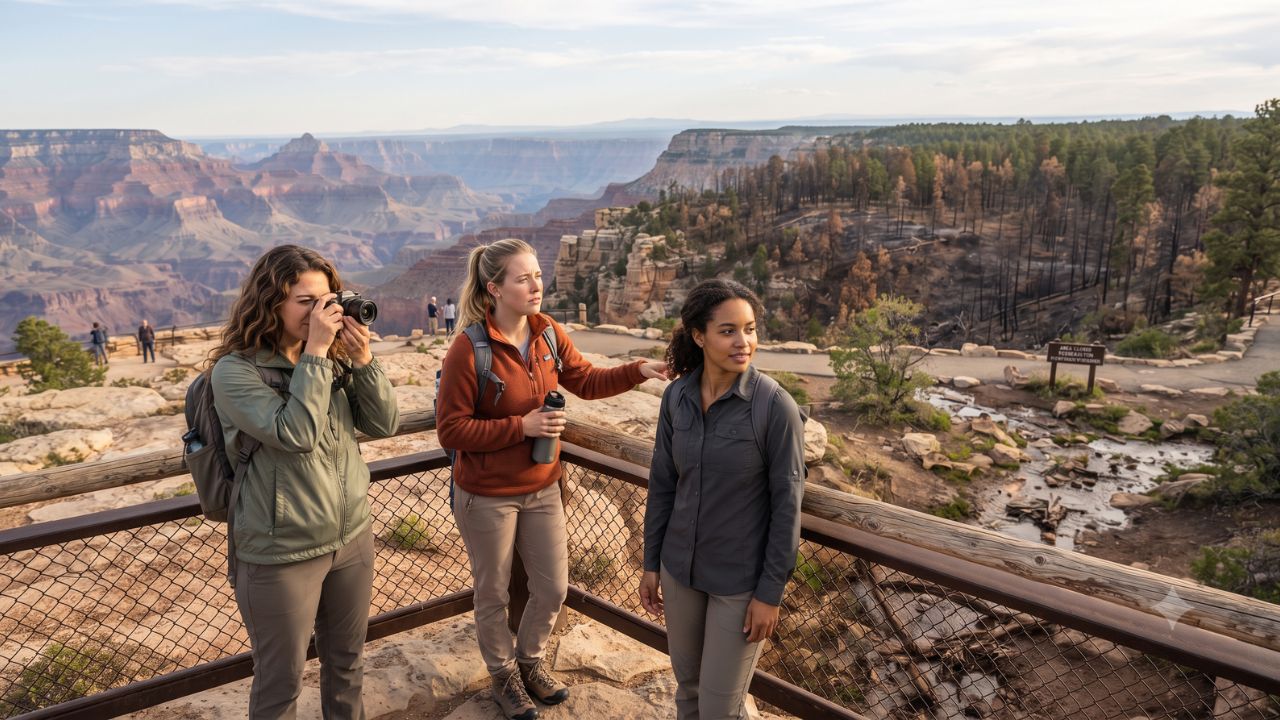
A catastrophic 54% plunge in vehicle traffic into the Grand Canyon’s North Rim between May and August 2026 compared to 2024 levels reveals the devastating economic and structural toll of the 150,000-acre Dragon Bravo Fire and deadly late-summer flash floods. Official National Park Service (NPS) visitor records detail an unprecedented operational retreat across the remote northern plateau, where the total destruction of the historic Grand Canyon Lodge alongside 97 surrounding structures has eliminated in-park hotel accommodations, reduced dining options, and triggered millions of dollars in losses across gateway communities in Arizona and southern Utah.
The physical crisis intensified dramatically on 29 August 2026, when a catastrophic flash flood tore through Bright Angel Canyon, claiming three lives, closing the critical North Kaibab Trail, and fracturing the Transcanyon Waterline that supplies potable water to both canyon rims. With federal agencies led by the U.S. Forest Service and park engineers managing water rationing, the disaster has disrupted multi-day rim-to-rim hiking itineraries and forced regional tour operators to haul drinking water into one of the premier natural wonders of the American West.
Dual Disaster Timeline: From 150,000-Acre Blaze to Lethal Canyon Floods
The collapse of the North Rim’s 2026 tourist season stems from consecutive climate disasters that overwhelmed park infrastructure in back-to-back years:
- The Dragon Bravo Wildfire: Ignited on 4 July 2025, the blaze burned through nearly 150,000 acres of high-altitude ponderosa pine and mixed conifer forests across the Kaibab Plateau before reaching containment nearly three months later. The fire gutted 98 historic structures, including the timber-and-stone Grand Canyon Lodge—the architectural and operational heart of the North Rim since 1928—destroying guest cabins, administrative offices, and surface water delivery pipes.
- Delayed and Compromised 2026 Reopening: While the North Rim highway access gates officially reopened on 15 May 2026 and the North Rim Campground welcomed campers on 1 June, zero permanent lodge rooms or cabin rentals operated inside the park throughout the season. The primary Visitor Center, permanent public restrooms, and sit-down dining rooms remained closed through October.
- The Bright Angel Canyon Flash Flood: Just as seasonal recovery efforts gained modest traction, torrential monsoonal rains on 29 August 2026 triggered massive debris flows through Bright Angel Canyon. The floodwaters killed three visitors, severed the North Kaibab Trail, and ruptured the Transcanyon Waterline, compromising South Rim water storage tanks and forcing park superintendents to impose Stage 4 water conservation rules.
The cascading operational impacts across Grand Canyon sectors and regional gateway corridors are outlined in the comparative performance matrix below:
| Park Sector or Commercial Entity | Baseline Function & Historic Role | Disruption Event & Damage Assessment | Operating Status (October 2026) | Economic & Passenger Consequence |
|---|---|---|---|---|
| North Rim Vehicle Entry | Main vehicular corridor to North Rim | 54% volume decline (May–Aug 2026 vs 2024) | Open under day-use restrictions | Sharp decline in self-drive tourists and regional visitor spending |
| Grand Canyon Lodge | Historic 1928 rim-edge lodging landmark | Completely destroyed by Dragon Bravo Fire | Closed indefinitely; public review launched 6 Oct | Complete loss of in-park hotel rooms; zero overnight lodge bookings |
| North Rim Facilities | Visitor Center, restaurants, restrooms | 98 historic structures destroyed or damaged | Core facilities shuttered; portable toilets deployed | Day visitors must self-supply food, water, and emergency gear |
| North Rim Campground | Primary plateau camping facility | Evacuated and damaged in 2025 wildfire | Reopened 1 June 2026 with limited services | Sole in-park overnight option; strict water limits enforced |
| North Kaibab Trail | Primary cross-canyon route (Rim-to-Rim) | Flash flood washouts on 29 August 2026 | Fully closed to all hikers and commercial mules | Rim-to-Rim backpacking suspended; hiking itineraries severed |
| Transcanyon Waterline | Cross-canyon pipeline supplying drinking water | Ruptured by 29 August flash flood debris | Active emergency pipeline repairs underway | South Rim under water conservation; water hauled into viewpoints |
| Jacob Lake Inn (Fredonia, AZ) | Historic gateway inn 45 miles north of rim | 3-week fire evacuation; $1.5M revenue loss | Open; lost 40 bookings within 24h of flood | Massive financial shortfall; cancellation wave from highway closures |
| Above and Beyond Tours | Guided Grand Canyon hiking operator | Booking drops across both rims; water shortages | Operating with independent water transport | Hauls potable water into park for commercial clients and guides |
| Grand Canyon River Outfitters | 16 commercial Colorado River operators | Tributary flash flooding & debris flow risks | Commercial river trips active with modified logistics | Heightened caution around canyon-bottom flash flood channels |
| South Rim Viewpoints | Mather Point, Yavapai Point, Desert View | Open but affected by pipeline water stress | Fully accessible for sightseeing | Absorbing diverted travelers; reduced concession facilities |
Gateway Economic Fallout: The $1.5 Million Deficit at Jacob Lake
The economic shocks of the North Rim closure have radiated along US Route 89A, impacting rural towns that rely on national park travelers. Jacob Lake Inn, a cornerstone family-run hotel near Fredonia, Arizona, situated 45 miles north of the canyon, suffered an estimated US$1.5 million revenue deficit between July 2025 and August 2026.
After enduring a mandatory three-week evacuation during the height of the Dragon Bravo Fire, the property faced a secondary cancellation shock following the 29 August flood, dropping 40 room reservations within 24 hours of the fatality reports. Similar cancellations spread north to Kanab, Utah, and east across the Navajo Nation, illustrating how national park infrastructure disruptions trigger immediate insolvency risks for regional hospitality businesses according to data tracked by the Arizona Office of Tourism.
Small business operators have had to overhaul logistics simply to keep tours running. Commercial guiding outfits like Above and Beyond Grand Canyon Tours reported softened bookings even for South Rim programs, requiring guides to transport external bulk drinking water tanks into park boundaries to compensate for damaged pipeline terminals.
Legislative Push: The North Rim Restoration Act and Public Comment
In response to the crisis, federal lawmakers moved to bypass bureaucratic procurement bottlenecks. Arizona Representative Eli Crane introduced the North Rim Restoration Act, which grants the National Park Service emergency contracting authority to fast-track debris clearing, utility restoration, and facility rebuilding.
The legislative progress of the bill reflects broad bipartisan recognition of the emergency:
- House Approval: Passed the US House of Representatives by voice vote in March 2026.
- Senate Committee Advancement: Advanced out of the Senate Energy and Natural Resources Committee on 30 September 2026.
- Statutory Bottleneck: As of mid-October 2026, the legislation awaits a full floor vote in the US Senate to achieve statutory enactment.
Simultaneously, the National Park Service launched a formal 30-day public scoping consultation on 6 October 2026 to gather stakeholder input on whether to reconstruct the Grand Canyon Lodge as an exact historical replica or design a modernized, climate-resilient hospitality complex equipped with advanced fire suppression systems and autonomous solar-water infrastructure.
Expert Analysis: The Breakdown of Rim-to-Rim Tourism and Planning Realities
For travelers planning trips to northern Arizona, the direct consequence of the 2025–2026 disasters is that the classic Grand Canyon vacation model has been structurally broken. Historically, the North Rim provided a serene, high-altitude sanctuary accommodating roughly 10% of total park visitation, with thousands of endurance backpackers completing the iconic 24-mile Rim-to-Rim trek between the North and South rims via the North Kaibab and Bright Angel trails.
The pricing pressure and logistical friction this creates means that travelers attempting to salvage cross-canyon itineraries face severe accommodation bottlenecks. With all North Rim cabins destroyed and trail connections severed, visitors are funneled exclusively toward the South Rim and Tusayan, driving hotel room rates to historic highs and overwhelming trailhead shuttle buses.
Furthermore, travelers must recognize that day-tripping to the North Rim requires self-supported expedition discipline. Because the Visitor Center and dining concessionaires remain shuttered, visitors driving the 45-mile Kaibab Plateau spur road cannot rely on running water, fuel stations, or food services. Travelers who fail to confirm trail closures before departing Jacob Lake risk arriving at locked gates after four hours of isolated driving.
Key Takeaways
- 54% Vehicle Drop: North Rim vehicle traffic collapsed by 54% between May and August 2026 compared to 2024 following multi-year environmental disasters.
- Grand Canyon Lodge Leveled: The 150,000-acre Dragon Bravo Fire destroyed 98 historic structures, leaving the North Rim without hotel or cabin rooms for the entire 2026 season.
- Lethal August Flood: A 29 August flash flood killed three people in Bright Angel Canyon, closing the North Kaibab Trail and severing the Transcanyon Waterline.
- Gateway Economic Crisis: Gateway businesses suffered catastrophic losses, highlighted by a US$1.5 million revenue deficit at Jacob Lake Inn.
- Emergency Legislation Pending: The North Rim Restoration Act passed the House and cleared a key Senate committee, seeking emergency rebuilding authority for the National Park Service.
FAQ: Grand Canyon North Rim Disruptions 2026
Is Grand Canyon’s North Rim open to visitors in late 2026?
The North Rim is open for day use and limited camping at the North Rim Campground, but all hotel rooms, cabins, the Visitor Center, and indoor restaurants remain closed.
Can hikers currently complete the Rim-to-Rim trek across the Grand Canyon?
No. The North Kaibab Trail is closed following severe flash flood damage in Bright Angel Canyon, preventing hikers from crossing between the North and South rims.
What caused the 54% decline in North Rim vehicle traffic?
The decline was caused by the destruction of 98 buildings in the 2025 Dragon Bravo Fire, the absence of lodging, damaged water utilities, and subsequent fatal flash floods in August 2026.
How are water supplies affecting the Grand Canyon South Rim?
Damage to the Transcanyon Waterline caused by August flash flooding has triggered Stage 4 water conservation measures at the South Rim, requiring visitors and tour operators to conserve drinking water.
As federal engineers debate how to rebuild an American icon, the charred plateaus and fractured trails of the Grand Canyon prove that even the most enduring monuments remain vulnerable to the climate forces that carved them.
Related Travel Guides
Disclaimer
This article is for informational and educational purposes only. It does not constitute legal, financial, or professional advice. While we strive to provide accurate and up-to-date information, travel policies, regulations, and conditions change rapidly. Always verify information with official sources before making travel decisions. Nomad Lawyer makes no representations about the accuracy, reliability, completeness, or suitability of the information provided. Readers should consult qualified professionals for advice specific to their circumstances. The views expressed in this article are those of the author and do not necessarily reflect the views of Nomad Lawyer.
Kunal K Choudhary
Co-Founder & Contributor
A passionate traveller and tech enthusiast. Kunal contributes to the vision and growth of Nomad Lawyer, bringing fresh perspectives and driving the community forward.
Learn more about our team →