
Argentina Launches Lithium Battery Powered Solar Railway Across Jujuy Province Connecting Six High Altitude Towns in the Andean Quebrada de Humahuaca
Argentina's Tren Solar de la Quebrada uses solar-charged lithium batteries to connect 6 Andean towns across Jujuy's UNESCO-listed valley.

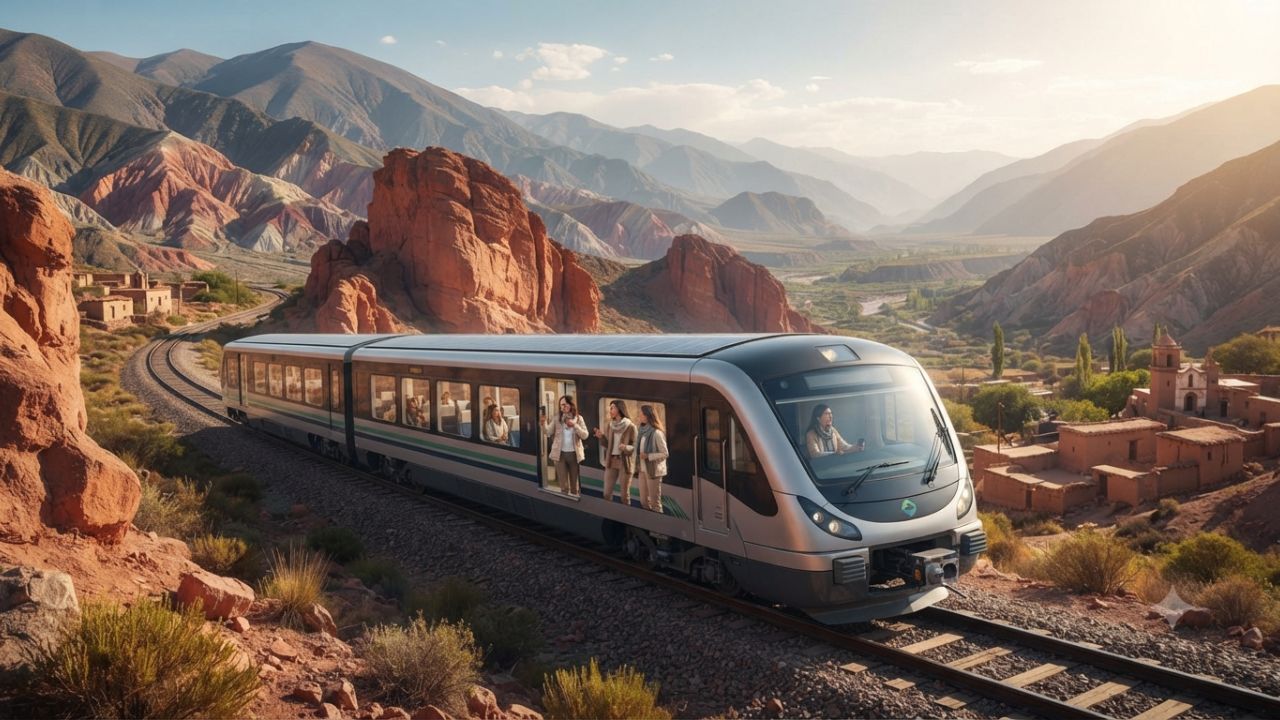
Image generated by AI
Argentina’s province of Jujuy has deployed the Tren Solar de la Quebrada, a zero-emission railway powered by solar-charged lithium batteries connecting six high-altitude Andean communities. Operating across a 42-kilometre corridor in the UNESCO World Heritage-listed Quebrada de Humahuaca, the two-carriage train has transported over 90,000 passengers since resuming rail passenger transit after a 30-year operational hiatus.
Solar-Powered Lithium Railway Innovation in Northern Argentina
The Tren Solar de la Quebrada serves as a focal point for regional passenger transit in northern Argentina. Promoted through national development initiatives alongside Visit Argentina, the 42-kilometre railway line weaves through the historic Quebrada de Humahuaca, a valley designated as a UNESCO World Heritage Centre site due to its thousands of years of indigenous trade routes and heritage communities.
Unlike conventional electric trains reliant on overhead catenary wires or diesel-electric locomotives, the passenger train operates using six onboard lithium batteries. Rather than capturing power directly via roof-mounted photovoltaic panels, the train recharges its battery system using solar energy generated at dedicated solar farms in Jujuy province.
Key technical and operational characteristics of the service include:
- Energy Storage Architecture: Six high-capacity lithium battery modules supply power to a two-carriage passenger configuration.
- Regenerative Braking Systems: Kinetic energy generated during deceleration on steep Andean down-gradients is converted into electrical energy and fed back into the onboard batteries.
- Operational Range: The battery system delivers an operational travel range between 100 and 120 kilometres on a single charge—more than double the current 42-kilometre route distance.
- Passenger Milestones: Since passenger operations commenced in June 2024, official Jujuy provincial government records confirm that more than 90,000 travelers have utilized the service.
Tren Solar de la Quebrada Route & Battery Technical Specifications
The operational specifications of northern Argentina's solar-battery train demonstrate how renewable micro-grids can support high-altitude regional transport:
| System Feature | Technical Specification | Operational Detail |
|---|---|---|
| Railway Operator | Tren Solar de la Quebrada | Regional passenger transport in Jujuy Province |
| Geographic Location | Quebrada de Humahuaca, Argentina | UNESCO World Heritage mountain valley corridor |
| Route Distance | 42 kilometres | Linking six historic Andean towns |
| Locomotive Configuration | Two-carriage electric trainset | Off-grid battery electric vehicle (BEV) rail system |
| Power Storage | 6 lithium battery units | Solar electricity sourced from Jujuy solar parks |
| Operating Range | 100 to 120 kilometres | Range capacity exceeds double the active line length |
| Active Charging Hubs | Volcán and Purmamarca | Fast-charging station infrastructure |
| Planned Charging Expansion | Tilcara station | Additional planned charging node |
| Passenger Volume | 90,000+ passengers | Recorded since June 2024 launch |
Traveler Logistics Guide: Exploring the Quebrada de Humahuaca by Solar Rail
Exploring Jujuy's mountain settlements via the Tren Solar de la Quebrada requires planning around high-altitude conditions, battery charging windows, and regional transit connections.
Accessing the Rail Corridor
- Gateway Airports: International travelers typically arrive via Gobernador Horacio Guzmán International Airport (JUJ) in San Salvador de Jujuy or Martín Miguel de Güemes International Airport (SLA) in neighboring Salta.
- Connecting Overland: From San Salvador de Jujuy, regional buses and private transfers travel north along National Route 9 to reach the southern rail terminus at Volcán.
Station Stops & Town Exploration
The 42-kilometre rail line connects six Andean towns, providing access to cultural landmarks:
- Volcán: The southern terminus featuring primary fast-charging infrastructure and historic station buildings.
- Purmamarca: Famous for the Cerro de los Siete Colores (Hill of Seven Colors) and local artisan markets. Allow a minimum 2-hour layover to explore the village on foot.
- Tilcara: Home to the ancient Pucará de Tilcara archaeological complex. Tilcara is slated to house the railway's third fast-charging installation.
- Humahuaca & Neighboring Stops: Remaining stops connect smaller rural hamlets, allowing travelers to experience indigenous gastronomy and high-altitude agricultural traditions.
Ticketing & High-Altitude Advice
- Ticket Reservations: Passengers can purchase hop-on, hop-off day passes or single-segment tickets online or at station counters in Volcán and Purmamarca. Booking in advance is recommended during peak South American holiday seasons (July and January-February).
- Altitude Preparedness: The Quebrada de Humahuaca ranges between 2,000 and 3,000 meters above sea level. Travelers should stay hydrated, carry sun protection, and allow acclimatization time before engaging in mountain hiking between train stops.
Environmental Impact & Andean Rail Electrification Comparison
The deployment of battery-electric rail in Jujuy highlights an alternative approach to regional rail modernization. Installing overhead catenary infrastructure across mountainous, seismic terrain often requires substantial capital investment. By combining local solar power generation with lithium energy storage, the Tren Solar model circumvents catenary construction while eliminating localized diesel emissions.
Across international transit networks, railway electrification strategies vary based on grid density:
- European Union Benchmarks: Approximately 58 percent of the European Union's rail network was fully electrified by 2024 using overhead catenary lines fed by national power grids.
- Renewable Procurement Models: European operators like NS in the Netherlands utilize direct wind and solar power purchase agreements, while Swiss projects test trackside solar panel arrays.
- Off-Grid High-Altitude Solutions: Argentina’s battery-electric approach demonstrates how sunshine-abundant regions can deliver clean passenger rail across remote valleys without continuous grid power lines.
Frequently Asked Questions: Argentina’s Solar Train (2026)
What is the name of Argentina's solar train and where does it operate?
The train is named the Tren Solar de la Quebrada. It operates through the Quebrada de Humahuaca valley in Jujuy province in northern Argentina.
Does the Tren Solar de la Quebrada have solar panels on its roof?
No. The train is powered by six onboard lithium batteries that are charged at station fast-charging hubs using solar electricity generated locally in Jujuy.
How far can Argentina's solar train travel on a single battery charge?
The train has an operational battery range of 100 to 120 kilometres per charge, which is more than double its current 42-kilometre route.
Where are the charging stations located along the solar railway route?
Active fast-charging stations operate in Volcán and Purmamarca, with a third charging station planned for Tilcara.
How long is the Tren Solar de la Quebrada railway route?
The active passenger railway line covers a distance of 42 kilometres, connecting six towns across Jujuy province.
Related Travel Guides
Argentina Hotel Tax Rules & VAT Exemption Guide for International Travelers
Italy Regional Rail Ticket Validation Rules and Fine Penalty Guide
Disclaimer
This article is for informational and educational purposes only. It does not constitute legal, financial, or professional advice. While we strive to provide accurate and up-to-date information, travel policies, regulations, and conditions change rapidly. Always verify information with official sources before making travel decisions. Nomad Lawyer makes no representations about the accuracy, reliability, completeness, or suitability of the information provided. Readers should consult qualified professionals for advice specific to their circumstances. The views expressed in this article are those of the author and do not necessarily reflect the views of Nomad Lawyer.
Kunal K Choudhary
Co-Founder & Contributor
A passionate traveller and tech enthusiast. Kunal contributes to the vision and growth of Nomad Lawyer, bringing fresh perspectives and driving the community forward.
Learn more about our team →