
April Flight Disruptions Trigger 311 Delays Across Seven Countries in 2026
April flight disruptions have cascaded across seven countries, delaying 311 flights through 2026. Weather, airspace restrictions, and airport congestion reveal systemic vulnerabilities in global aviation networks affecting remote workers and nomadic professionals.

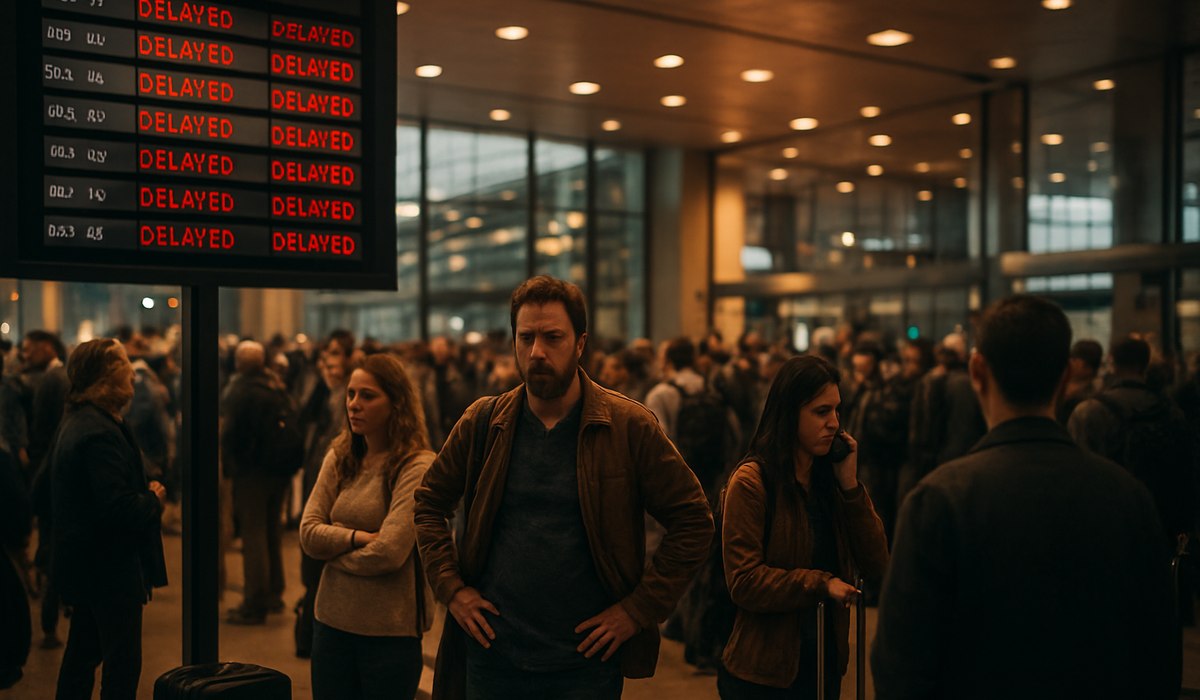
Image generated by AI
April Flight Disruptions Expose Fragility of Interconnected Aviation Networks
At least 311 flights have been delayed across seven countries during April 2026, revealing how localized weather, airspace restrictions, and airport capacity constraints trigger cascading failures throughout the global aviation system. Unlike isolated incidents that dominate headlines, these april flight disruptions demonstrate a patchwork of overlapping operational challenges that collectively strand thousands of passengers daily. The United Kingdom, Spain, Denmark, Turkey, the Netherlands, and North American hubs have all experienced significant delays, with this data underscoring how tightly coupled modern aviation has become—where problems at one airport ripple outward within hours.
Scattered Disruptions Paint Picture of Interconnected Aviation Chaos
The April 2026 disruption pattern defies a single narrative. Rather than one catastrophic event, public flight tracking data compiled from FlightAware and regional aviation authorities documents dozens of smaller incidents converging simultaneously. Major European hubs report consecutive days where 1,000+ flights departed behind schedule, while fewer than 5% faced outright cancellations. This distinction matters: airlines prioritize schedule completion even when pushing departures back several hours, maximizing passenger throughput at the cost of connection reliability.
North American carriers amplified the global tally considerably. One major U.S. network airline alone logged over 300 delayed services on a single April operating day, illustrating how hub-level congestion inflates delay statistics rapidly. When aircraft and crews fall behind their rotations, subsequent flights downstream experience cascading delays—sometimes affecting routes thousands of miles away. The april flight disruptions trigger wasn't a single weather system or security incident, but rather multiple, overlapping operational stressors hitting an already stretched infrastructure.
Weather and Airspace Restrictions Drive April Delays
Seasonal meteorological volatility remains aviation's primary disruptor. European storm systems and lingering North American winter weather have produced low visibility, crosswinds exceeding safe landing thresholds, and runway contamination requiring reduced arrival rates. When airports cut capacity by 20-30%, queues build both airborne and ground-side within minutes.
Beyond meteorology, airspace closures related to Iran-adjacent geopolitical tensions continue distorting transatlantic and Europe-Asia routing. Airlines diverting around restricted zones fly longer tracks through Central Asia or Africa, consuming additional fuel, crew duty time, and schedule buffer. Aircraft returning late to their home bases miss connecting rotations. In dense schedules with minimal spare aircraft, these knock-on effects propagate across the network, creating measurable delays in cities experiencing fair weather.
Regional news outlets and industry bulletins document this compound effect: infrastructure operating near maximum capacity since early 2026 means even moderate shocks surface as significant delay tallies rather than being absorbed through scheduling flexibility.
North American Carriers Contribute Substantially to Global Tally
U.S. and Canadian airlines account for roughly half the 311 april flight disruptions recorded across the seven-country dataset. Chicago O'Hare and Newark Liberty International—two of North America's busiest hubs—experienced particularly severe April days. Hundreds of delayed departures logged within single 24-hour windows reflect systemic bottlenecks rather than isolated weather encounters.
One major carrier's operational data reveals an important pattern: high delay rates paired with low cancellation rates indicate deliberate schedule completion strategies. Rather than cancel flights proactively, airlines maintain departure queues, accepting 2-3 hour delays to ultimately complete most bookings. This approach maximizes revenue but concentrates passenger frustration and increases missed-connection cascades.
Recovery at North American hubs typically takes 48-72 hours, during which crews cycle through duty-time constraints and aircraft return from unexpected diversions. Understanding these operational dynamics helps travelers anticipate secondary delays rippling through subsequent days.
Real-Time Tracking and Passenger Rights During April Disruptions
Monitoring ongoing april flight disruptions requires access to authoritative flight tracking. FlightAware provides real-time delay visualization, while the FAA publishes capacity-related notices affecting major airspace. For U.S. flights, the U.S. Department of Transportation enforces passenger compensation rules: domestic flights delayed 3+ hours entitle passengers to meal vouchers, rebooking on alternative carriers, and potential monetary compensation.
European passengers covered under EU261 regulations enjoy stronger protections—€250-€600 compensation for delays exceeding 3 hours, regardless of cause (except extraordinary circumstances). Non-EU carriers operating into European airports must honor these requirements. Documenting delays and collecting boarding passes, receipts, and booking confirmations strengthens compensation claims.
Airlines often cite weather as a force majeure exemption. However, EU261 jurisprudence increasingly holds carriers accountable for operational decisions (e.g., failing to position aircraft efficiently before predicted storms). Legal databases tracking April 2026 compensation cases may provide guidance for your specific route and carrier.
What This Means for Nomadic Professionals and Remote Workers
April flight disruptions create operational friction for location-independent workers depending on reliable connections. A 3-hour delay can eliminate planned work hours; a missed connection can strand you 1,000 miles from your intended destination. Here are actionable responses:
- Book flights with 3+ hour buffer windows between connections, especially during April's volatile period.
- Select airlines with strong reliability ratings via FlightAware historical data rather than lowest-fare options.
- Maintain flexible accommodations by booking refundable hotels for 1-2 nights post-arrival, not pre-arrival.
- Establish geofencing alerts through FlightAware to receive real-time delay notifications 12+ hours before departure.
- Document all receipts (meals, alternative transportation, accommodations) for compensation claims under EU261 or U.S. DOT rules.
- Research visa implications if delays force unplanned country extensions; some territories have strict duration-of-stay enforcement.
Remote workers should communicate flight delays immediately to clients/employers, establish offline-capable work protocols, and maintain backup internet hotspots independent of airport WiFi (which often fails during congestion).
Key Data Table: April 2026 Flight Disruptions Summary
| Metric | Value | Impact |
|---|---|---|
| Total Delays (7 countries) | 311+ flights | Estimated 50,000+ passengers affected |
| Primary cause | Weather + airspace restrictions | Secondary cascading delays across 48-72 hours |
| UK delays | Highest volume documented | Major European hub congestion |
| Single-day U.S. carrier max | 300+ delays | Demonstrates hub-level vulnerability |
| Avg. delay duration | 2-4 hours | Few cancellations; schedule completion priority |
| EU261 compensation trigger | 3+ hour delays | €250-€600 per passenger eligible |
| Expected recovery window | 48-72 hours post-incident | Crews/aircraft cycling through duty constraints |
| Interconnected disruption radius | 1,000+ miles from incident | Aircraft/crew ripple effects across networks |
Traveler Action Checklist
-
Check your airline's April 2026 operational status via FlightAware or the carrier's website before departure; prioritize flights departing before 10 AM (less backlog accumulation).
-
Enroll in real-time delay alerts through FlightAware and your airline's mobile app; set geofencing to trigger notifications 12+ hours pre-departure.
-
Photograph and store all boarding passes, receipts, and booking confirmations digitally; maintain copies in cloud storage for compensation claim documentation.
-
**Review
Disclaimer
This article is for informational and educational purposes only. It does not constitute legal, financial, or professional advice. While we strive to provide accurate and up-to-date information, travel policies, regulations, and conditions change rapidly. Always verify information with official sources before making travel decisions. Nomad Lawyer makes no representations about the accuracy, reliability, completeness, or suitability of the information provided. Readers should consult qualified professionals for advice specific to their circumstances. The views expressed in this article are those of the author and do not necessarily reflect the views of Nomad Lawyer.
Raushan Kumar
Founder & Lead Developer
Full-stack developer with 11+ years of experience and a passionate traveller. Raushan built Nomad Lawyer from the ground up with a vision to create the best travel and law experience on the web.
Learn more about our team →