
Amtrak Riders Trapped Nearly 24 Hours in Florida Wildfire Crisis
Amtrak riders trapped nearly 24 hours after Florida wildfires halted service in 2026, exposing rail network vulnerabilities and passenger communication gaps.

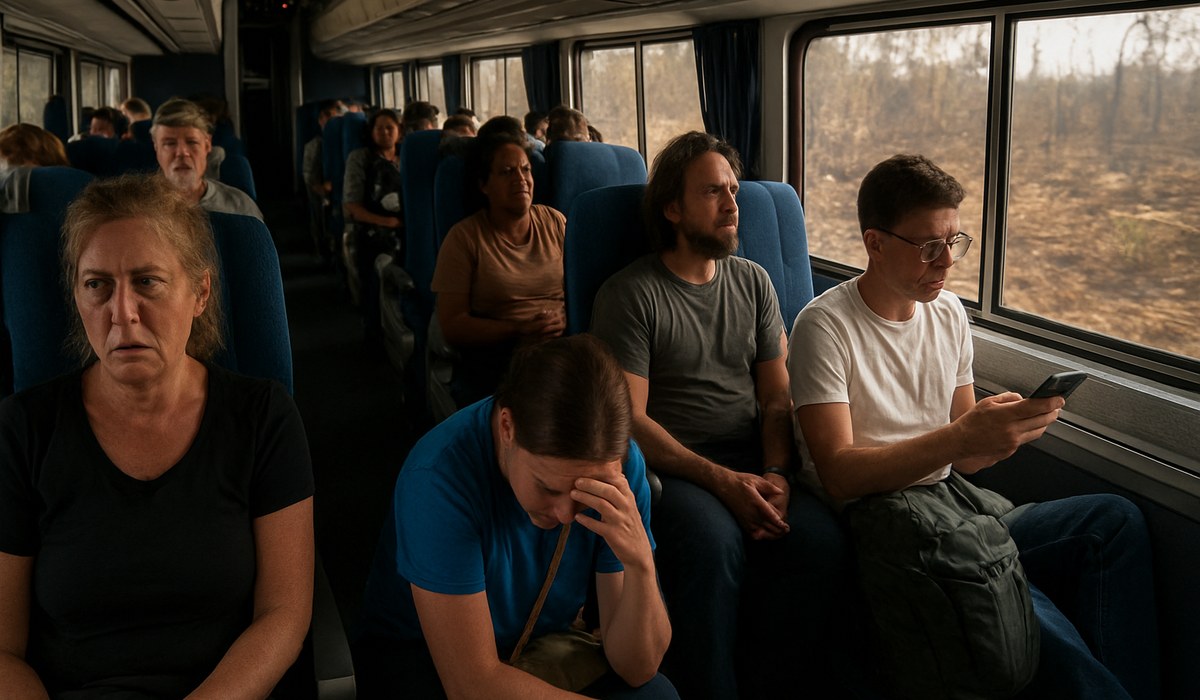
Image generated by AI
Quick Summary
An Amtrak northbound train carrying hundreds of passengers remained stranded for nearly 24 hours in north Florida on April 20-21, 2026, after rapidly advancing wildfires forced emergency service halts near Clay and Putnam County rail lines. Passengers endured overflowing sanitation facilities, depleted food supplies, and prolonged uncertainty as fire suppression efforts blocked access to the corridor. The incident has prompted industry-wide discussions about crisis protocols, real-time passenger communication systems, and contingency planning for environmental emergencies affecting long-distance rail networks.
Amtrak Riders Trapped Nearly 24 Hours During Florida Wildfire Emergency
Environmental disasters are reshaping how transportation carriers manage crisis response. When uncontrolled fires sweep through rail corridors, the consequences extend far beyond track closures—they test infrastructure resilience, expose communication gaps, and force operators to balance passenger safety against prolonged confinement. The April 2026 incident involving Amtrak riders trapped on a stationary train in Florida demonstrates how climate-driven disasters demand fundamentally new approaches to passenger protection and real-time crisis messaging.
On April 20, 2026, rapidly spreading wildfires ignited across brush and forestland near the Clay County and Putnam County boundary in north-central Florida. Within hours, smoke densification and flame advancement forced fire management agencies to restrict access to rail corridors traversing the affected zone. The Amtrak Silver Meteor service, operating Train 98 on its regular northbound route from Miami toward New York Penn Station, came to an abrupt halt near the Jacksonville region. What transportation officials initially projected as a brief precautionary hold extended into an extended immobilization affecting more than 400 passengers aboard.
By the time Amtrak service resumed on April 21, the train had remained essentially stationary or moving only marginal distances for nearly 24 consecutive hours. The standstill triggered widespread passenger frustration, social media commentary criticizing crisis management protocols, and renewed scrutiny of how rail carriers prepare for environmental emergencies. Industry analysts now view this Florida incident as a watershed moment forcing comprehensive reassessment of contingency frameworks across North American rail networks.
Wildfire Conditions Overwhelm Central Florida Rail Corridor
The fires that halted Amtrak service erupted during an exceptionally volatile weather period across the southeastern United States. Elevated temperatures, below-average humidity levels, and sustained wind patterns combined to create ideal conditions for rapid fire propagation. Meteorological data from regional weather monitoring stations indicated that fire behavior accelerated dramatically between April 18 and April 20, with flame advancement covering multiple square miles within 48-hour windows.
The specific fire complex near the rail right-of-way grew to encompass approximately 8,000 acres by April 21, according to state forestry service reports. Thick smoke plumes reduced visibility along rail lines to dangerous levels, prompting state and local fire management officials to impose immediate transit halts. Rail dispatchers coordinating Amtrak, freight rail operators, and commuter services received emergency notifications restricting all movement through affected segments.
The Silver Meteor's position created an especially challenging situation. The train had departed Miami during normal operations before conditions deteriorated explosively. Once halted, reversing direction or executing alternative routing proved logistically complex given the interconnected nature of Florida's primary rail corridors and the geographic extent of the fire zone. Single-track operations characterizing many segments of the Florida rail network meant limited flexibility for routing decisions. Dispatchers faced a binary choice: maintain the train's position and wait for clearance or risk traversing active fire zones.
Passenger Conditions Deteriorate Aboard Stranded Train
As delays extended from hours into the full-day range, conditions aboard the immobilized Silver Meteor degraded significantly. Passengers began documenting their experiences through social media platforms and local news interviews, painting a portrait of escalating discomfort and inadequate preparation for prolonged stoppages.
The most pressing issue involved sanitation infrastructure. Train holding tanks for wastewater reached capacity roughly 16 hours into the delay. Multiple passenger accounts described restroom facilities becoming inoperable as tanks overflowed, forcing crew members to close lavatories and redirect passengers to non-functional facilities. Water service became spotty as pressure fluctuated, and crew members struggled to manage demand from over 400 people confined to a stopped train.
Food service presented secondary complications. The train's onboard dining and café services were not provisioned for delays exceeding initial timeframes. Supplies of prepared meals, beverages, and snacks depleted rapidly. By hour 18 of the stoppage, available food options had become severely limited, creating particular hardship for travelers with dietary restrictions, young children, and elderly passengers requiring regular nutrition.
Temperature regulation aboard added another layer of discomfort. Extended static operation meant reduced air conditioning efficiency, particularly in sleeping compartments where ventilation systems rely partially on train momentum. Some passengers reported cabin temperatures climbing into uncomfortable ranges during afternoon hours of April 20.
Crew members endeavored to maintain order and manage expectations, but communication channels proved inadequate. Passengers received minimal updates about estimated clearance times or contingency plans. Official explanations of fire conditions and safety protocols remained sparse, fostering anxiety and frustration. Many travelers reported feeling abandoned by corporate messaging systems designed for routine delays rather than environmental emergencies.
Communication Gaps Expose Industry-Wide Vulnerability
The Amtrak incident revealed stark deficiencies in passenger communication protocols during extended environmental emergencies. Unlike aviation, where platforms such as FlightAware provide real-time tracking and status updates, rail passenger services lack equivalent systems for transparent, moment-by-moment information dissemination. Stranded passengers received information sporadically, often through unofficial channels rather than from Amtrak directly.
Federal transportation regulations enforced by the FAA establish rigorous passenger notification standards for airline operations experiencing delays or disruptions. These protocols mandate regular updates, compensation disclosures, and contingency options communicated directly to affected travelers. Rail carriers operate under less prescriptive regulatory frameworks, enabling inconsistent communication practices across different companies and incident types.
International benchmarking of crisis response procedures reveals gaps in American rail protocols. European air traffic management coordinated by Eurocontrol maintains comprehensive crisis communication standards that extend beyond aviation to surface transportation networks experiencing environmental disruptions. These frameworks emphasize early notification, regular update cycles, alternative routing information, and passenger welfare communications—standards largely absent in the Amtrak response to the Florida wildfire incident.
Industry observers have noted that real-time crisis communication systems could have mitigated passenger anxiety significantly. Systematic updates regarding fire containment progress, anticipated clearance timelines, onboard supply management, and alternative transportation options would have provided psychological stability and enabled informed decision-making. Amtrak's existing communication infrastructure, designed for routine scheduling announcements, proved inadequate for emergency situations demanding frequent, detailed messaging.
Service Disruptions Cascade Across Florida Network
The Silver Meteor's stoppage was not an isolated incident. Wildfire impacts disrupted multiple Amtrak services across Florida between April 20 and April 22, 2026. The company suspended or substantially modified operations on several major routes, including the Miami-to-Jacksonville corridor and the Auto Train service connecting Sanford, Florida, with Lorton, Virginia.
One northbound service was reversed entirely, returning passengers to originating terminals rather than proceeding into the fire zone. This operational decision stranded motorists who had boarded vehicles bound for northern destinations. Alternative bus transportation, hastily arranged, proved insufficient for the volume of affected travelers. Reboo
Disclaimer
This article is for informational and educational purposes only. It does not constitute legal, financial, or professional advice. While we strive to provide accurate and up-to-date information, travel policies, regulations, and conditions change rapidly. Always verify information with official sources before making travel decisions. Nomad Lawyer makes no representations about the accuracy, reliability, completeness, or suitability of the information provided. Readers should consult qualified professionals for advice specific to their circumstances. The views expressed in this article are those of the author and do not necessarily reflect the views of Nomad Lawyer.
Preeti Gunjan
Contributor & Community Manager
A passionate traveller and community builder. Preeti helps grow the Nomad Lawyer community, fostering engagement and bringing the reader experience to life.
Learn more about our team →