
Amsterdam Schiphol Airport Chaos: KLM, Delta, and Air France Cancel 31 Flights to US and Europe in 2026
Over 30 key flights were cancelled at Amsterdam Schiphol Airport over four days, disrupting travel for thousands of passengers heading to major hubs like London, Paris, Los Angeles, and Washington.

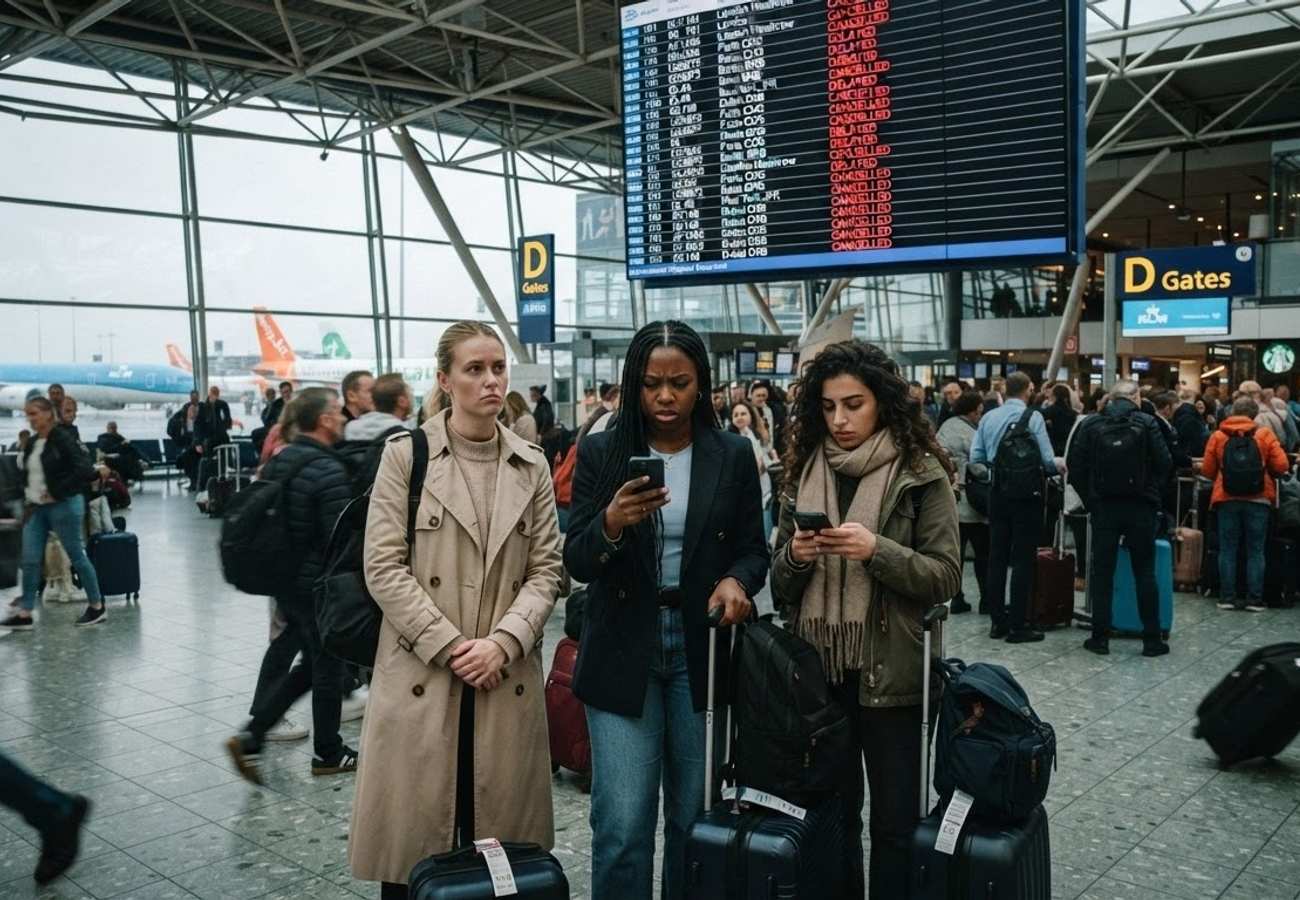
Image generated by AI
A series of operational failures at Amsterdam Schiphol Airport has left thousands of travelers stranded after 31 scheduled departures were scrapped over a four-day window. The disruptions hit a broad spectrum of carriers, with KLM bearing the brunt of the cancellations, followed by Air France, Delta Air Lines, and EasyJet.
The instability spanned from Saturday through Tuesday, indicating a systemic operational struggle rather than a momentary glitch. The cancellations impacted 24 different destinations, creating a ripple effect across both European regional networks and high-capacity transatlantic corridors.
Network-Wide Impact: KLM and Long-Haul Disruptions
KLM experienced the most significant losses in its schedule. The airline cancelled a variety of short-haul European services and critical long-haul routes. The loss of Boeing 777 aircraft on U.S. routes was particularly impactful, as these wide-body jets carry hundreds of passengers per flight.
Affected U.S. gateways included:
- Washington Dulles
- Los Angeles
- Houston George Bush Intercontinental
In Europe, the disruption hit a diverse mix of business and leisure hubs, including London Heathrow, London City, Madrid, Barcelona, Milan Linate, and Dublin. Other cancelled services reached further into the continent, impacting flights to Geneva, Split, Newcastle, Lisbon, Bergen, Stockholm, Munich, Marseille, Venice, Zagreb, Aberdeen, and Düsseldorf.
Multi-Carrier Failures and Hub Connectivity
The chaos extended beyond KLM, affecting the tight connectivity between Amsterdam and other primary European hubs. Air France saw multiple cancellations on the high-frequency Amsterdam–Paris Charles de Gaulle route, specifically flights AFR1341, AFR1441, and AFR1741. Additionally, HOP!—operating on behalf of Air France—withdrew a corresponding service.
Because Paris CDG serves as a global transit point, these specific cancellations likely triggered a secondary wave of missed connections for passengers traveling toward Asia and North America.
Other notable carrier disruptions included:
- Delta Air Lines: Cancellation of an Airbus A330-900 service to Minneapolis–Saint Paul.
- EasyJet: Cancellation of an Airbus A320neo flight to Palma de Mallorca.
- Croatia Airlines: Service to Zagreb withdrawn.
- German Airways: Flights to Aberdeen and Düsseldorf cancelled.
Timeline of Operational Collapse
The cancellations were not concentrated in a single event but persisted over four consecutive days, suggesting that airlines struggled to recover aircraft or crew positioning.
Saturday saw seven cancellations, primarily affecting routes to Barcelona, Marseille, Madrid, Houston, Venice, Munich, and Paris. Sunday marked the peak of the crisis with 13 cancelled flights, including long-haul services to Los Angeles and Minneapolis, as well as regional hops to Stockholm, Bergen, and London.
By Monday, eight more flights were removed, including services to Washington Dulles and London City. The instability tapered off on Tuesday with three final cancellations to Madrid and Barcelona.
Summary of Flight Disruptions (Saturday – Tuesday)
| Day | Total Cancellations | Airlines Involved | Affected Destinations |
|---|---|---|---|
| Saturday | 7 | KLM, Air France, HOP! | Barcelona, Marseille, Madrid, Houston, Venice, Munich, Paris CDG |
| Sunday | 13 | KLM, Delta, EasyJet, Croatia Airlines, German Airways | Los Angeles, Minneapolis, Stockholm, Bergen, Lisbon, Newcastle, Split, Geneva, London Heathrow, Dublin, Aberdeen, Palma de Mallorca, Zagreb |
| Monday | 8 | KLM, Air France, HOP! | London Heathrow, Washington Dulles, Milan Linate, Paris CDG (2), London City |
| Tuesday | 3 | KLM | Madrid, Barcelona |
| Total | 31 | 7 Carriers | 24 Destinations |
Passenger Consequences and Logistics
While official passenger counts have not been disclosed, the scale of the disruption is immense. Short-haul aircraft (Airbus A320, Boeing 737, and Embraer jets) typically carry 90 to 190 passengers. However, the cancellation of Boeing 777 and Airbus A330 wide-body aircraft on U.S. routes means each single cancellation likely displaced over 250 passengers.
The resulting logistical burden on travelers included:
- Forced rebooking on alternative carriers.
- Missed international connections at hubs like London Heathrow and Paris CDG.
- Unexpected costs for emergency accommodation and ground transport.
- Significant delays in reaching business-critical destinations in Milan, Munich, and Düsseldorf.
Operational Outlook for Schiphol
Hub airports like Schiphol rely on "wave" scheduling, where aircraft arrive and depart in tight windows to maximize connectivity. When aircraft availability or crew scheduling fails, airlines are often forced to cancel specific "spoke" flights to prevent the entire network from collapsing.
The four-day stretch of cancellations suggests a struggle to regain "operational equilibrium." Passengers are advised to maintain strict vigilance over flight statuses and review passenger rights regarding compensation for these systemic delays.
Travelers are urged to confirm departure times and monitor airline notifications before heading to the airport.
Related Travel Guides
Disclaimer
This article is for informational and educational purposes only. It does not constitute legal, financial, or professional advice. While we strive to provide accurate and up-to-date information, travel policies, regulations, and conditions change rapidly. Always verify information with official sources before making travel decisions. Nomad Lawyer makes no representations about the accuracy, reliability, completeness, or suitability of the information provided. Readers should consult qualified professionals for advice specific to their circumstances. The views expressed in this article are those of the author and do not necessarily reflect the views of Nomad Lawyer.
Raushan Kumar
Founder & Lead Developer
Full-stack developer with 11+ years of experience and a passionate traveller. Raushan built Nomad Lawyer from the ground up with a vision to create the best travel and law experience on the web.
Learn more about our team →