
Aviation Updates: Massive Travel Chaos Engulfs Amsterdam Schiphol as 432 Delays Paralyze KLM, Delta, and Emirates
As catastrophic airport disruptions violently paralyze the Dutch aviation grid, thousands of transit passengers are trapped in severe travel chaos following a staggering 432 flight delays at Amsterdam Schiphol.

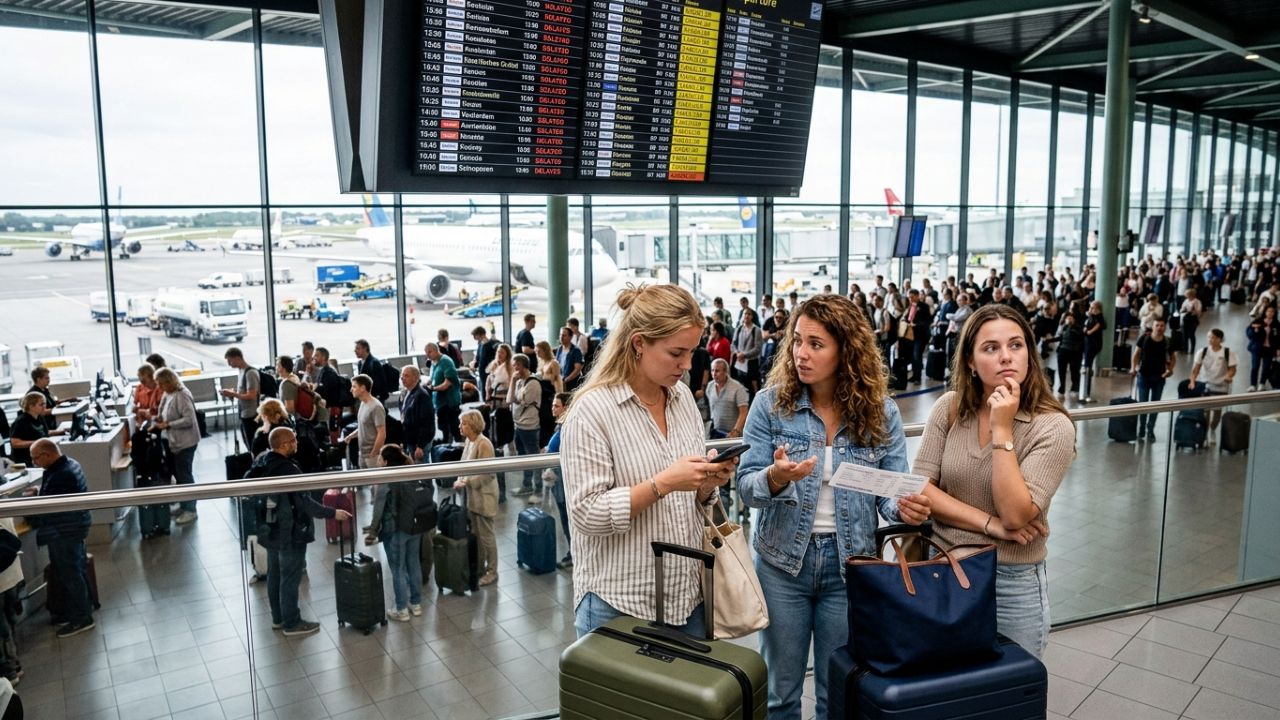
Image generated by AI
Aviation Updates: Massive Travel Chaos Engulfs Amsterdam Schiphol as 432 Delays Paralyze KLM, Delta, and Emirates
As catastrophic logistical failures and suddenly compounding infrastructure bottlenecks continue to crush the European transit grid, thousands of international passengers have been brutally trapped in a massive wave of terminal gridlock at one of the continent's most vital transfer hubs.
Image generated by AI
As high-impact airline news platforms rapidly issue continuous aviation updates regarding the intense fragility of the global transit network, Amsterdam Airport Schiphol has suffered a devastating operational meltdown. For thousands of international travelers passing through the Netherlands today, highly anticipated holidays, vital business trips, and crucial family reunions instantly transformed into grueling lessons in survival. Schiphol recorded a staggering 432 delayed flights and 32 outright flight cancellations, inflicting severe airport disruptions that tore across domestic, European, and long-haul schedules. This massive wave of travel chaos directly impacted 464 total flight movements, severely crippling operations for massive legacy carriers including KLM (Royal Dutch Airlines), Delta Air Lines, British Airways, Lufthansa, and Emirates. Consequently, highly lucrative intercontinental routes connecting Amsterdam to London, New York, Paris, Dubai, Frankfurt, Singapore, and Toronto were thrown into absolute operational disarray.
Expanded Overview: The Collapse of a Transfer Hub
To fully comprehend the sheer scale of this localized disaster, aviation analysts must examine the massive strategic importance and structural vulnerability of Amsterdam Schiphol.
Unlike standard regional airports that primarily handle simple point-to-point traffic, Schiphol functions as a massive, hyper-connected transfer hub directly linking Europe with North America, Asia, Africa, and the Middle East. Because tens of thousands of passengers use Amsterdam strictly as a connecting point rather than their final destination, a breakdown in Dutch airspace instantly triggers a catastrophic global ripple effect. As departure boards filled entirely with revised timings and red cancellation notices, frantic passengers found themselves aimlessly waiting in congested terminals, desperately searching for alternative connections before international flight inventory vanished completely.
Section-Wise Breakdown: The Cascading Operational Collapse
Flight delays of this massive magnitude demonstrate exactly how quickly operational challenges at one of Europe’s largest hub airports can spiral entirely out of control.
In the complex ecosystem of a mega-hub, one single delayed arrival can easily postpone a dozen subsequent departures because the exact same aircraft, pilots, or cabin crew are strictly scheduled to continue operating multiple flights throughout the day. Once these disruptions begin, schedule recovery becomes incredibly difficult. Aircraft arriving behind schedule miss their narrow runway windows and immediately require new departure slots from heavily congested air traffic controllers. Furthermore, subterranean baggage transfers take exponentially longer, ensuring that even if a passenger sprints to their connecting gate, their luggage will likely be abandoned in Amsterdam. These cascading logistical failures explain precisely why hundreds of flights can be brutally impacted even when the initial trigger appears relatively minor.
Section-Wise Breakdown: KLM and the Global Ripple Effect
The devastation experienced in Amsterdam did not remain contained within the Netherlands; it instantly infected the entire global network.
Because Schiphol serves as the absolute primary fortress hub for KLM Royal Dutch Airlines—while simultaneously accommodating dozens of massive international carriers like Emirates and Delta—delays at Schiphol rapidly destroy itineraries worldwide. Travelers flying between distant cities in Europe and intercontinental destinations across North America, Asia, and the Middle East suffered catastrophic missed onward connections, drastically revised itineraries, and grueling, hours-long transit times. Even if weather conditions remained perfectly favorable at Schiphol itself, severe delays originating hundreds of kilometers away in London or Paris aggressively spread throughout the interconnected KLM network as aircraft consistently arrived later than legally scheduled.
Flight Details: Amsterdam Schiphol Airport (AMS) Disruption Matrix
To ensure international travelers and aviation analysts can accurately track the sheer scale of this massive transit failure, the verified disruption telemetry has been consolidated into the mandatory matrix below.
| Operational Metric | Verified Data |
|---|---|
| Total Flight Delays | 432 Flights |
| Total Cancellations | 32 Flights |
| Primary Hub Carrier | KLM Royal Dutch Airlines |
| Affected Legacy Carriers | Delta Air Lines, British Airways, Lufthansa, Emirates |
| Severed Global Routes | London, New York, Paris, Dubai, Frankfurt, Singapore, Toronto |
| Passenger Protections | EU Regulation EC261 |
Passenger Impact: Enforcing European Consumer Rights
For the thousands of stranded tourists violently caught in the crossfire of this massive Dutch aviation failure, executing European passenger rights is absolutely critical for financial survival.
Travelers departing from airports within the European Union are powerfully protected under the highly strict EU Regulation EC261. Eligibility for financial compensation completely depends on the exact length of the delay and whether the circumstances were considered outside the airline’s direct control (such as severe regional weather or sudden air traffic management restrictions). However, even when direct financial compensation does not legally apply, airlines are still strictly required by law to provide immediate assistance, including free meals, refreshments, and hotel accommodation if an overnight delay is forced upon the passenger. Travelers are fiercely encouraged to retain all physical receipts and boarding passes to successfully claim these vital reimbursements.
Industry Analysis: Operating at Maximum Capacity
From a macro-aviation perspective, this massive 464-flight disruption explicitly highlights the extreme vulnerability of operating massive infrastructure at maximum capacity.
Large international airports like Schiphol face a terrifying variety of operational pressures throughout the peak season. Incredibly high passenger demand, strict air traffic management restrictions, rapid aircraft turnaround times, and highly complex crew scheduling laws heavily restrict daily operations. When airport infrastructure is already operating dangerously close to its absolute physical limits, any minor deviation instantly creates a backlog that ground handling teams simply cannot recover from, forcing massive, unannounced flight cancellations just to reset the system.
Conclusion: Surviving the Hub Gridlock
Ultimately, the staggering 432 flight delays and 32 cancellations at Amsterdam Airport Schiphol represent a brutal day for global transit. For passengers, travel is vastly more than simply reaching a destination; it represents crucial family reunions, massive business opportunities, and highly anticipated international holidays. As sudden airspace bottlenecks and severe operational breakdowns continue to trigger massive airport disruptions across Europe, the Dutch aviation network has proven highly vulnerable to cascading failures. While airport staff, airline employees, and operational teams at Schiphol tirelessly work behind the scenes to restore their fractured schedules, international passengers must remain hyper-vigilant. Relying explicitly on airline mobile apps for real-time updates and heavily utilizing EU EC261 protections remain the only absolute methods to survive the grueling realities of modern European air travel.
Key Takeaways
- Massive Hub Gridlock: Amsterdam Airport Schiphol suffered a devastating 432 flight delays and 32 cancellations, disrupting a total of 464 flight movements.
- Major Carriers Crippled: The travel chaos severely impacted the primary hub operations of KLM Royal Dutch Airlines, alongside Delta, British Airways, Lufthansa, and Emirates.
- Global Routes Severed: Highly lucrative intercontinental routes connecting Amsterdam to London, New York, Paris, Dubai, Frankfurt, Singapore, and Toronto were thrown into absolute disarray.
- Cascading Failures: Delays compounded rapidly because Schiphol functions as a massive transfer hub; late-arriving aircraft immediately destroyed thousands of onward connecting itineraries.
- Passenger Protections: Stranded travelers are heavily encouraged to seek meals, hotel accommodations, and financial compensation under the strict rules of EU Regulation EC261.
FAQ: Amsterdam Schiphol Flight Disruptions
How many total flights were delayed or canceled at Amsterdam Schiphol today? Official airport telemetry confirmed a staggering 464 disrupted movements, consisting of 432 delayed flights and 32 outright cancellations.
Which major airlines were impacted by the travel chaos in Amsterdam? The massive gridlock heavily disrupted operations for KLM Royal Dutch Airlines, which uses Schiphol as its primary hub, as well as Delta Air Lines, British Airways, Lufthansa, and Emirates.
Why did so many flights get delayed at once? Because Schiphol is a massive international transfer hub, a single delayed arrival often cascades into dozens of subsequent delays as interconnected aircraft, pilots, and cabin crews miss their narrow operational windows.
What should I do if my flight from Amsterdam is severely delayed? Passengers are fiercely advised to immediately contact their airline for rebooking options, retain all receipts for unexpected food and hotel expenses, and review their legal eligibility for compensation under EU Regulation EC261.
Related Travel Guides
Italy Airports 879 Delays ITA Airways Ryanair Travel Chaos 2026
France Airports 1075 Delays Air France easyJet Travel Chaos 2026
Europe Regional Tourism and Transit Survival Guide 2026
Disclaimer: This article is strictly for informational and aviation planning purposes. The specific flight disruption telemetry (432 delays, 32 cancellations), affected airlines (KLM, Delta, Emirates), and impacted routes (New York, Singapore, Dubai) are based on verified operational data available at the time of publication. European airspace conditions, specific airline recovery schedules, and passenger compensation eligibility under EU EC261 are highly dynamic and subject to immediate modification by the operating carriers and regulatory authorities. Passengers planning international travel through Amsterdam Schiphol Airport should explicitly verify their exact flight itineraries, strictly monitor their airlines for sudden flight cancellations, and secure comprehensive travel insurance prior to departure.
Disclaimer
This article is for informational and educational purposes only. It does not constitute legal, financial, or professional advice. While we strive to provide accurate and up-to-date information, travel policies, regulations, and conditions change rapidly. Always verify information with official sources before making travel decisions. Nomad Lawyer makes no representations about the accuracy, reliability, completeness, or suitability of the information provided. Readers should consult qualified professionals for advice specific to their circumstances. The views expressed in this article are those of the author and do not necessarily reflect the views of Nomad Lawyer.
Raushan Kumar
Founder & Lead Developer
Full-stack developer with 11+ years of experience and a passionate traveller. Raushan built Nomad Lawyer from the ground up with a vision to create the best travel and law experience on the web.
Learn more about our team →