
American Airlines Joins United, Delta, ANA, Lufthansa, Air India as SFO Delays Quadruple to Twenty Minutes, Japan, China, South Korea, India Hit Hard by FAA’s Parallel Landing Ban at San Francisco International Airport
SFO flight delays quadruple to 20 minutes as FAA parallel landing ban hits United, Delta, and ANA. See how Japan, India,

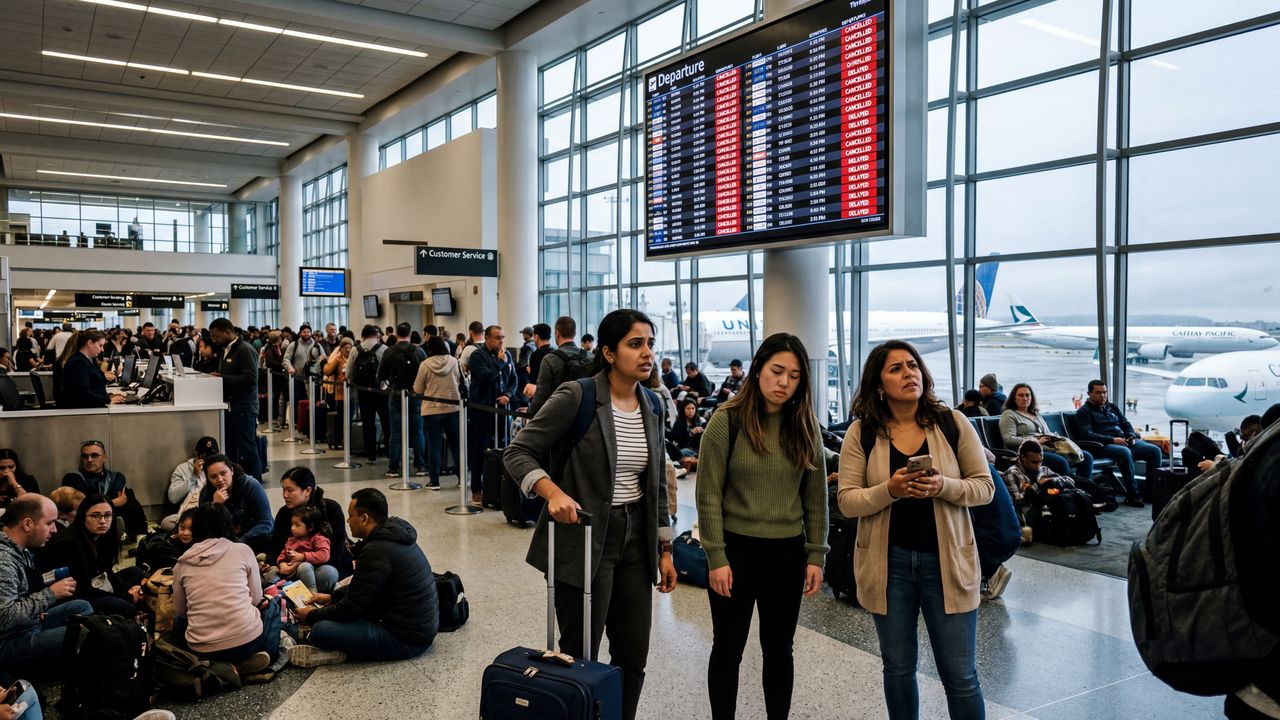
Image generated by AI
[San Francisco, June 23, 2026] — Major international flight disruptions are intensifying at San Francisco International Airport (SFO) as a Federal Aviation Administration (FAA) ban on parallel landings has caused average delays to quadruple to 20 minutes. The restriction, combined with active runway modernization projects, is severely impacting high-volume corridors to Japan, China, South Korea, and India, affecting global carriers including United, Delta, American Airlines, ANA, Lufthansa, and Air India.
Regulatory Shifts Trigger SFO Operational Bottlenecks
The current surge in aviation delays is primarily attributed to a strategic shift in safety protocols implemented by the FAA. The agency has introduced a restriction on parallel landings at SFO to widen safety margins between aircraft. Because the airport's runways are separated by only 750 feet—one of the narrowest configurations among major U.S. airports—the FAA has mandated a move from visual approaches to stricter radar-based sequencing.
Industry observers indicate that this regulatory change has effectively stripped the airport of one-third of its landing capacity. The situation is further complicated by ongoing runway modernization efforts, creating a structural bottleneck rather than a temporary seasonal spike. These constraints are most acute during the peak operational window between 1:00 PM and 9:00 PM, where air traffic congestion reaches its zenith.
Global Carriers Struggle with Transpacific and Transatlantic Delays
The operational fallout is most visible among long-haul carriers that utilize San Francisco as a primary gateway for the Asia-Pacific and European markets. Airlines such as United Airlines and ANA, which maintain heavy traffic flows from Tokyo, are seeing significant arrival sequencing delays. Similarly, Delta Air Lines and American Airlines are reporting a rise in missed domestic connections as international arrivals slide past their scheduled slots.
Beyond the immediate clock-time delays, these carriers are facing secondary operational costs. Flight tracking data suggests an increase in fuel burn as aircraft are forced into extended holding patterns while awaiting clearance. Furthermore, the instability in arrival times has forced airlines to restructure their arrival and departure "banks," attempting to mitigate the ripple effect of late arrivals on subsequent flight legs.
Statistical Analysis of 2026 Flight Disruptions
The scale of the slowdown is evident in recent performance metrics. Average delay times have climbed from approximately 5 minutes to 20 minutes, representing a fourfold increase in wait times. Data indicates that flights operating during peak hours now face a probability of delay exceeding 50%.
While domestic flights are experiencing moderate impacts, international arrivals are the hardest hit. Interestingly, reports show that departure delays are currently escalating at a faster rate than arrival delays across several datasets. Year-on-year, overall flight disruption levels at the hub have increased by roughly 1.8 times.
Regional Impact on Key International Markets
Because SFO serves as a critical bridge between North America and the East, specific nations are experiencing disproportionate disruptions:
- Japan: High-frequency routes between Tokyo and San Francisco are facing extended sequencing delays, which disrupt both corporate travel and onward domestic connections within the U.S.
- China: Coastal routes and flights from Shanghai are experiencing prolonged holding patterns, which also negatively impact the timing of critical cargo shipments.
- South Korea: Flights from Seoul Incheon are seeing high variability in arrival times, creating scheduling challenges for the tech and semiconductor sectors.
- India: The high volume of travel for the tech diaspora is under pressure, with an increased risk of missed connections for passengers on one-stop itineraries.
- Europe: Routes from Frankfurt (Lufthansa) and London are suffering secondary delays as the congestion at SFO spills over into the U.S. domestic transfer network.
Economic Consequences for Tourism and Hospitality
The instability of flight schedules is beginning to influence the broader travel economy in the Bay Area. Industry sources suggest that the lack of reliability is making short-stay itineraries less attractive, leading some travelers to divert their bookings to alternative West Coast gateways such as Los Angeles (LAX) or Seattle (SEA).
The hospitality sector is also feeling the strain. Hotels are reporting a rise in delayed check-ins and a reduction in the effective stay duration for business travelers whose schedules are compressed by flight delays. Additionally, tour operators and transfer services are facing scheduling inefficiencies as the unpredictability of arrivals makes precision timing nearly impossible.
Airline Route Operations Impact Table
| Airline | Key Routes Affected | Primary Impact |
|---|---|---|
| American Airlines | SFO–London, SFO–Dallas | Hub connection delays |
| United Airlines | SFO–Tokyo, SFO–Sydney | Transpacific disruption |
| Delta Air Lines | SFO–Seoul, SFO–Atlanta | Domestic connection misses |
| ANA | Tokyo–SFO | Arrival sequencing delays |
| Lufthansa | Frankfurt–SFO | Extended holding patterns |
| Air India | Delhi–SFO | Increased US connection risk |
Strategic Advice for Affected Travelers
Given the systemic nature of the 2026 disruptions, aviation experts recommend that passengers fundamentally alter their travel planning. Travelers are urged to maintain connection buffers of at least two to three hours to account for arrival variability.
To minimize risk, passengers are advised to prioritize morning departures, which currently show significantly lower delay rates than evening flights. Utilizing flexible booking options and monitoring real-time airline alerts is essential. Additionally, those with the flexibility to do so are encouraged to consider alternative Bay Area airports to bypass the SFO bottleneck.
Long-term Aviation Industry Implications
The current crisis at San Francisco International Airport serves as a case study in the tension between safety regulations and operational efficiency. The FAA's prioritization of safety margins via parallel landing restrictions has effectively lowered the capacity ceiling of one of the world's most important hubs.
This shift is likely to drive a long-term redistribution of transpacific traffic flows, as airlines seek more reliable alternatives to avoid the high operational costs associated with holding patterns and missed connections. As the industry adapts, the reliance on secondary airports may increase, signaling a move away from the traditional "mega-hub" reliance in favor of more distributed network stability.
Related Travel Guides
Disclaimer
This article is for informational and educational purposes only. It does not constitute legal, financial, or professional advice. While we strive to provide accurate and up-to-date information, travel policies, regulations, and conditions change rapidly. Always verify information with official sources before making travel decisions. Nomad Lawyer makes no representations about the accuracy, reliability, completeness, or suitability of the information provided. Readers should consult qualified professionals for advice specific to their circumstances. The views expressed in this article are those of the author and do not necessarily reflect the views of Nomad Lawyer.
Preeti Gunjan
Contributor & Community Manager
A passionate traveller and community builder. Preeti helps grow the Nomad Lawyer community, fostering engagement and bringing the reader experience to life.
Learn more about our team →