
American Airlines Offers $4,000 as Aspen Flight Diverts to Grand Junction
American Airlines offered passengers up to $4,000 in travel credit on an overbooked SkyWest-operated CRJ900 flight from Chicago O'Hare to Aspen, which then diverted to Grand Junction — 125 miles from the destination — due to weight restrictions at the high-altitude mountain airport.

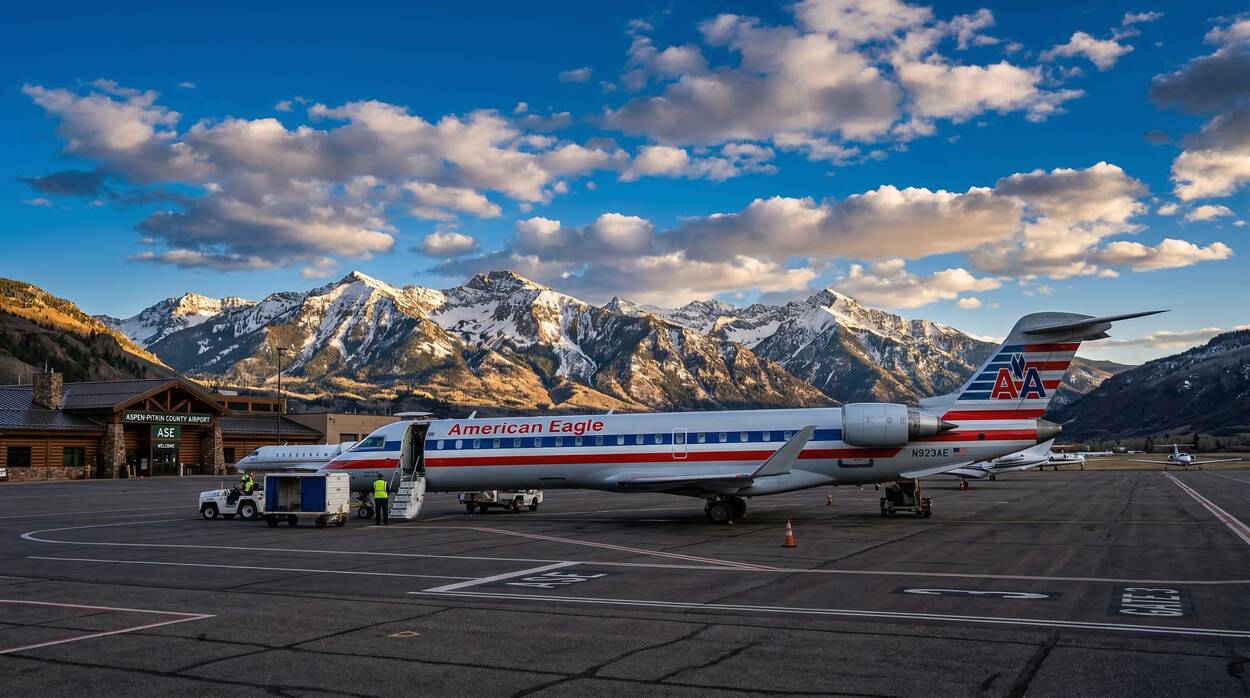
Image generated with AI
Quick Summary
- American Airlines offered up to $4,000 in travel credit to volunteers on an overbooked SkyWest Airlines CRJ900 flight from Chicago O'Hare (ORD) to Aspen-Pitkin County Airport (ASE)
- The flight — American Airlines Flight 6506 — was subsequently diverted to Grand Junction Regional Airport (GJT), approximately 125 miles from Aspen, due to weight restrictions at the high-altitude mountain airport
- Rental cars at Grand Junction were sold out; the airline ultimately arranged bus transportation to carry passengers from Grand Junction to Aspen
- Passengers who accepted the $4,000 offer avoided the diversion entirely and later boarded a separate flight to Aspen — emerging with both compensation and a smoother journey
American Airlines made a rare and striking offer of up to $4,000 in travel credit to passengers aboard an overbooked flight from Chicago O'Hare International Airport (ORD) to Aspen-Pitkin County Airport (ASE), operated by SkyWest Airlines on behalf of the carrier. The offer, which far exceeds standard voluntary denied boarding packages, escalated through successive rounds as passengers declined — before the flight took an unexpected turn and was diverted to Grand Junction Regional Airport (GJT) in Colorado, roughly 125 miles short of Aspen.
The incident on American Airlines Flight 6506 highlights the compounding pressures airlines face when overbooking collides with the operational realities of high-altitude mountain airports — where strict weight limits can force extraordinary decisions long after boarding begins.
Why the Flight Was Overbooked — and Why It Mattered at Aspen
Overbooking is standard practice across the U.S. airline industry. Carriers routinely sell more tickets than available seats, calculating that a percentage of passengers will cancel or no-show before departure. The strategy works — until every passenger shows up.
On this Chicago-to-Aspen service, the overbooking scenario was made significantly more acute by the unique operational constraints of Aspen-Pitkin County Airport (ASE). At an elevation of 7,820 feet, ASE is one of the highest-altitude commercial airports in the United States. The thinner air at altitude reduces aircraft performance, meaning weight limits on the Bombardier CRJ900 are considerably tighter than at sea-level airports.
With all passengers present, the aircraft's weight restrictions left the crew with no room to maneuver. The airline was forced to leave multiple ski bags on the tarmac rather than loading them — a decision driven by the aircraft's hard weight ceiling rather than any standard luggage protocol.
The Escalating Compensation Offer
Gate agents began the voluntary denied boarding process in the typical manner, requesting volunteers in exchange for travel credit at standard compensation levels. When the initial offers failed to generate sufficient volunteers, the airline progressively raised the stakes.
By the time the boarding process concluded, American Airlines had authorized a payout of up to $4,000 per volunteer — a figure well above the compensation most passengers encounter on overbooked domestic flights. The escalation reflects a rarely used but legitimate airline tool: when minimum statutory offers fail to generate adequate volunteers, supervisors can approve significantly higher amounts to avoid the more disruptive and legally complex process of involuntary denied boarding.
The practice is not unique to American Airlines. Delta Air Lines has pioneered an app-based bidding system that allows passengers to submit the lowest compensation figure they would accept — giving the airline a real-time market view of volunteer willingness. United Airlines, following its highly publicized 2017 involuntary removal incident, raised its voluntary compensation ceiling to $10,000. Delta has previously authorized voluntary compensation as high as $9,950.
American Airlines itself had a precedent for this: in 2018, a manager on a separate overbooked flight authorized $5,000 per volunteer to resolve the situation quickly. Such high-level authorizations remain rare and are typically only granted when a faster resolution is essential to the airline's operational schedule.
The Diversion: Chicago to Aspen Becomes Chicago to Grand Junction
The most dramatic element of this incident was not the compensation offer — it was what happened next. Despite the voluntary denied boarding process, the weight constraints on the CRJ900 ultimately forced a more drastic operational decision: Flight 6506 was diverted mid-operation to Grand Junction Regional Airport (GJT) in western Colorado.
Passengers were informed of the diversion after the aircraft had already departed, leaving them with limited time to process the implications. Grand Junction, while a functioning regional airport, sits approximately 125 miles west of Aspen — a significant distance through mountain terrain.
Upon landing at GJT, passengers seeking to complete the final leg to Aspen by road discovered that rental car availability at Grand Junction had been exhausted, with no vehicles left to hire. American Airlines ultimately stepped in to arrange dedicated bus transportation from Grand Junction to Aspen, though the overland journey through Colorado's mountain corridors added considerable time to the total travel experience.
A Hidden Upside: Volunteers Fared Better Than Those Who Stayed
In an ironic twist, passengers who accepted the $4,000 travel credit and gave up their seats before departure avoided the diversion entirely. These volunteers were subsequently rebooked onto a later flight operating directly to Aspen-Pitkin County Airport, reaching their destination without the Grand Junction detour — and with a lucrative credit to use on future American Airlines travel.
For those who remained on the flight, the diversion transformed what would have been a straightforward short hop from Chicago into a protracted multi-stage journey involving an unplanned airport landing, a scramble for ground transportation, and a lengthy bus ride through mountain terrain to the Aspen area.
Key Facts at a Glance
- Flight: American Airlines Flight 6506, operated by SkyWest Airlines
- Route: Chicago O'Hare (ORD) → Aspen-Pitkin County Airport (ASE)
- Aircraft: Bombardier CRJ900
- Compensation offered: Up to $4,000 per volunteer in American Airlines travel credit
- Diversion airport: Grand Junction Regional Airport (GJT) — ~125 miles from Aspen
- Cause: Aircraft weight restrictions at high-altitude Aspen airport (elevation: 7,820 ft)
- Ski bags left behind on Chicago tarmac due to weight limits
- Ground transportation: Bus arranged by American Airlines from Grand Junction to Aspen
- Rental cars at GJT: Sold out upon passengers' arrival
- Comparable compensation records: United Airlines ceiling — $10,000; Delta Air Lines — up to $9,950; American Airlines (2018 precedent) — $5,000
What This Means for Travelers
This incident is a useful reminder that overbooked flights to high-altitude or slot-controlled airports carry additional risk factors that passengers at standard airports do not face. Aspen's elevation imposes genuine physical constraints on aircraft payload — and passengers should be aware that weight restrictions, not just passenger counts, can determine who ultimately boards.
For travelers flying into mountain airports such as Aspen, Telluride (TEX), Eagle (EGE), or Steamboat Springs (HDN), it is worth recognizing that ski equipment, heavy checked baggage, and passenger count combine to determine actual aircraft weight — and in borderline situations, the airline will prioritize compliance with safety weight limits over passenger convenience.
On overbooked flights where voluntary denied boarding compensation is offered, this incident demonstrates that holding out through multiple rounds of offers can result in significantly higher payouts than the initial figure. The $4,000 offer at this stage was well above standard minimums — and passengers who accepted it ultimately had a better travel experience than those who stayed on board.
Frequently Asked Questions
Why did American Airlines offer $4,000 in compensation for one overbooked flight? The compensation escalated from standard levels because insufficient passengers volunteered at lower offer amounts. American Airlines supervisors authorized the higher figure to secure enough voluntary seat surrenders and avoid the more legally complex process of involuntary denied boarding. Such escalations are rare and require management approval.
Why did Flight 6506 divert to Grand Junction instead of landing at Aspen? The Bombardier CRJ900 operating the flight was subject to weight restrictions at Aspen-Pitkin County Airport (ASE), which sits at an elevation of 7,820 feet. Thinner air at altitude reduces aircraft performance and payload capacity. With all passengers and luggage aboard, the aircraft could not safely land at Aspen and was diverted to Grand Junction Regional Airport (GJT), approximately 125 miles away.
What happened to passengers after the diversion to Grand Junction? Rental cars at Grand Junction Airport were fully sold out when passengers arrived. American Airlines arranged bus transportation to carry affected passengers from Grand Junction to Aspen. The overland journey added significant time to the total travel experience for those who remained on the diverted flight.
Is $4,000 the maximum compensation American Airlines can offer for overbooking? No. American Airlines has previously offered $5,000 per volunteer on an overbooked flight in 2018. Competitor airlines have authorized higher amounts: United Airlines has a voluntary compensation ceiling of $10,000, and Delta Air Lines has offered up to $9,950 per volunteer. These maximum figures require senior management authorization and are reserved for situations where standard offers fail to produce enough volunteers.
Related Travel Guides
Massive Flight Chaos at U.S. Airports: Cancellations Hit Hawaii-Bound Travelers Hard
Sacramento Flights in Crisis: 30+ Cancellations Rock U.S. Travel in March 2026
BWI Crisis: 40+ Flights Canceled — Miami, Orlando & Chicago Hit Hard
Disclaimer
This article is for informational and educational purposes only. It does not constitute legal, financial, or professional advice. While we strive to provide accurate and up-to-date information, travel policies, regulations, and conditions change rapidly. Always verify information with official sources before making travel decisions. Nomad Lawyer makes no representations about the accuracy, reliability, completeness, or suitability of the information provided. Readers should consult qualified professionals for advice specific to their circumstances. The views expressed in this article are those of the author and do not necessarily reflect the views of Nomad Lawyer.
Preeti Gunjan
Contributor & Community Manager
A passionate traveller and community builder. Preeti helps grow the Nomad Lawyer community, fostering engagement and bringing the reader experience to life.
Learn more about our team →