
Altınbeşik Cave National Park: Türkiye's Largest Underground Lake Is Drawing a New Generation of Mediterranean Travelers
Altınbeşik Cave National Park in Mediterranean Türkiye, home to the country's largest underground lake and ranked among the world's most significant subterranean lake systems, is attracting growing international interest in 2026 as community-led conservation models and slow-travel demand combine to redirect visitors from Türkiye's crowded coastal resorts toward the cave's silent karst chambers, accessible only by boat guided into the darkness along an underground river.
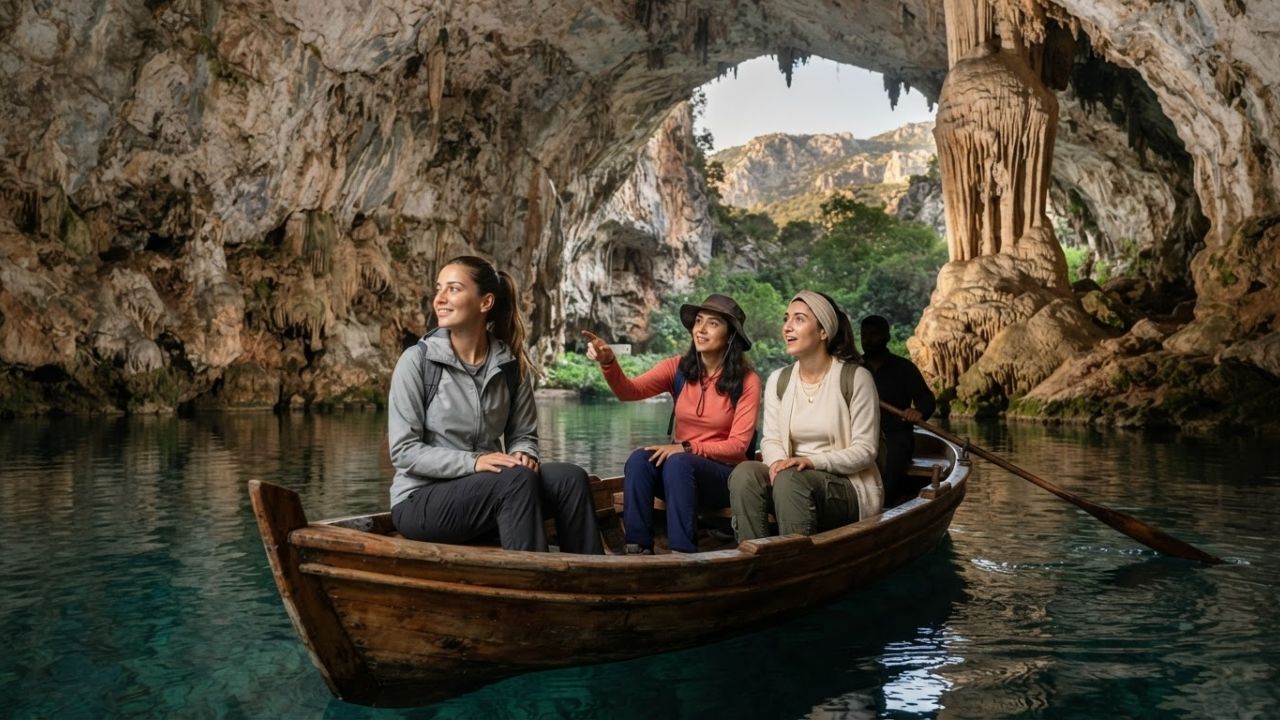
Image generated by AI
Altınbeşik Cave National Park in Mediterranean Türkiye — home to the country's largest underground lake and ranked among the largest subterranean lake systems anywhere in the world — is emerging as one of the region's most compelling slow-travel destinations in 2026, with community-led conservation programs and a growing international appetite for geological tourism directing visitor attention toward its ancient karst chambers, accessible only by wooden boat along an underground river that has been carving through limestone for millennia.
The experience of arriving at Altınbeşik is, by design, an act of subtraction. Mobile signals disappear. The ambient noise of the Mediterranean coastline — which draws millions of visitors to Türkiye annually — gives way to something that functions almost as its opposite: the acoustic environment of a vast underground lake, where the sound of water moving through limestone is the only constant. For a growing segment of international travelers actively seeking escape from the oversaturated coastal tourism circuits of southern Türkiye, that silence has become the destination itself.
Türkiye's Largest Underground Lake and the Karst System That Created It
Altınbeşik Cave National Park, located in the Mediterranean region of Türkiye, contains the country's largest underground lake — a designation that places it within a category of global geological significance. The cave system also ranks among the largest underground lakes in the world, a scale that is genuinely difficult to comprehend before arrival and consistently reported by visitors as exceeding all prior expectation once inside.
The cave is the product of thousands of years of karst formation — the geochemical process by which slightly acidic water, carrying dissolved carbon dioxide from passing through soil, dissolves porous limestone over timescales that dwarf recorded human history. As water carved passages through the bedrock, it created the complex network of chambers, galleries, mineral formations, and aquatic corridors that visitors now enter by boat. The underground river that feeds the lake system continues to flow and reshape the environment, meaning the cave is a living geological system rather than a static museum exhibit.
Stalactites and stalagmites throughout the cave record environmental data in their mineral layers — each formation a natural archive of water chemistry, temperature variation, and rainfall patterns across centuries. Speleologists and climate researchers who work within cave systems like Altınbeşik use these mineral records to reconstruct historical climate patterns, making the cave valuable not only as a tourism asset but as a scientific resource whose preservation directly supports ongoing climate research.
The Boat Ride Into the Dark: What the Altınbeşik Experience Actually Delivers
Access to Altınbeşik's underground lake is not by foot. Visitors board wooden boats at the cave's river entrance and are guided into the darkness along the underground waterway — a mode of access that strips away the self-directed browsing tempo of most museum and park visits and replaces it with something more akin to passage.
The boat ride enforces a particular quality of attention. Without the ability to set your own pace, control your route, or retreat to a comfortable vantage point, the scale and atmosphere of the cave engages differently than a conventionally accessible tourist site. The ceiling rises and drops. Mineral formations emerge from the water and overhang the passage. The light from the guide's lantern creates shadows in chambers that daylight has never reached.
For travelers who have spent the preceding days of a Türkiye trip moving between coastal resorts where the supply of sensory stimulation is continuous and overwhelming, the transition into Altınbeşik's underground environment represents a genuinely disorienting contrast — one that many visitors describe as the most memorable experience of their Mediterranean itinerary, precisely because its qualities are not reproducible by any other means.
The practical implication for travel planning is that Altınbeşik cannot be adequately experienced as a half-day extension of a Antalya beach holiday. The cave's distance from the major coastal resort hubs, the specific experience structure it imposes, and the ecological significance of its surrounding national park all argue for building the visit into a dedicated itinerary segment — ideally combined with the broader landscape of the Taurus Mountain region.
Community-Led Conservation at Altınbeşik: How Local Villages Are Becoming Frontline Stewards
The governance model around Altınbeşik Cave National Park reflects a pattern that is increasingly recognized as the most durable approach to managing high-value natural sites in regions where local communities depend on the same landscape for their economic survival.
Local residents — many from villages whose proximity to the cave and surrounding national park has historically meant limited economic alternatives — are now functioning as the primary guides, caretakers, and service providers for visitors to the park. That integration is not incidental. When the people with the deepest generational knowledge of a landscape are also the people who derive direct economic benefit from its careful management, the incentive structure for conservation becomes self-reinforcing. A guide who grew up walking the limestone plateau above Altınbeşik and whose family's income depends on the cave remaining ecologically intact and internationally appealing has stronger practical motivation to protect it than any externally imposed regulatory framework can generate.
International travelers who choose local guides over generic tourism packages at sites like Altınbeşik are not simply paying a premium for authenticity. They are participating in an economic model that directs revenue toward the communities with the longest-term stake in the destination's survival. Regional artisans, family-run guesthouses in nearby villages, local food producers, and transport operators all benefit when visitor spending circulates within the local economy rather than being captured by vertically integrated tour operators based in Antalya or Istanbul.
This community-centered tourism model is gaining traction across Mediterranean Türkiye as both tourism boards and international travelers recognize that the destinations most likely to remain worth visiting in twenty years are those where conservation and community prosperity are treated as the same objective rather than competing priorities.
Eco-Infrastructure and the Engineering Challenge of Welcoming Visitors Without Damaging the Cave
Providing visitor access to a fragile underground ecosystem without degrading it requires infrastructure solutions that are substantially more constrained than those applicable to surface-level destinations. At Altınbeşik, the boat-based access model is itself the primary ecological protection mechanism — restricting the volume of visitors who can enter the cave at any given time to the capacity of the available boats, and preventing the foot-traffic impact on cave formations and floor sediments that walking access would produce.
Above ground, the national park's management approach prioritizes low-impact infrastructure: elevated wooden boardwalks that minimize direct soil compaction and water-course disruption, lighting systems calibrated to guide visitors without the photosynthesis-enabling wavelengths that promote algae growth on mineral formations, and visitor flow management that prevents the CO₂ concentration increases that large numbers of breathing visitors can produce in enclosed underground spaces.
The conservation tension that exists at every high-value natural site — between the revenue generated by visitor access and the ecological cost of that access — is managed at Altınbeşik through visitor number controls and seasonal management protocols. These constraints, which can frustrate travelers seeking spontaneous visits, are inseparable from the quality of the experience they protect. A cave whose formations remain intact and whose underground lake remains clear is a more compelling destination than one where unconstrained access has produced the gradual degradation visible at many of the world's more heavily visited subterranean attractions.
Slow Travel in Mediterranean Türkiye: Why Altınbeşik Is Attracting the Post-Resort Traveler
The traveler profile emerging at destinations like Altınbeşik in 2026 is distinct from the archetypal Mediterranean tourist. Rather than optimizing an itinerary around beach access, restaurant variety, and accommodation quality, this segment is building trips around specific natural or cultural experiences that cannot be approximated elsewhere — and accepting the logistical complexity of reaching less-connected destinations as part of the experience's value.
Türkiye's Mediterranean coastline has long been one of the world's most visited tourism regions, with destinations including Antalya, Alanya, Bodrum, and Marmaris drawing millions of package-holiday visitors annually. The infrastructure built to serve that market — all-inclusive resorts, charter flight capacity, organized transfers — has made the Turkish coast exceptionally accessible while simultaneously standardizing the experience it delivers.
Altınbeşik exists outside that infrastructure. Reaching it requires engagement with the destination rather than passive consumption of it. The travelers who seek it out in increasing numbers in 2026 are precisely those for whom the friction of getting there is not a problem to be solved but a signal that the experience at the end is genuine.
For this segment, Altınbeşik is part of a broader reorientation of Türkiye as a travel destination — away from the coast's well-documented strengths and toward the Taurus Mountains, the karst plateaux of the interior Mediterranean, and the village communities whose traditions and landscapes have remained relatively unaltered by the mass-market tourism that transformed the coastal strip over the past three decades.
What Visiting Altınbeşik Cave National Park Requires in Practice
For travelers planning an Altınbeşik visit, several practical realities shape the experience.
Access requires reaching the Antalya province interior — typically via private vehicle or organized tour from the provincial capital or coastal resorts. The cave's location within national park boundaries means road access follows the park's management protocols, including seasonal variations in visitor routing.
Booking ahead is essential. Boat capacity limits mean that visitors arriving without prior arrangements during peak season — primarily spring and autumn, when Mediterranean temperatures make cave visits most comfortable — may find access restricted. Local community guide organizations can arrange combined village and cave experiences that distribute the logistical complexity across a structured itinerary.
Timing matters: Morning visits typically offer the most favorable light conditions at the cave entrance and the coolest temperatures for the surrounding national park walks that complement the boat tour. The underground temperature remains stable regardless of season, but the approach through the national park landscape is most rewarding when ambient conditions are mild.
FAQ: Altınbeşik Cave National Park Türkiye 2026
What makes Altınbeşik Cave National Park significant? Altınbeşik Cave National Park in Mediterranean Türkiye is home to the country's largest underground lake and ranks among the largest underground lake systems in the world. The cave is accessible only by boat along an underground river, and its karst formations serve as natural climate archives used by researchers studying long-term environmental change.
How do visitors access Altınbeşik Cave? Visitors enter the cave by wooden boat, guided along the underground river into the cave's interior. Walking access into the cave itself is not available, making the boat ride the defining element of the experience and the primary mechanism for controlling visitor numbers and protecting the cave's geological formations.
Why is community-led tourism important at Altınbeşik? Local villages near Altınbeşik Cave National Park serve as the primary providers of guides, accommodation, and ground services. Community-led tourism ensures that visitor revenue flows to the residents with the strongest long-term incentive to maintain the cave's ecological integrity, creating a self-reinforcing conservation model that external regulation alone cannot replicate.
When is the best time to visit Altınbeşik Cave National Park? Spring and autumn offer the most comfortable conditions for visiting Altınbeşik, with mild ambient temperatures in the surrounding national park landscape. The cave interior maintains a stable underground temperature year-round, making it accessible in summer and winter, though peak visitor pressure during summer months makes advance booking particularly important.
Related Travel Guides
Disclaimer
This article is for informational and educational purposes only. It does not constitute legal, financial, or professional advice. While we strive to provide accurate and up-to-date information, travel policies, regulations, and conditions change rapidly. Always verify information with official sources before making travel decisions. Nomad Lawyer makes no representations about the accuracy, reliability, completeness, or suitability of the information provided. Readers should consult qualified professionals for advice specific to their circumstances. The views expressed in this article are those of the author and do not necessarily reflect the views of Nomad Lawyer.