
Qatar Airways, Emirates, Etihad, Air India, Lufthansa, British Airways, and KLM Reroute Flights Around Russia, Iran, and Gulf Airspace Shutdowns as Ticket Prices Surge 20–30% for India, US, and EU Travelers
Geopolitical airspace shutdowns across Russia, Iran, and the Gulf force seven major airlines to reroute flights through the Arctic and Central Asia, causing 20–30% ticket price surges and significant delays for India, US, and EU passengers.

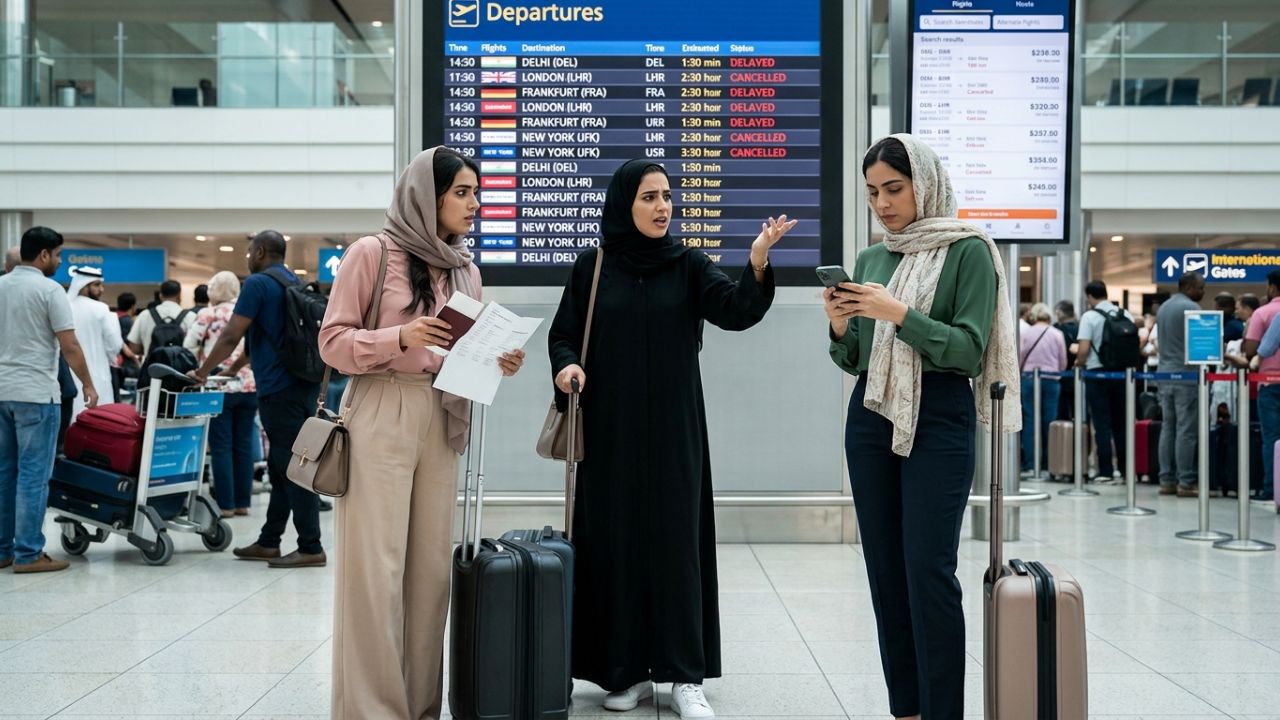
Image generated by AI
Qatar Airways, Emirates, Etihad, Air India, Lufthansa, British Airways, and KLM Forced to Reroute Flights Around Russia, Iran, and Gulf Airspace Shutdowns as Ticket Prices Surge 20–30% for India, US, and EU Tourists
Published on May 13, 2026
The skies above some of the world's most traveled aviation corridors are effectively closed — and the consequences for global air travel in 2026 are severe, expensive, and deeply disruptive. Qatar Airways, Emirates, Etihad Airways, Air India, Lufthansa, British Airways, and KLM have all been forced to reroute their long-haul services away from Russian, Iranian, and Gulf region airspace following a combination of geopolitical tensions and regional conflict escalations that have rendered some of the world's most strategically important flight corridors inaccessible. The impact is being felt at the highest-traffic hubs in global aviation — Dubai International (DXB), Doha's Hamad International (DOH), and London Heathrow (LHR) — where flight times are lengthening, fuel costs are escalating, and ticket prices on key routes between India, the United States, and the European Union are surging by as much as 20–30%. For the millions of travelers planning journeys on the world's most popular long-haul corridors, this is the geopolitical aviation crisis that demands an immediate, clear-eyed response.
Quick Summary:
- Seven major airlines — Qatar Airways, Emirates, Etihad, Air India, Lufthansa, British Airways, and KLM — have been forced to reroute long-haul flights to avoid closed Russian, Iranian, and Gulf region airspaces.
- Major hubs impacted: Dubai (DXB), Doha (DOH), London Heathrow (LHR), Frankfurt (FRA), Amsterdam (AMS), New Delhi (DEL), Mumbai (BOM), New York (JFK), and Los Angeles (LAX).
- Alternative routing corridors in use: Central Asia, the Arctic, North Pacific, and Southeast Asia — all significantly longer than the blocked direct corridors, adding hours to flight times.
- Ticket prices have surged 20–30% on affected routes — particularly on India–Europe, India–North America, Middle East–Europe, and Europe–Asia corridors — driven by increased fuel consumption and operational cost pressure.
- Flight cancellations are occurring on routes where rerouting adds operationally impractical flight hours — particularly some routes that previously transited Iranian or Russian airspace as a necessity of geographic efficiency.
- Airlines are offering waived rebooking fees and alternative routing options for passengers on canceled or significantly delayed services — travelers should contact their carrier immediately if affected.
- Travel insurance with trip interruption coverage is now essential for any itinerary routing through affected carriers and hubs — the disruption environment is genuinely unpredictable and shows no near-term resolution timeline.
The Airspace Closures Explained: How Three Geopolitical Crises Are Rewriting Global Flight Paths
The simultaneous closure of Russian, Iranian, and Gulf region airspaces has created a geopolitical aviation crisis of a scale not seen since the early months of Russia's 2022 Ukraine invasion closed Russian airspace to European and North American carriers.
Russian airspace — closed to most Western carriers since 2022 — was heavily used by European airlines for the Europe-to-East Asia corridors (particularly London/Frankfurt/Paris to Tokyo, Beijing, Seoul, and Hong Kong). The continued closure forces European carriers through the North Pacific or via Gulf hubs, adding hours to previously efficient routings.
Iranian airspace — now partially or fully restricted following the escalation of regional tensions in 2026 — is particularly consequential for Gulf carriers. Emirates, Qatar Airways, and Etihad have historically routed significant portions of their European and Indian subcontinent services through or adjacent to Iranian airspace. The closure forces these carriers to rethink flight paths that their entire network efficiency was partially built around.
Gulf region restrictions — driven by the ongoing regional conflict environment — add a further layer of complexity for carriers whose hub cities (Dubai, Doha, Abu Dhabi) sit within or adjacent to the affected airspace zones. Even carriers whose flights do not transit Iranian territory face operational uncertainty regarding the security environment surrounding their hub airports.
The combination of all three simultaneous restrictions has created an extraordinary aviation geography challenge — multiple airlines, multiple hubs, and multiple major route corridors all simultaneously requiring rerouting solutions that were not designed into these carriers' operational frameworks.
How Each Airline Is Responding: Route by Route, Hub by Hub
Qatar Airways (DOH)
Qatar Airways — whose entire network is built around Hamad International in Doha — is rerouting long-haul services to New York (JFK), Paris (CDG), London (LHR), and other European and North American destinations via the North Pacific, adding significant block time to services that previously benefited from more efficient routing across the affected airspace regions.
The carrier is expanding Southeast Asia services to maintain passenger flow through alternative connectivity channels, and is offering full rebooking flexibility for passengers on affected services.
Emirates (DXB)
Emirates — operating from Dubai International, the world's busiest international airport — is adjusting its India and London routes most significantly, with services rerouted via Central Asian corridors. The carrier's extraordinary scale (over 270 aircraft, 150+ destinations) provides some rerouting flexibility that smaller carriers cannot access, but the operational cost impact of longer routing on Emirates' high-frequency services is substantial.
Etihad Airways (AUH)
Etihad Airways — Abu Dhabi-based — is revising flight paths for European and Asian long-haul departures, with particular impact on the carrier's India corridors (Delhi, Mumbai, Chennai) that previously benefited from efficient routing through now-restricted airspace zones.
Air India (DEL / BOM)
Air India — already managing a complex fleet modernization program — faces perhaps the most acute impact of any carrier in this crisis. India's primary international carrier relies on efficient transoceanic and overland routing to North America and Europe, and the closure of both Russian airspace (for its transpacific operations) and Iranian airspace (for some Middle East and European routing) forces significant rerouting that adds hours to journeys that Indian passengers are acutely cost-sensitive about.
Air India's New Delhi to San Francisco route — one of its flagship transpacific services — is being rerouted via Central Asian corridors, adding materially to block time and fuel cost.
Lufthansa (FRA / MUC)
Lufthansa faces compounding challenges from Russian airspace closure (impacting its East Asia routes, which must now route via the Arctic or Gulf) and the Gulf region instability (affecting its Middle East connectivity). The carrier has implemented Arctic routing for some Frankfurt–Tokyo Narita services — adding approximately 2–3 hours compared to the Siberian routing that Russian airspace previously allowed.
British Airways (LHR)
British Airways is rerouting London Heathrow to Hong Kong (HKG) services via Southeast Asia following the restrictions affecting its previously used corridors, and is adjusting Middle East services to account for Gulf airspace uncertainty. The carrier has significantly modified its operational flying to ensure aircraft and crew remain outside restricted zones throughout all phases of flight.
KLM (AMS)
KLM — Amsterdam-based — is adjusting key Middle East and Asia services from Amsterdam Schiphol, increasing fleet utilization on alternative routing corridors while managing the additional fuel and crew costs associated with longer flight times.
The Price Surge: What 20–30% More Expensive Means for Travelers
The 20–30% ticket price increase on affected corridors represents one of the most significant sudden fare escalations on major aviation routes since the post-pandemic demand surge of 2022.
For India–Europe travelers — the largest volume market on the affected corridors — a 25% price increase on a typical round-trip Economy fare of US$800–$1,200 translates to an additional US$200–$300 per person. For families of four traveling from Mumbai or Delhi to London or Frankfurt, the cumulative cost impact is US$800–$1,200 additional per trip — a sum that meaningfully changes travel affordability calculations.
For India–US travelers — a market that has seen extraordinary growth in direct and one-stop services over the past three years — the combination of longer flight times and higher fares creates both cost and schedule disruption. Air India's direct Delhi–San Francisco service, Air India's Delhi–New York JFK, and connecting services via Gulf hubs all face elevated pricing pressure.
For EU–Asia travelers — particularly those routing between Europe and Japan, South Korea, Southeast Asia, or Australia — the Arctic and North Pacific rerouting adds 2–4 hours to return journey times and elevates fuel surcharges that feed directly into ticket pricing.
Guide for Travelers:
- Check your specific route's airspace impact before drawing conclusions about your journey. Not all routes through DXB, DOH, or LHR are equally affected — short-haul and some regional services are not impacted. Use your airline's website and FlightRadar24 to check actual routing on your specific flight.
- Rebook canceled flights immediately — airlines including Qatar Airways, Emirates, Etihad, and Lufthansa are waiving rebooking fees for passengers on canceled or significantly delayed services. Contact the airline directly or use the app; do not wait for the airline to contact you.
- Book refundable or flexible fares for any upcoming long-haul travel through affected regions — the airspace situation is geopolitically uncertain and could deteriorate further or improve. Flexible tickets give you the ability to date-shift without financial penalty.
- Purchase travel insurance now if you haven't already — trip interruption, flight delay (typically 3+ hours), and missed connection coverage are the most valuable components for this disruption environment. World Nomads, Allianz Global Assistance, and AXA Travel Insurance all offer strong long-haul disruption products.
- Budget for the 20–30% fare increase if booking new tickets on India–Europe, India–US, Middle East–Europe, or Europe–Asia corridors. Waiting for prices to return to pre-disruption levels is not advisable — airspace closures of this type typically persist for extended periods.
- Consider alternative hub routings: For India-to-North America travelers, carriers routing through Singapore (Singapore Airlines via SIN), Tokyo (ANA or JAL via NRT), or Seoul (Korean Air via ICN) may offer more efficient routing options than Gulf hub connections that are currently subject to the most acute disruption.
- For London Heathrow travelers: British Airways Avios holders facing route changes should contact the BA Executive Club line — significant disruptions typically trigger points-protected rebooking options that allow status members to protect their ticket value on alternative routings.
- Monitor updates at your airline's official website: The airspace situation in 2026 is evolving rapidly. Route adjustments that are operational today may change within 48 hours as the geopolitical situation develops.
Related Travel Guides
- UK, Germany, and France to Enjoy Cheaper Summer Airfares Despite 80% Fuel Surge and 13,000 Cancellations
- Etihad Airways Denies Fire on Chennai to Abu Dhabi Flight EY343 After Technical Issue Triggers Emergency Response
- Middle East Aviation Crisis: EgyptAir, Saudia, and FlyDubai Cancel 48 Flights Across Cairo, Dubai, and Jeddah
The simultaneous closure of Russian, Iranian, and Gulf airspace in 2026 has created one of the most complex geopolitical aviation disruptions in recent history — a challenge that Qatar Airways, Emirates, Etihad, Air India, Lufthansa, British Airways, and KLM are managing with extraordinary operational resourcefulness but at unavoidable cost to both their own economics and to the passengers whose journeys depend on the efficient functioning of the global airspace network. Ticket prices are up. Flight times are longer. Some routes are canceled. The disruption is real, and its duration is uncertain. But the destinations remain extraordinary — India's incomparable heritage cities, the Gulf's magnificent modernity, Europe's ancient cultural capitals, and the US West Coast's dynamic innovation hubs — and the airlines serving these corridors are doing everything operationally possible to keep global connectivity functioning. Book flexibly. Insure fully. Stay informed. And know that the world's finest aviation teams are working every hour to find the best possible path through the closed skies to the destinations that matter most.
Disclaimer
This article is for informational and educational purposes only. It does not constitute legal, financial, or professional advice. While we strive to provide accurate and up-to-date information, travel policies, regulations, and conditions change rapidly. Always verify information with official sources before making travel decisions. Nomad Lawyer makes no representations about the accuracy, reliability, completeness, or suitability of the information provided. Readers should consult qualified professionals for advice specific to their circumstances. The views expressed in this article are those of the author and do not necessarily reflect the views of Nomad Lawyer.
Kunal K Choudhary
Co-Founder & Contributor
A passionate traveller and tech enthusiast. Kunal contributes to the vision and growth of Nomad Lawyer, bringing fresh perspectives and driving the community forward.
Learn more about our team →