
Paris CDG, New York JFK, Tokyo Haneda, London Heathrow, and Dubai Airports Boost Profits Through Retail and Parking as Delta, Emirates, United, Lufthansa, and ANA Passengers Feel the Cost Impact
The world's busiest airports — Paris CDG, New York JFK, Tokyo Haneda, London Heathrow, and Dubai DXB — are rewriting their business models around retail, parking, and commercial revenue, shifting cost pressure onto airlines and travelers.

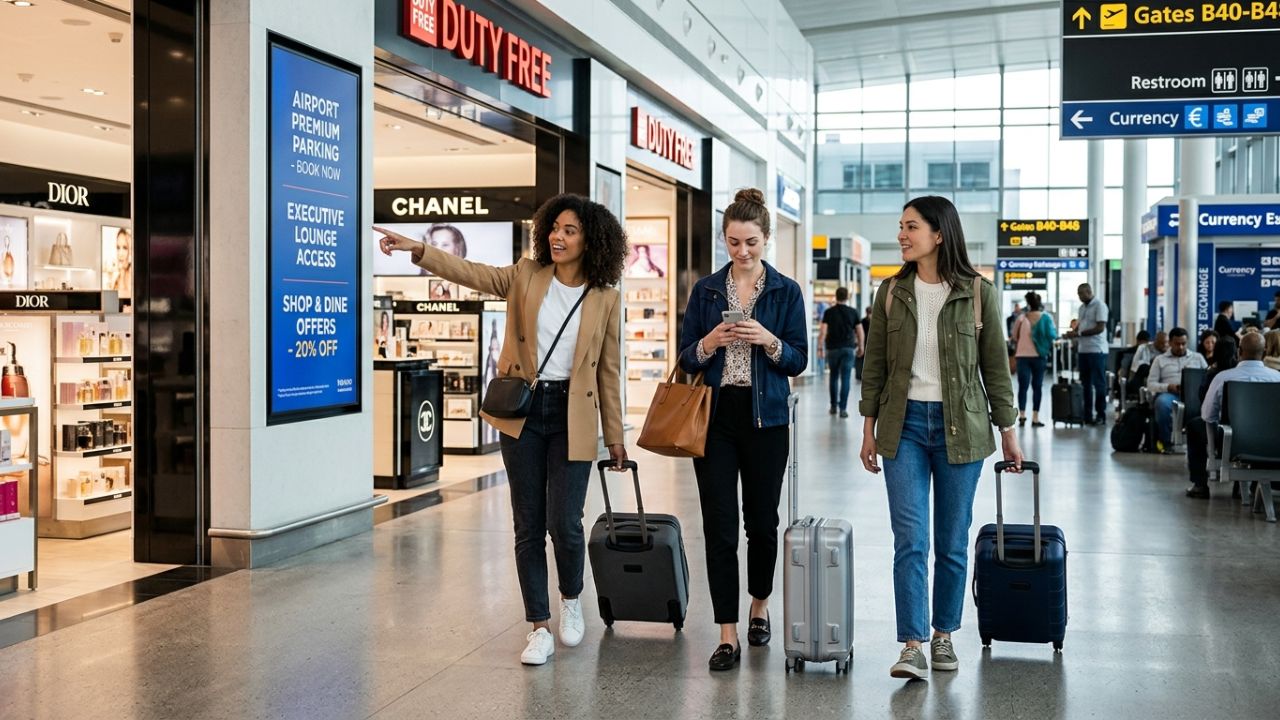
Image generated by AI
Paris CDG, New York JFK, Tokyo Haneda, London Heathrow, and Dubai Airports Boost Profits Through Retail, Parking, and Commercial Revenue as Delta, Emirates, United, Lufthansa, and ANA Passengers Bear the Rising Cost
Published on May 13, 2026
The world's greatest airports have always been more than transit points — they have been cities unto themselves, with hotels, restaurants, art galleries, spas, and retail empires contained within their extraordinary terminals. But in 2026, the financial architecture behind those terminal cities is undergoing a fundamental transformation — and it has direct consequences for every passenger boarding a Delta, Emirates, United Airlines, Lufthansa, or ANA flight through Paris Charles de Gaulle, New York JFK, Tokyo Haneda, London Heathrow, Dubai International, or Sydney Airport. As global passenger traffic races toward 10.2 billion travelers annually, the world's most powerful airport authorities are discovering that growing passenger numbers alone no longer guarantee profitability. The answer? Non-aeronautical revenue — the extraordinary and rapidly expanding ecosystem of retail, parking, property leases, lounge services, and premium commercial offerings that now, at the world's most sophisticated hubs, generates as much revenue as the landing fees and passenger service charges that aviation has traditionally relied upon. This is the business transformation reshaping global aviation — and this is what it means for every traveler walking through those magnificent, revenue-optimized terminals.
Quick Summary:
- Global airports including Paris CDG, New York JFK, Tokyo Haneda, London Heathrow, Dubai DXB, and Sydney are aggressively expanding non-aeronautical revenue streams — retail, parking, property, and premium services — to offset rising operational costs that aviation fees alone cannot cover.
- Global passenger traffic is forecast to reach 10.2 billion people by 2026 — but higher passenger numbers are no longer sufficient on their own to guarantee airport profitability, driving the shift to commercial diversification.
- Airports of Thailand (AOT) has raised its passenger service charge from 730 baht to 1,120 baht per passenger — expected to generate an additional 10 billion baht annually — a concrete example of the global PSC increase trend.
- Airlines most affected: Delta, Emirates, United Airlines, Lufthansa, and ANA — all operating high-frequency services through the most commercially aggressive major hubs — face higher service charges that create direct pressure on ticket pricing and route economics.
- Traveler impact is dual: Higher airport fees contribute to rising total ticket prices, while non-aeronautical reinvestment funds improved lounges, faster check-ins, enhanced retail, and sustainability infrastructure that benefits the passenger experience.
- Budget travelers face the most pressure — the premium retail and commercial focus of non-aeronautical models primarily benefits higher-spending passengers, potentially widening the experience gap between premium and economy travel.
- Airlines are responding through route rationalization, pricing model adjustment, and direct collaboration with airport authorities to ensure fee increases produce tangible passenger benefits.
The Business Model Revolution: How the World's Airports Are Reinventing Themselves
The shift from aeronautical-first to non-aeronautical-dominant airport economics is one of the most significant structural changes in global aviation finance — and it has been building for years.
Traditional airport revenue models were straightforward: charge airlines landing fees, terminal fees, and passenger service charges proportional to aircraft size and passenger volumes. The more flights, the more revenue. The bigger the aircraft, the bigger the fee. Airport profitability was, at its core, a simple function of traffic volume.
That model worked when jet fuel was cheap, airline margins were reasonable, and passenger growth rates were predictable. The aviation disruptions of the pandemic era — followed by cost inflation, fuel price surges, and labor market pressures — exposed the fragility of pure aeronautical revenue dependence. Airports discovered that when airlines cut routes, reduce frequencies, or collapse entirely, pure aeronautical revenue models produce catastrophic revenue gaps.
Non-aeronautical revenue — everything from the Gucci store in Terminal 2F at Paris CDG to the 50,000-space car park at London Heathrow, from the luxury hotel embedded in Singapore Changi's Terminal 3 to the premium lounge subscription services at New York JFK — represents the airport industry's answer to this fragility. Revenue sources that continue to generate income regardless of individual airline decisions, weather disruptions, or geopolitical flight restrictions.
Paris CDG: Europe's Greatest Airport Hub Leads the Retail Revolution
Paris Charles de Gaulle Airport — Europe's second-busiest airport and France's primary international gateway — has been among the most aggressive global airports in developing non-aeronautical revenue over the past decade.
CDG's extraordinary duty-free and luxury retail complex — spanning multiple terminals with French fashion houses, perfumeries, Parisian food halls, and wine specialists — generates revenues that rival and in some cases exceed the aeronautical income from the same terminal. LVMH-adjacent brands, Hermès, Cartier, L'Occitane, and the extraordinary food offerings of the Relay and Exki network create a commercial environment that makes Paris CDG one of the most sophisticated shopping destinations in Europe — regardless of whether you're catching a flight.
For Delta Airlines — CDG's largest transatlantic partner alongside Air France through the SkyTeam alliance — the consequence of this non-aeronautical expansion is a passenger service charge environment that has risen steadily, adding cost pressure to Delta's Paris operations that the carrier must either absorb or pass through to ticket prices.
For travelers, the CDG retail experience is genuinely extraordinary — but the elevated passenger service charges that fund it are an invisible component of every ticket price through France's flagship gateway.
New York JFK: America's Global Gateway Redefines the Airport Economy
John F. Kennedy International Airport — New York City's primary international gateway and one of the world's most iconic aviation addresses — is in the middle of a $19 billion transformation that represents the most ambitious airport reinvestment program in American aviation history.
That transformation is funded — in significant part — by JFK's rapidly expanding non-aeronautical revenue ecosystem, which includes the airport's extraordinary Terminal 4 retail complex, extensive parking infrastructure serving one of the world's most car-dependent metropolitan areas, and an expanding portfolio of food, beverage, and luxury service concessions that target the enormous premium traveler segment that JFK's transatlantic and international route network attracts.
United Airlines, Delta Air Lines, and international carriers including British Airways, Lufthansa, and Emirates all operate major JFK services — and all face the passenger service charge environment that JFK's Port Authority of New York and New Jersey has calibrated to fund both operational costs and the transformation project.
For the travelers pouring through JFK on Emirates' A380 services, Delta's transatlantic network, and United's global connections, the airport's commercial revenues are being reinvested in dramatically improved terminal experiences — new lounges, faster security lanes, redesigned arrivals halls — that make JFK's transformation genuinely visible and experiential, not just financial.
Tokyo Haneda: Japan's Precision Hub Adds Commercial Sophistication
Tokyo Haneda Airport — already widely praised for its extraordinary cleanliness, operational precision, and remarkably authentic Japanese food and retail offerings — has been expanding its non-aeronautical revenue base in ways that align perfectly with the premium expectations of Japan's international visitor market.
Haneda's famous market hall in Terminal 3's international arrivals area — featuring genuine regional Japanese specialty foods, sake, green tea, handcraft items, and seasonal local products — is one of global aviation's finest examples of airport retail authentically connected to local culture. This is not generic duty-free — it is a curated expression of Japanese food and craft culture that generates genuine retail revenue while simultaneously serving as a powerful destination marketing tool.
ANA (All Nippon Airways) and Japan Airlines — along with their international partners including Lufthansa, Delta, Emirates, and United — operate through a Haneda that is raising passenger service charges in line with its expanding commercial infrastructure. For travelers, Haneda's PSC increases are offset by one of the world's genuinely finest airport commercial experiences — a terminal environment where spending feels rewarding rather than extractive.
London Heathrow: The World's Busiest International Airport and Its Retail Empire
London Heathrow Airport — the world's busiest international airport by international passenger count — has been operating one of the most sophisticated non-aeronautical revenue models in global aviation for decades, and its approach represents the industry benchmark for commercially integrated airport strategy.
Heathrow's Terminal 5 retail hall (dedicated to British Airways' premium passengers), the Fortnum & Mason and Harrods presence in landside and airside retail, and the airport's extraordinary parking estate — one of the largest and most profitable in the UK — collectively generate revenues that fund Heathrow's continuous infrastructure investment and operational excellence.
Heathrow's passenger service charge, at approximately £27–£33 per departing passenger depending on terminal and class, is among the highest of any major international hub — a PSC level that reflects both the airport's extraordinary operational costs and its position as a genuinely premium international gateway.
For British Airways, Virgin Atlantic, Emirates, Delta, and Lufthansa — all operating major Heathrow services — the PSC environment is a significant operational cost that informs route economics, particularly on competitive transatlantic routes where margin pressure is constant.
Dubai International: The World's Busiest International Airport Invests at Scale
Dubai International Airport (DXB) — the world's busiest airport by international passenger traffic, processing over 85 million passengers annually — operates perhaps the world's most ambitious non-aeronautical revenue ecosystem at any single airport facility.
Dubai Duty Free — the airport's legendary retail arm — generated revenues exceeding US$2.1 billion in its most recent full trading year, making it one of the largest duty-free operations on the planet. The jewellery halls, electronics floors, perfumery areas, and extraordinary food and beverage offerings of DXB's Terminals 1, 2, and 3 create a commercial environment that is genuinely destination-competitive with major urban retail districts.
Emirates — DXB's home carrier and the world's largest long-haul airline — is in a unique relationship with Dubai International, as both the airport's primary commercial driver and a major payer of its passenger service charges. The airline's extraordinary scale at DXB gives it negotiating influence that other carriers serving the airport cannot match.
For international carriers including United, Delta, Lufthansa, and ANA operating Gulf connections through DXB, the passenger service charge environment reflects both the airport's premium infrastructure and the extraordinary commercial revenues that Dubai Duty Free generates for the overall airport system.
Guide for Travelers:
- Check total ticket cost — not just the base fare — airport passenger service charges and infrastructure fees are typically embedded in the total ticket price shown by airlines and booking platforms. Understanding what percentage of your ticket is aviation fees vs. carrier costs helps identify true value.
- Use airport lounges where accessible — at major non-aeronautical revenue hubs including Heathrow, CDG, JFK, Dubai DXB, and Haneda, lounge access (through airline status, Priority Pass, or day passes) allows you to access premium services that the airport's commercial reinvestment has funded. This is the most direct way to convert higher PSCs into personal travel value.
- Shop strategically at duty-free — Dubai Duty Free, CDG's luxury retail, and Heathrow's premium stores offer genuine savings on luxury goods, perfumes, alcohol, and electronics compared to high-street retail. The airport's commercial revenue model partially funds its operations through your purchases — so buying strategically at quality airport retail is a genuine value exchange.
- Pre-book airport parking early — major airport parking at JFK, Heathrow, CDG, and Sydney is a primary non-aeronautical revenue source. Pre-booking via official airport parking platforms consistently delivers 20–40% savings compared to walk-in rates.
- Airports of Thailand PSC increase: If you're transiting through Bangkok's Suvarnabhumi or Don Mueang in 2026, the new 1,120 baht PSC (up from 730 baht) is embedded in your ticket. Budget accordingly for onward Thai destination travel.
- Best airports for premium retail experiences: Dubai DXB (duty-free scale), Singapore Changi (entertainment and dining), Tokyo Haneda (authentic Japanese products), Heathrow T5 (luxury British brands), and CDG (French fashion and food) consistently lead global rankings for commercial airport quality.
- For budget-conscious travelers: Consider whether routing through smaller, lower-PSC regional airports serves your destination equivalently. Secondary airports in major European cities (London Gatwick vs. Heathrow, Paris Orly vs. CDG, Milan Bergamo vs. Malpensa) often carry meaningfully lower passenger service charges, with modest additional transit time to city centers.
Related Travel Guides
- UK, Germany, and France to Enjoy Cheaper Summer Airfares Despite 80% Fuel Surge and 13,000 Cancellations
- Lufthansa Acquires 90% Majority Stake in ITA Airways for €325 Million, Reshaping European Aviation
- Emirates, British Airways, KLM, and Ryanair Cancel 12 Flights Across Heathrow, Gatwick, and Manchester
The transformation of Paris CDG, New York JFK, Tokyo Haneda, London Heathrow, Dubai DXB, and Sydney Airport into commercially integrated revenue ecosystems is not simply a business story — it is a story about what airports are becoming in the 21st century. These are no longer transit facilities. They are destinations in their own right — places where Delta, Emirates, United, Lufthansa, and ANA passengers browse Hermès, taste Michelin-quality food, enjoy Japanese craft markets, and access luxury lounges that rival the finest hotels in the cities they're connecting to. The rising passenger service charges that fund these experiences are real, and their impact on ticket prices is measurable. But the investment is equally real — and the airports that get this balance right are creating travel environments that make the journey itself part of the destination experience. Shop strategically. Use your lounge access. Pre-book your parking. And recognize that the extraordinary airports you pass through are engineering every square meter of their terminal space to give you more reasons to spend — and more reasons to love being there.
Disclaimer
This article is for informational and educational purposes only. It does not constitute legal, financial, or professional advice. While we strive to provide accurate and up-to-date information, travel policies, regulations, and conditions change rapidly. Always verify information with official sources before making travel decisions. Nomad Lawyer makes no representations about the accuracy, reliability, completeness, or suitability of the information provided. Readers should consult qualified professionals for advice specific to their circumstances. The views expressed in this article are those of the author and do not necessarily reflect the views of Nomad Lawyer.
Kunal K Choudhary
Co-Founder & Contributor
A passionate traveller and tech enthusiast. Kunal contributes to the vision and growth of Nomad Lawyer, bringing fresh perspectives and driving the community forward.
Learn more about our team →