
AirAsia Expands Osaka-Taipei-Kuala Lumpur Route to Nine Weekly Flights for Winter 2026–27
AirAsia expands its Osaka-Taipei-Kuala Lumpur route to nine weekly flights for winter 2026–27, deploying Airbus A321neo aircraft and taking over operations from AirAsia X.

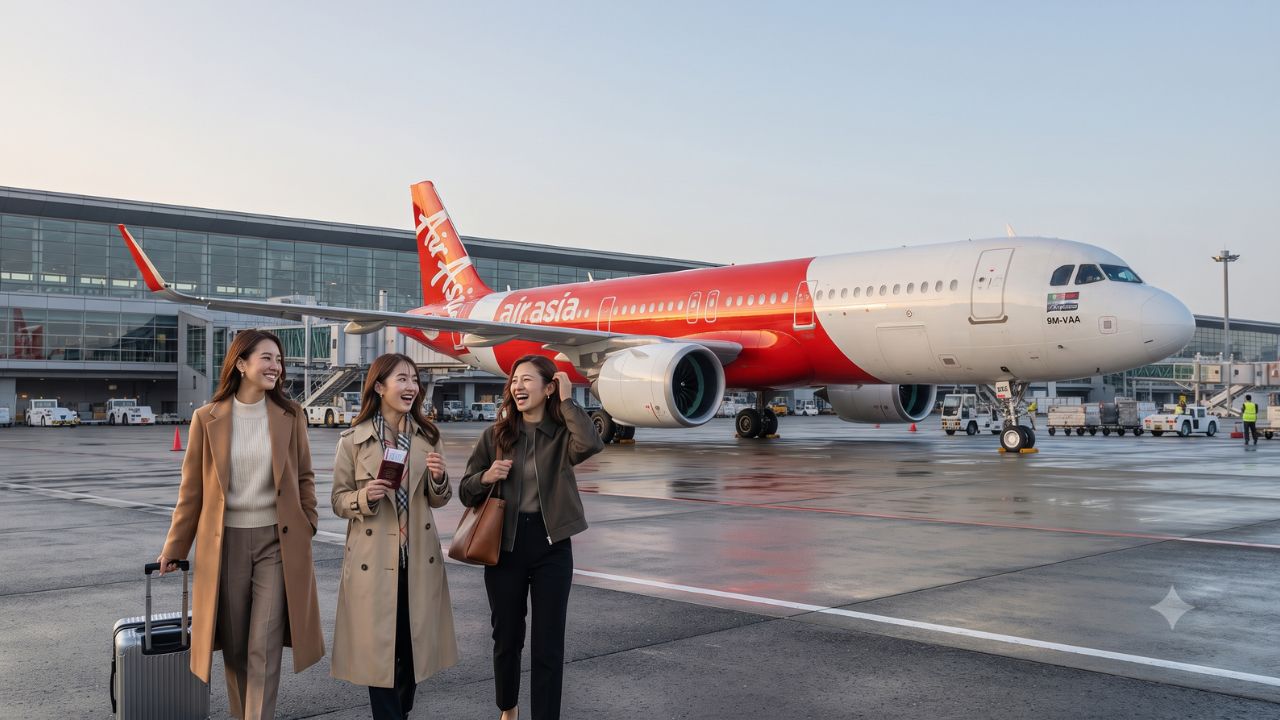
A 28.6% expansion in scheduled flight frequencies along the Osaka–Taipei–Kuala Lumpur corridor highlights an aggressive winter scheduling adjustment by AirAsia as budget carriers restructure multi-sector Asian operations. Beginning 22 November 2026 and continuing through 24 February 2027, the low-cost carrier will augment its existing daily frequency by adding two weekly return services, increasing total operations on the route to nine weekly round trips. This seasonal ramp-up coincides with an earlier structural carrier realignment taking effect on 25 October 2026, when short-haul operator AirAsia assumes route management from medium-haul affiliate AirAsia X, replacing twin-aisle Airbus A330-300 wide-body aircraft with fuel-efficient Airbus A321neo narrow-body jets.
The operational realignment reflects tactical network management across North and Southeast Asia, combining seasonal demand absorption with disciplined aircraft gauge control. By transferring the multi-sector service to mainline AirAsia while maintaining separate nonstop Osaka–Kuala Lumpur flights under AirAsia X, the airline group is recalibrating its capacity to serve three distinct passenger flows without overcommitting wide-body capacity to intermediate sectors.
Fleet Reallocation and Winter Capacity Strategy Across East Asia
The schedule adjustment announced in mid-October 2026 specifically targets the multi-stop rotation linking Osaka Kansai International Airport (KIX), Taipei Taoyuan International Airport (TPE), and Kuala Lumpur International Airport (KUL). Operating under flight numbers AK179 and AK178, the service functions as an integrated multi-market trunk route. Rather than serving purely point-to-point itineraries, the rotation provides commercial capacity for passengers flying between Japan and Taiwan, travelers moving between Taiwan and Malaysia, and through-ticketed customers completing the full three-city journey.
The operational handover on 25 October 2026 represents a notable divergence in fleet strategy. AirAsia X, which specializes in medium- and long-haul operations utilizing high-density wide-body aircraft, vacates the one-stop routing to concentrate resources on its direct, non-stop flights between Osaka and Kuala Lumpur. Mainline AirAsia, which commands a vast short-haul regional network across ASEAN, assumes full operational control using the single-aisle Airbus A321neo.
Parallel fleet shifts are simultaneously taking place across AirAsia's broader regional matrix for the winter 2026–27 timetable:
- Fukuoka–Taipei–Kota Kinabalu: Transitioning to Airbus A321neo aircraft to augment passenger capacity between Kyushu, northern Taiwan, and Sabah in Malaysian Borneo.
- Osaka/Kansai–Kaohsiung: Introducing Airbus A321neo aircraft on direct flights linking western Japan with southern Taiwan's maritime commercial hub, raising seat counts without adding departure frequencies.
- Osaka/Kansai–Taipei–Kuala Lumpur: Adding two weekly rotations operated by the Airbus A321neo, elevating departures from seven to nine round trips weekly during the winter peak.
This synchronized deployment illustrates how the group uses narrow-body equipment to adjust capacity on secondary and multi-sector routes where wide-body economics present unnecessary yield exposure.
Flight Timetables and Winter Operating Schedules
The temporary frequency expansion commences on 22 November 2026 and concludes on 24 February 2027. The supplemental services depart Osaka/Kansai on Mondays and Wednesdays, while the corresponding departures from Kuala Lumpur operate on Sundays and Wednesdays. Because the flights operate with different departure blocks depending on the day of the week, flight timing variations require careful planning by passengers booking connecting rail, ferry, or regional flight connections.
All times indicated in the schedule published via Traicy on 12 October 2026 reflect local airport time zones.
| Flight Number | Sector / Routing | Day of Operation | Departure Time | Intermediate Stop (Taipei Taoyuan) | Final Destination Arrival | Aircraft Type |
|---|---|---|---|---|---|---|
| AK179 | Osaka (KIX) – Taipei (TPE) – Kuala Lumpur (KUL) | Monday | Osaka 13:25 | Arrives 15:45 / Departs 17:00 | Kuala Lumpur 21:50 | Airbus A321neo |
| AK179 | Osaka (KIX) – Taipei (TPE) – Kuala Lumpur (KUL) | Wednesday | Osaka 14:55 | Arrives 17:15 / Departs 18:30 | Kuala Lumpur 23:20 | Airbus A321neo |
| AK178 | Kuala Lumpur (KUL) – Taipei (TPE) – Osaka (KIX) | Sunday | Kuala Lumpur 23:40 | Arrives 04:40 (+1) / Departs 05:55 (+1) | Osaka 09:35 (Monday) | Airbus A321neo |
| AK178 | Kuala Lumpur (KUL) – Taipei (TPE) – Osaka (KIX) | Wednesday | Kuala Lumpur 03:05 | Arrives 08:05 / Departs 09:20 | Osaka 13:00 | Airbus A321neo |
The timetable structure reveals distinct logistical patterns for travelers. The Sunday departure from Kuala Lumpur operates as an overnight red-eye flight, landing in Taipei before dawn at 04:40 on Monday morning before continuing to Osaka for a 09:35 arrival. In contrast, the Wednesday outbound service from Kuala Lumpur departs in the early morning at 03:05, reaching Osaka just after midday at 13:00. On the southbound return from Osaka, both flights provide afternoon departures that reach Kuala Lumpur late in the evening.
| Route Parameter | Prior Operations (Pre-25 Oct 2026) | Transition Operations (25 Oct – 21 Nov 2026) | Peak Winter Expansion (22 Nov 2026 – 24 Feb 2027) |
|---|---|---|---|
| Operating Carrier | AirAsia X (D7) | AirAsia (AK) | AirAsia (AK) |
| Assigned Aircraft | Airbus A330-300 (Twin-Aisle) | Airbus A321neo (Single-Aisle) | Airbus A321neo (Single-Aisle) |
| Weekly Round Trips | 7 (Daily) | 7 (Daily) | 9 (Mon/Wed extra from KIX; Sun/Wed extra from KUL) |
| Intermediate Stop | Taipei Taoyuan (TPE) | Taipei Taoyuan (TPE) | Taipei Taoyuan (TPE) |
| Nonstop Alternative | AirAsia X Nonstop KIX–KUL | AirAsia X Nonstop KIX–KUL | AirAsia X Nonstop KIX–KUL |
Expert Analysis: Narrow-Body Economics and Fifth-Freedom Fleet Optimization
For passengers booking international itineraries through East Asia, the transition from wide-body to narrow-body equipment highlights important commercial and operational realities. According to commercial airline capacity research from the International Air Transport Association (IATA), operating twin-aisle wide-body aircraft on multi-leg routes carries substantial financial liabilities when seasonal demand fluctuates unevenly between intermediate flight sectors.
A twin-aisle Airbus A330-300 carries over 370 passengers in standard budget configurations. Filling that volume of seats on both the Osaka–Taipei sector and the Taipei–Kuala Lumpur leg requires airlines to heavily discount tickets during off-peak mid-week periods. By contrast, deploying the Airbus A321neo lowers the airline's trip-cost threshold. The narrow-body aircraft burns significantly less fuel per flight hour while offering a capacity envelope that allows AirAsia to defend passenger yields. Adding two weekly rotations—reaching nine weekly round trips—gives the carrier the schedule density needed to capture business and short-break leisure travelers without flooding the market with unabsorbed seat inventories.
From a regulatory standpoint, operating international flights with intermediate stops requires traffic rights coordinated under bilateral air service agreements managed by bodies such as the Civil Aeronautics Administration of Taiwan. These traffic rights permit the carrier to deplane and board independent passenger segments in Taipei. AirAsia effectively operates two distinct commercial routes within a single aircraft rotation: East Asian regional traffic between Kansai and Taiwan, and Southeast Asian traffic between Taiwan and Malaysia.
For consumers, however, the shift brings tangible trade-offs in comfort and journey logistics:
- Cabin Architecture: Transitioning from the twin-aisle A330-300 to the single-aisle A321neo changes cabin dynamics. While the A321neo features modern cabin air systems and quieter engines, long journeys exceeding seven hours of total flight time on narrow-body aircraft offer less aisle space and restricted movement compared to wide-body jets.
- Intermediate Transit Protocols: Travelers booking the complete Osaka–Kuala Lumpur journey via Taipei must carefully review boarding pass issuance and transit requirements. Depending on ticketing arrangements, passengers may be required to disembark during the scheduled 75-minute ground stop in Taipei Taoyuan, undergo security screening, and re-board the same aircraft.
- Nonstop vs. Multi-Sector Pricing: Travelers seeking the fastest transit time between Osaka and Malaysia should confirm whether their reservation corresponds to the AK-operated one-stop flight or the separate nonstop service retained by AirAsia X. Nonstop flights bypass intermediate customs airspace and save upwards of two hours of total travel time.
Key Takeaways
- Frequency Expansion: AirAsia increases its Osaka/Kansai–Taipei/Taoyuan–Kuala Lumpur schedule from seven to nine weekly round trips between 22 November 2026 and 24 February 2027.
- Fleet Transition: Mainline AirAsia assumes route management from AirAsia X on 25 October 2026, replacing Airbus A330-300 wide-body aircraft with Airbus A321neo narrow-body jets.
- Additional Flight Departures: Supplemental services depart Osaka on Mondays (AK179 at 13:25) and Wednesdays (AK179 at 14:55), with extra departures from Kuala Lumpur on Sundays (AK178 at 23:40) and Wednesdays (AK178 at 03:05).
- Nonstop Alternative Retained: AirAsia X will continue operating dedicated nonstop flights between Osaka and Kuala Lumpur independently of the expanded Taipei-routed service.
- Regional Capacity Upgrades: AirAsia is simultaneously upgrading aircraft on the Fukuoka–Taipei–Kota Kinabalu and Osaka–Kaohsiung routes to the Airbus A321neo for the winter 2026–27 season.
FAQ: AirAsia East Asia Route Expansion 2026–2027
When do the additional AirAsia flights between Osaka, Taipei, and Kuala Lumpur operate?
The two additional weekly round trips begin on 22 November 2026 and conclude on 24 February 2027, temporarily expanding the route from seven to nine weekly frequencies.
Does AirAsia X still offer direct nonstop flights between Osaka and Kuala Lumpur?
Yes. AirAsia X maintains its separate nonstop flights between Osaka and Kuala Lumpur. The operational transfer to AirAsia and the A321neo aircraft applies exclusively to the routing via Taipei.
What aircraft operates the expanded Osaka–Taipei–Kuala Lumpur route?
The route is operated by the single-aisle Airbus A321neo, replacing the twin-aisle Airbus A330-300 previously deployed by AirAsia X on the one-stop service.
Can passengers book only the Osaka–Taipei or Taipei–Kuala Lumpur segment?
Yes. The service operates with traffic rights allowing passengers to purchase individual segments between Osaka and Taipei, Taipei and Kuala Lumpur, or the complete through-itinerary.
Savvy travelers booking winter flights across East Asia should carefully verify intermediate stopover times and aircraft types to balance cost savings against narrow-body transit comfort.
Related Travel Guides
Disclaimer
This article is for informational and educational purposes only. It does not constitute legal, financial, or professional advice. While we strive to provide accurate and up-to-date information, travel policies, regulations, and conditions change rapidly. Always verify information with official sources before making travel decisions. Nomad Lawyer makes no representations about the accuracy, reliability, completeness, or suitability of the information provided. Readers should consult qualified professionals for advice specific to their circumstances. The views expressed in this article are those of the author and do not necessarily reflect the views of Nomad Lawyer.
Kunal K Choudhary
Co-Founder & Contributor
A passionate traveller and tech enthusiast. Kunal contributes to the vision and growth of Nomad Lawyer, bringing fresh perspectives and driving the community forward.
Learn more about our team →