
Finnair AirLounge Business Class Redefines Long-Haul Comfort with Motorless Shells and Nordic Design
Finnair and Collins Aerospace eliminate motorized recline with the AirLounge fixed-shell seat, combining 1969 Ultima Thule heritage with weight-saving cabin engineering on Delhi–Helsinki routes.

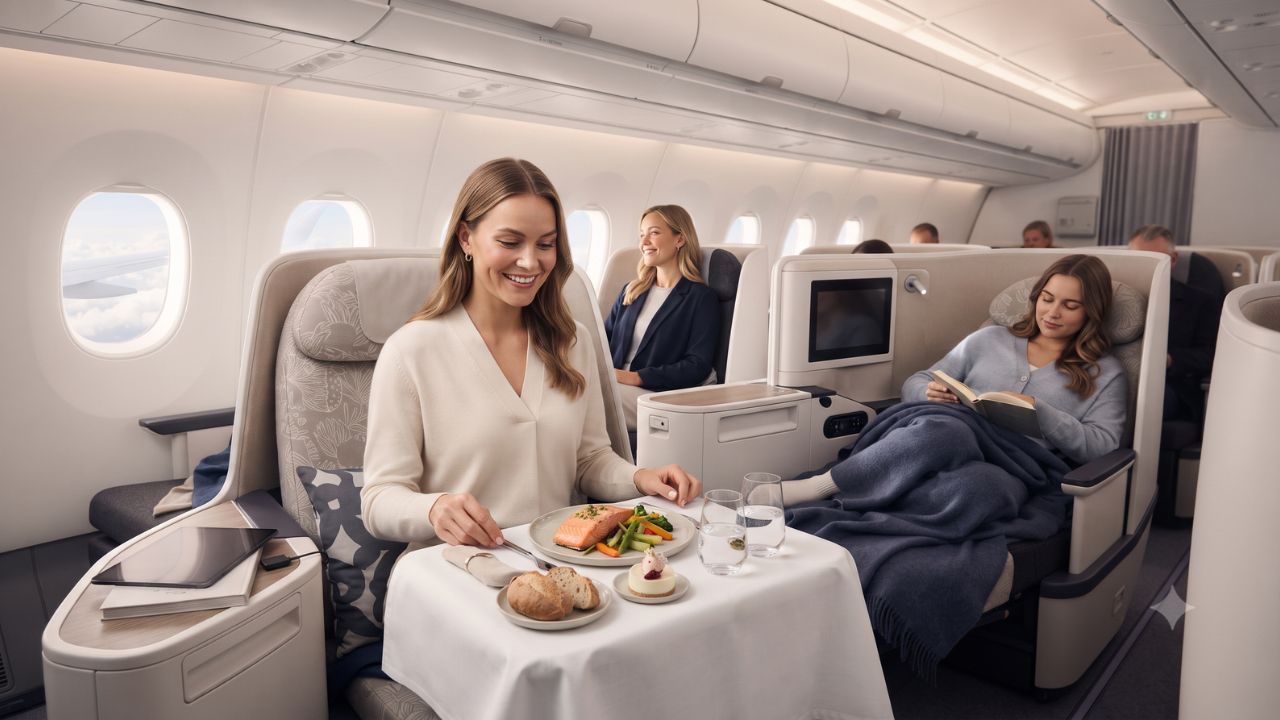
With an 18-inch entertainment display and an innovative fixed-shell architecture that eliminates heavy motorized recline mechanisms entirely, Finnair’s AirLounge business class seat represents one of long-haul aviation’s most radical operational departures from standard premium cabin engineering. Developed in close engineering collaboration with Collins Aerospace, the non-reclining cocoon transforms passenger space on key international routes, notably the flagship long-haul link connecting Delhi’s Indira Gandhi International Airport with Helsinki Airport (HEL). Rather than relying on motorized seat tracks and actuators that introduce maintenance downtime and parasitic airframe weight, the Finnish flag carrier has converted residential furniture design into a commercial advantage against Gulf and European competitors.
The strategic deployment of the AirLounge reflects an airline adapting to altered global flight physics. Facing structural route extensions following the closure of Russian airspace, Finnair has systematically overhauled its widebody cabin interiors across its Airbus A350 and A330 fleets. By integrating Nordic craftsmanship—from textiles by Marimekko to heritage glassware dating back to 1969—with modern digital connectivity, the carrier offers corporate and leisure passengers traveling between India, Northern Europe, and North America an environment centered on physical freedom rather than mechanical confinement.
Ergonomic Architecture: Deconstructing the Motorless AirLounge Shell
Conventional premium airline seats rely on complex motorized systems that slide backrests, deploy footrests, and recline seat pans along rigid tracks. Over extended multi-sector operations, these mechanical components suffer heavy wear, creating frequent maintenance defects where seats jam mid-flight. The AirLounge solves this mechanical liability by eliminating motorized recline mechanisms altogether.
Instead, the seat presents a contoured, organic shell that functions like an expansive living room lounge chair. Passengers do not push buttons to recline; instead, they alter their posture naturally within a wide, padded enclosure. The space accommodates stretching out diagonally, curling up, or sitting cross-legged during flight. When travelers wish to sleep, mechanical infill panels raise manually to bridge the seat and ottoman, converting the entire shell into a spacious, fully flat bed.
The surrounding console integrates passenger technology directly into the furniture structure:
- Display Interface: An 18-inch high-definition screen featuring an updated, intuitive media interface.
- Power Hub: Dedicated USB-C ports, traditional universal PC power sockets, and integrated wireless induction charging pads embedded into armrest storage ledges.
- Table Mechanics: A dual-fold table system that slides and locks, allowing travelers to exit the seat during meal services without disturbing dining trays.
- Digital Access: Complimentary high-speed in-flight internet access for premium fare classes and eligible elite tier frequent flyers within the oneworld alliance.
Nordic Industrial Heritage: Crafting Identity Across Textiles, Glass, and Ceramics
While many international carriers rely on generic luxury cues, Finnair uses its long-haul cabins as an ambassadorial platform for classical Finnish industrial design. Every textile, plate, and glass reflects decades of Nordic aesthetic philosophy prioritizing functional simplicity and material durability.
| Cabin Element | Design Partner & Origin | Material & Creative Specification | Operational & Passenger Significance |
|---|---|---|---|
| AirLounge Shell | Collins Aerospace / Tangerine | High-durability composite fixed shell with manual infill panels | Eliminates motor breakdowns; cuts airframe weight; enables flexible postures |
| Cabin Textiles | Marimekko (Maija Isola prints) | Custom acoustic weaves, jacquard blankets, and down-filled pillows | Enhances sound dampening; delivers recognizable Finnish visual identity |
| Meal Tableware | Harri Koskinen for Iittala | Kuulas collection: custom lightweight porcelain and glassware | Rounded rim geometries reduce edge chipping and fit compact service trays |
| Welcome Drink Glassware | Tapio Wirkkala for Iittala | Ultima Thule melted-ice textured glass (inaugurated 1969) | Historical service artifact originally debuted on Finnair’s 1969 New York route |
| Digital IFE & Charging | Collins / Finnair Systems | 18-inch monitor with USB-C, wireless Qi charging, and PC power | Supports uninterrupted device productivity on lengthy overnight flights |
Textiles designed by Marimekko, featuring iconic motifs associated with mid-century print designer Maija Isola, soften the cabin atmosphere while providing acoustic absorption across widebody fuselages. At meal times, flight attendants present the dining service using tableware created by industrial designer Harri Koskinen for Iittala. Named the Kuulas collection, these custom ceramics and glassware pieces feature soft, organic shapes that withstand high-heat industrial catering wash cycles while minimizing service cart weight.
Connecting this modern hardware to the golden age of transatlantic aviation is Tapio Wirkkala’s Ultima Thule glassware. First introduced aboard Finnair’s inaugural transatlantic service to New York in 1969, the textured base—inspired by melting Lappish ice—remains the signature vessel for pre-departure beverages, preserving a tangible link to Finland’s aviation heritage.
Culinary Curation and Service Protocols on the India–Europe Gateway
On long-haul sectors linking Delhi and Helsinki, Finnair structures its service to respect natural sleep rhythms. Long-haul flights feature a structured two-phase culinary program: a comprehensive multi-course meal service shortly after departure, followed by a lighter, energizing breakfast or pre-arrival meal.
The primary dinner service includes seasonal appetizers, artisanal cheeses, and a selection of international and regional main courses that blend Finnish culinary ingredients—such as wild berries, root vegetables, and cold-water fish—with global palate preferences. Passengers can pre-select their preferred hot entree through Finnair’s digital booking channels prior to airport departure, minimizing in-flight food waste while ensuring individual menu preferences are guaranteed.
For travelers boarding in Delhi, this dining flow provides an unhurried, restaurant-style service before cabins dim for sleep. By decoupling the dining experience from rigid service carts and incorporating on-demand snack pantries, the airline mirrors contemporary hospitality trends rather than traditional rigid airline dining cycles.
Expert Analysis: Fleet Weight Economics, Geopolitical Airspace Detours, and Nordic Hub Strategy
The operational genius of the AirLounge extends beyond passenger comfort; it is a masterclass in fleet physics and commercial resilience. Following the closure of Russian airspace in 2022, Finnair lost its primary geographical advantage—the direct great-circle routing linking Europe and East Asia. Routes between Helsinki and Asian hubs that previously took 8 to 9 hours suddenly required 12 to 14 hours as aircraft skirted north over the Arctic or south through Central Asia.
For travelers booking this route, the direct consequence is that flight durations have expanded, making physical seat ergonomics far more important than on shorter traditional segments. The ability to shift positions freely, sit cross-legged, or curl up against a solid curved shell prevents the muscle fatigue that routinely occurs in narrow, motorized cubicles during 10-hour flights.
The pricing pressure this creates means that airlines must find aggressive weight savings across the cabin to offset elevated fuel burn on extended bypass routes. Heavy electric motors, wiring harnesses, and metal linkages in conventional business class seats add hundreds of kilograms to an aircraft's operational empty weight. By eliminating electric reclining motors, the AirLounge trims structural airframe weight. This weight reduction directly translates into lower fuel consumption per available seat kilometer, enabling Finnair to maintain competitive base fares on the Delhi–Helsinki corridor while absorbing the financial penalty of extended circumnavigational flight paths.
Key Takeaways
- Motorless Seat Innovation: Developed with Collins Aerospace, the AirLounge eliminates motorized recline systems, reducing mechanical failure rates and airframe weight while allowing flexible seating and sleeping postures.
- Finnish Design Integration: Cabins feature Marimekko textiles, Harri Koskinen’s custom Iittala Kuulas tableware, and iconic 1969 Ultima Thule glassware by Tapio Wirkkala.
- Modern Connectivity Infrastructure: Every AirLounge seat includes an 18-inch entertainment screen, USB-C outlets, PC power sockets, wireless charging, and complimentary Wi-Fi for eligible ticket holders.
- Structured Dining Program: Passengers receive a multi-course dinner with advance online entree selection, followed by a lighter meal service prior to landing.
- Geopolitical Route Adaptation: The weight-saving seat design offsets elevated fuel costs caused by ongoing polar and southern detours around closed Russian airspace.
FAQ: Finnair AirLounge Business Class and Long-Haul Amenities 2026
Does the Finnair AirLounge seat recline?
No. The seat uses a fixed, contoured shell without motorized reclining mechanisms. Passengers adjust their seating position naturally within the spacious shell and deploy manual infill panels to create a completely flat bed for sleeping.
What connectivity features are available at the AirLounge seat?
Each seat includes an 18-inch entertainment screen, wireless phone charging on the armrest ledge, USB-C ports, and universal PC power outlets. Eligible ticket holders and frequent flyers receive complimentary in-flight Wi-Fi.
Which famous Finnish designers contributed to Finnair's cabin?
The cabin integrates textiles from Marimekko (Maija Isola patterns), Kuulas tableware designed by Harri Koskinen for Iittala, and heritage Ultima Thule glassware designed by Tapio Wirkkala in 1969.
Can business class passengers pre-order meals on the Delhi–Helsinki route?
Yes. Passengers can reserve their preferred main course online prior to departure through Finnair’s digital channels, ensuring their choice is secured alongside a multi-course dinner service and pre-landing light meal.
True luxury in long-haul flight is not found in complex motorized mechanisms, but in the quiet freedom of uncluttered space.
Related Travel Guides
- Euroairlines Posts 53% Sales Spike as Super-Distribution Model Captures Global Airline Inventory
- Oman Air Expands Winter 2026/27 Network with Tripled Zurich Capacity, Moscow Expansion, and oneworld Codeshares
- Bristol Airport Deploys OneReg Digital Safety Platform to Power Airfield Modernization and 2030 Net-Zero Growth
Disclaimer
This article is for informational and educational purposes only. It does not constitute legal, financial, or professional advice. While we strive to provide accurate and up-to-date information, travel policies, regulations, and conditions change rapidly. Always verify information with official sources before making travel decisions. Nomad Lawyer makes no representations about the accuracy, reliability, completeness, or suitability of the information provided. Readers should consult qualified professionals for advice specific to their circumstances. The views expressed in this article are those of the author and do not necessarily reflect the views of Nomad Lawyer.
Preeti Gunjan
Contributor & Community Manager
A passionate traveller and community builder. Preeti helps grow the Nomad Lawyer community, fostering engagement and bringing the reader experience to life.
Learn more about our team →