
Air New Zealand Lifts July 2026 On-Time Performance to 83.1% and Automates International Rebooking

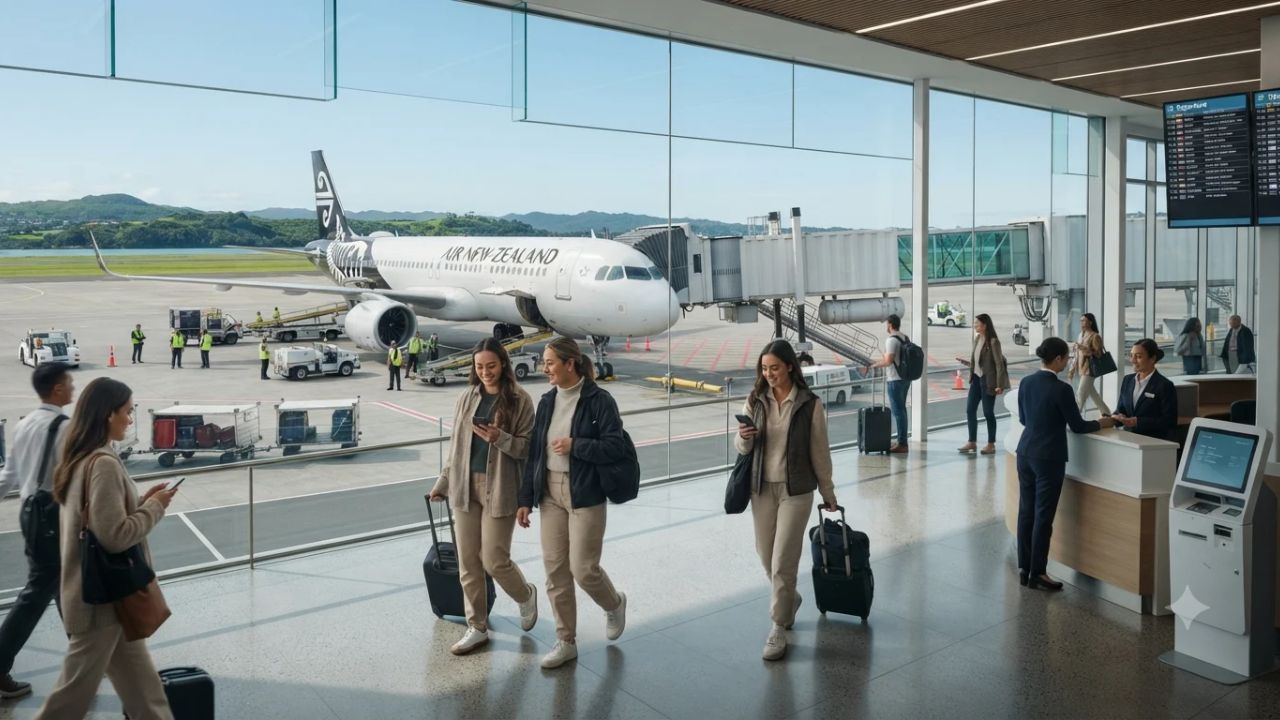
Image generated by AI
Despite enduring a punishing 74 percent year-on-year surge in weather-related delay minutes across the Southern Hemisphere winter, Air New Zealand lifted its network on-time arrival rate to 83.1 percent in July 2026—a 6.4 percentage point improvement over July 2025. Disclosed in the flag carrier’s comprehensive operational review, the performance gains were anchored by a dramatic 41 percent reduction in reactionary knock-on delays, while controllable flight cancellations fell to a lean 1.0 percent across a grueling operating schedule of 13,397 completed flights.
The operational rebound is especially significant given the geographical vulnerabilities of the New Zealand aviation market. Operating long-haul routes across the Pacific alongside high-frequency regional turboprop hops over mountainous terrain leaves airline schedules uniquely exposed to Antarctic cold fronts, coastal fogs, and gale-force runway winds. By coupling physical schedule buffering with the international rollout of its proprietary Automated Passenger Rebooking Technology—which slashes rebooking times from six hours down to just 20 minutes—the national carrier is demonstrating how digital decision engines can insulate travelers from winter travel chaos.
Taming the Winter Vortex: Weather Resilience and Auckland Hub Turnarounds
Winter operations across New Zealand present some of the most volatile meteorological conditions in commercial aviation. In July 2026, extreme weather events across the Cook Strait and Southern Alps generated a 74 percent year-on-year spike in weather delay minutes. Yet, rather than cascading into widespread gridlock, the airline's on-time arrivals (defined under global aviation standards as wheels-down within 15 minutes of published schedules) held firm at 83.1 percent. While moderating slightly from the 86.0 percent achieved in milder June weather, it marked a substantial recovery from the disrupted baselines of 2025.
A major catalyst for this resilience was the stabilization of Auckland Airport (AKL), the carrier's primary international and domestic transfer hub. Auckland operations posted an improvement of almost 10 percentage points in punctuality compared to July 2025.
Because Auckland processes the vast majority of international arrivals and trans-Tasman widebody banks, runway and baggage delays here historically triggered severe disruptions across secondary regional routes. Coordinated ground handling interventions, optimized gate turnarounds, and improved aircraft de-icing and towing protocols enabled the carrier to isolate weather disruptions at their point of origin rather than permitting them to infect downstream schedules. Concurrently, international flight punctuality jumped by more than nine percentage points year-on-year, providing reliable arrival times for long-haul vacationers and business executives.
Halving the Ripple Effect: Slashing Reactionary Delays and Flight Cancellations
In airline operations, primary delays (such as a sudden fog ground stop) are often less damaging than secondary "reactionary delays"—the compounding knock-on effects that occur when a delayed incoming aircraft causes late departures for four subsequent flights on the same airframe.
During July 2026, Air New Zealand reduced reactionary delay minutes by 41 percent compared to July 2025, ensuring that 1,366 fewer flights were impacted by domino delays. Network planners accomplished this by introducing strategic "firebreaks" in daily tail-assignment schedules, building realistic ground-turn buffers at main hubs, and maintaining standby crew and spare airframes at strategic maintenance bases.
| Performance Metric | July 2025 Baseline | July 2026 Performance | Year-on-Year Variance | Operational & Passenger Significance |
|---|---|---|---|---|
| Network On-Time Performance (A15) | 76.7% | 83.1% | +6.4 Percentage Points | Significant punctuality rebound across 13,397 flights |
| June Preceding Benchmark | Historical Baseline | 86.0% (June 2026) | Seasonal Winter Dip | Demonstrates winter operational resilience |
| Weather Delay Exposure | Baseline Minutes | +74% Increase YoY | +74% Weather Severity | Strong operational holding despite severe storms |
| International Route Punctuality | Baseline Punctuality | >9.0 Percentage Point Gain | >+9.0 Pts YoY | Smoother transatlantic and Asian passenger connections |
| Auckland Hub Punctuality | Baseline AKL Performance | ~10.0 Percentage Point Gain | ~+10.0 Pts YoY | De-bottlenecking New Zealand's primary gateway |
| Reactionary Knock-on Delays | Baseline Minutes | -41% Reduction YoY | 1,366 Fewer Flights Delayed | Prevents single morning delays from ruining evening flights |
| Total Cancellation Rate | 4.4% | 2.8% | -1.6 Percentage Points | 246 fewer total cancellations across the network |
| Controllable Cancellation Rate | 2.2% | 1.0% | -1.2 Percentage Points | 184 fewer airline-attributable cancellations |
| Freight Volume Handled | Baseline Tonnage | 14,149 Tonnes Cargo | High Belly-Hold Utilization | Includes 370 tonnes of premium export salmon & seafood |
Total network cancellations dropped by 1.6 percentage points to 2.8 percent, representing 246 fewer canceled flights. More significantly for consumer accountability, cancellations within the airline's direct control—such as unscheduled mechanical maintenance or crew scheduling lapses—dropped by 1.2 percentage points to just 1.0 percent, representing 184 fewer carrier-induced cancellations.
Algorithmic Recovery: How Automated Rebooking Replaced Six-Hour Queues
Operational disruptions will inevitably occur in commercial aviation, particularly when polar maritime storms shut down regional airports. What distinguishes modern airline management is how carrier software handles irregular operations (IROPS).
Having initially piloted its Automated Passenger Rebooking Technology on domestic routes in mid-2025, Air New Zealand completed the international rollout of the software during mid-2026. Historically, an unexpected widebody cancellation on a long-haul route like Auckland to Los Angeles or Singapore triggered operational chaos. Rebooking 300 passengers across international partner networks required manual intervention by airport customer service agents, leaving travelers stranded in airport queues for four to six hours.
Under the automated framework, algorithmic intelligence ingests flight cancellations instantaneously, querying real-time seat availability across the carrier’s fleet and Star Alliance partners. Within 20 minutes, replacement flight itineraries are dynamically generated, ticketed, and pushed directly to passengers via the Air New Zealand mobile app and email. Travelers can accept the recommended itinerary with a single tap or browse alternative departure dates, while airport customer service staff are liberated from administrative data entry to focus exclusively on passengers with complex visa requirements, wheelchair assistance, or unaccompanied minors.
Expert Analysis: Trans-Tasman Hub Synchronization, Cargo Protection, and Passenger Rights
From an airline economic perspective, punctuality and rapid recovery are vital components of revenue management. According to operational oversight data from the Civil Aviation Authority of New Zealand (CAA NZ), airline schedule integrity directly dictates brand loyalty and corporate account retention. In competitive trans-Tasman and long-haul markets, business travelers readily abandon carriers that exhibit chronic delay cascades.
For travelers booking this route, the direct consequence is that transfer connections between regional South Island gateways (such as Queenstown, Christchurch, or Dunedin) and international departures at Auckland operate with substantially reduced risk of missed onward flights, even during mid-winter storm cycles.
The pricing pressure this creates means Air New Zealand can command a premium corporate fare structure over competitors. By guaranteeing that 83.1 percent of flights arrive on time and that 99 percent of flights operate without controllable cancellations, the carrier minimizes the financial overhead associated with hotel accommodation vouchers, meal compensation, and missed passenger connections.
In parallel, schedule integrity is critical for belly-hold cargo monetization. During July 2026, the carrier transported 14,149 tonnes of cargo across its network. This freight volume included 370 tonnes of high-value frozen seafood and fresh King salmon exported to North American culinary markets. For perishable seafood exporters, a four-hour delay at Auckland can cause entire shipments to spoil or miss connecting flights in Los Angeles, leading to severe commercial penalties. Maintaining an 83.1 percent on-time rate protects both multi-thousand-dollar business class tickets and multimillion-dollar agricultural export supply chains.
Key Takeaways
- Substantial Punctuality Rebound: Air New Zealand achieved an 83.1 percent on-time arrival rate in July 2026, marking a 6.4 percentage point gain over July 2025 despite a 74 percent jump in severe weather delay minutes.
- Reactionary Delays Slashed: Knock-on delays were reduced by 41 percent year-on-year, preventing disruptions from rippling across 1,366 downstream flights.
- Controllable Cancellations at 1.0%: Carrier-induced cancellations fell to a record low of 1.0 percent (down 1.2 percentage points), with total cancellations settling at 2.8 percent across 13,397 completed flights.
- 20-Minute Automated Rebooking: The global expansion of Automated Passenger Rebooking Technology reduced international disruption rebooking times from four-to-six hours down to under 20 minutes.
- Critical Freight Throughput: Alongside passenger operations, the carrier transported 14,149 tonnes of cargo in July 2026, including 370 tonnes of premium seafood and salmon exported to North America.
FAQ: Air New Zealand Reliability and Automated Rebooking 2026
What was Air New Zealand's on-time flight performance in July 2026?
Air New Zealand recorded an 83.1 percent on-time arrival rate (within 15 minutes of schedule) in July 2026 across 13,397 flights, an increase of 6.4 percentage points compared to July 2025.
How does Air New Zealand's Automated Passenger Rebooking Technology work?
When a flight is canceled, automated software instantly finds alternative flights across Air New Zealand and partner airlines, sending confirmed replacement tickets to passengers within 20 minutes via the airline's mobile app.
How much did flight cancellations decrease for Air New Zealand?
Total cancellations dropped 1.6 percentage points to 2.8 percent in July 2026 (246 fewer cancellations), while cancellations within the airline's direct control fell to 1.0 percent (184 fewer cancellations).
What caused flight delays in New Zealand during July 2026?
Severe winter weather was the primary cause, generating a 74 percent increase in weather-related delay minutes, though improved hub operations at Auckland kept on-time arrivals above 83 percent.
[By pairing operational discipline on the tarmac with intelligent automation in the terminal, Air New Zealand proves that winter weather does not have to derail modern air travel.]
Related Travel Guides
Disclaimer
This article is for informational and educational purposes only. It does not constitute legal, financial, or professional advice. While we strive to provide accurate and up-to-date information, travel policies, regulations, and conditions change rapidly. Always verify information with official sources before making travel decisions. Nomad Lawyer makes no representations about the accuracy, reliability, completeness, or suitability of the information provided. Readers should consult qualified professionals for advice specific to their circumstances. The views expressed in this article are those of the author and do not necessarily reflect the views of Nomad Lawyer.
Raushan Kumar
Founder & Lead Developer
Full-stack developer with 11+ years of experience and a passionate traveller. Raushan built Nomad Lawyer from the ground up with a vision to create the best travel and law experience on the web.
Learn more about our team →