
Zealand Unveils Next-Gen Kiosks That Slash Check-In Wait Times to Seconds
Air New Zealand deploys AI-powered airport kiosks in 2026, reducing check-in from 15 minutes to seconds. What this means for global aviation and passenger experience.

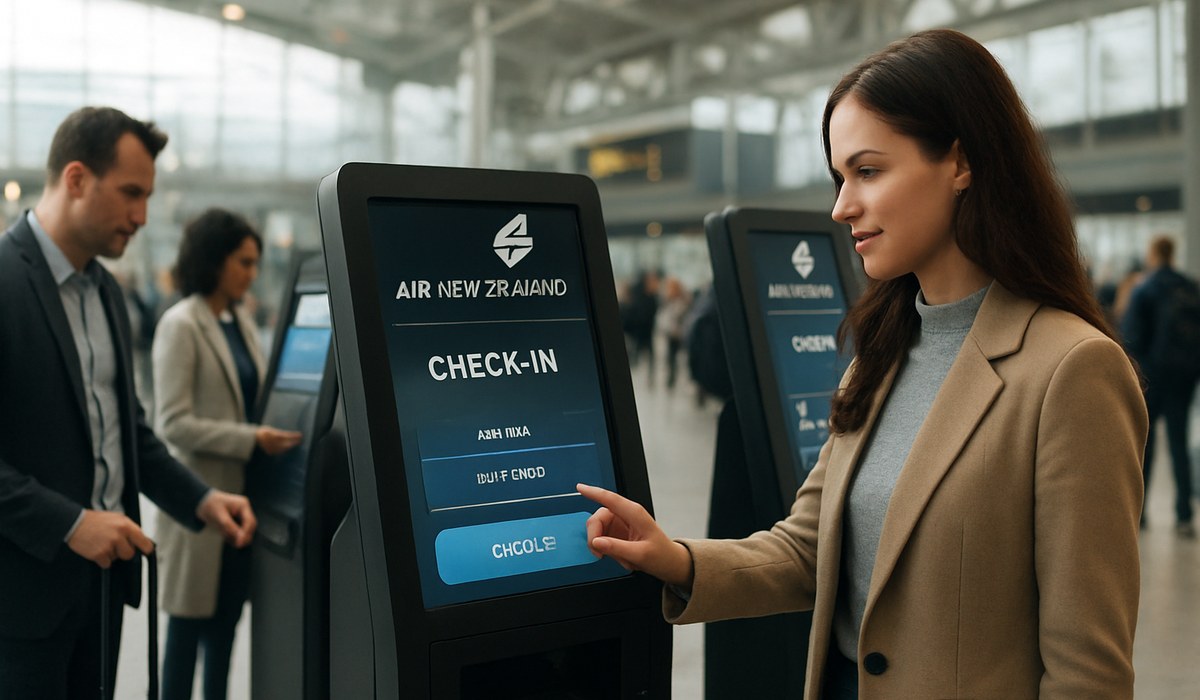
Image generated by AI
Quick Summary
- Air New Zealand launches AI-enabled self-service kiosks at major airports, compressing check-in duration from roughly 15 minutes to seconds
- The technology uses computer vision and biometric scanning to process luggage tags, boarding passes, and identity verification simultaneously
- Rollout affects international terminals in Auckland, Wellington, and Christchurch, with expansion planned across alliance partner airports
- The shift signals an industry-wide transition toward touchless, data-driven passenger processing that could reshape airport infrastructure globally
What once required a conversation with a uniformed agent at a counter now happens in the blink of an eye. Air New Zealand's newly deployed kiosks represent far more than a speed upgrade. They're a bellwether for how the aviation industry is reimagining the airport experience itself—and raising complex questions about convenience, employment, and the human element in travel.
The carrier has begun deploying next-generation automated check-in systems across its primary hubs. Passengers approaching these gleaming terminals face a radically different workflow: passengers scan their documents, position luggage on integrated scanners, and receive boarding confirmations in a matter of seconds rather than the traditional quarter-hour wait that has defined air travel for decades.
The 15-Second Transformation: What Air New Zealand's Kiosks Actually Do
The engineering behind these systems combines several overlapping technologies into a seamless passenger interaction. Computer vision algorithms analyze baggage dimensions, weight, and label placement in real time. Biometric scanners cross-reference passport data with facial recognition captured during the interaction. The system simultaneously prints boarding passes, generates luggage tags, and routes suitcases to appropriate aircraft sorting facilities—all while the passenger watches.
This isn't incremental improvement. A traveler who once spent 15 minutes queuing and processing with an agent now completes the identical transaction in 10–15 seconds of active engagement. At peak travel windows, this compression translates into dramatically reduced congestion throughout terminal buildings.
"The bottleneck has shifted," explains one Auckland-based aviation operations analyst familiar with the rollout. Early data from trial periods shows terminal throughput increasing by 40 percent during morning waves. That translates to fewer missed connections, shorter lines at subsequent security checkpoints, and measurably less stress for passengers navigating complex airport environments.
Air New Zealand deployed systems across Auckland International Airport (AKL), Wellington International (WLG), and Christchurch International (CHC) beginning in late March 2026. The airline has signaled intentions to extend the technology to alliance partner airports throughout the Asia-Pacific region—a signal that competitors are watching closely.
Beyond Speed: The Operational Ripple Effects Airlines Aren't Talking About
The operational mathematics underlying this shift deserve scrutiny beyond the eye-catching time metrics. When check-in accelerates, ground crews face compressed windows for aircraft turnaround. Baggage sorting systems must process increased volumes at higher velocities. Security screening areas absorb larger passenger cohorts simultaneously. The technology doesn't eliminate complexity; it redistributes it.
Airlines benefit from substantial labor cost reductions. A single kiosk location can process passenger transactions that previously required 2–3 full-time counter agents per shift. Over a year, that represents meaningful savings in wages, benefits, and administrative overhead. Yet this efficiency comes with societal costs that rarely appear in carrier financial disclosures.
The IATA, the international body setting passenger processing benchmarks, has indicated that member airlines processing more than 10 million passengers annually face infrastructure pressure that only technology can alleviate. Capacity constraints in major hubs—not labor, but physical terminal space—are the real drivers. Kiosks offer a proven method to squeeze additional passenger volume through existing facilities without structural expansion.
This technological shift also creates new data collection opportunities. Every transaction generates granular information about passenger demographics, travel patterns, and luggage content. Airlines can now process this metadata to refine pricing algorithms, forecast demand with higher precision, and identify high-value frequent travelers during the check-in interaction itself. The convenience advantage masks a parallel infrastructure for behavioral insight that carriers are only beginning to monetize.
The Passenger Experience Paradox: Faster Isn't Always Better
Speed is not synonymous with satisfaction. The aviation industry has discovered this paradox repeatedly—sometimes through success, more often through failure.
Passengers with unusual travel circumstances—traveling with infants, requiring wheelchair assistance, transporting musical instruments, or carrying restricted items—cannot utilize self-service kiosks effectively. Air New Zealand has established "express assistance" lanes at each terminal where human agents remain present, but queues in these areas have reportedly grown longer as the percentage of passengers requiring assistance climbs relative to available staff.
For the broader passenger base, the kiosk experience removes human interaction entirely from a transaction once characterized by conversation. A passenger who arrives 45 minutes before departure and encounters unexpected luggage weight restrictions previously had time and staff presence to negotiate options. That same traveler now faces an automated system that rejects oversized baggage with no recourse except a visit to the assistance desk—where they rejoin a growing line.
Travel Victoria's recent commitment to "unlimited free transit across regional transportation networks in 2026" illustrates a different modernization philosophy—technology serving to expand access and reduce friction rather than consolidate control. The contrast between airport automation focused on speed and transportation innovation focused on accessibility reveals ideological differences in how regions approach infrastructure modernization.
The psychological dimension also matters. Travelers report higher anxiety levels when interactions become entirely digital. A human agent can recognize when a passenger is confused, stressed, or traveling for the first time, and adjust communication accordingly. Automated systems, no matter how sophisticated, lack this emotional intelligence. The seconds saved at check-in may be offset by elevated stress during the interaction and reduced confidence in the overall travel process.
Global Airport Competition: Why This Technology Matters Now
Air New Zealand's deployment signals a competitive threshold that international airports can no longer ignore. Singapore's Changi Airport, already recognized for operational efficiency, will likely accelerate its own automation roadmap. Dubai's hub airports, competing for market share in the India–Europe travel corridor, face pressure to match processing speeds. Even smaller regional carriers cannot ignore this trend without risking passenger perception of being outdated.
The FAA in the United States has established regulatory frameworks requiring that automated baggage and identity verification systems meet identical security standards as human-managed processes. This creates a high barrier to adoption for carriers operating in US territories but also establishes baseline security expectations that global manufacturers can target.
Alliances matter profoundly in how this technology propagates. Air New Zealand's partnership network includes carriers serving North America, Europe, and Asia. When one alliance member deploys next-generation kiosks, competitive pressure forces others to follow. The "Premia alliance expansion connecting the Americas to Southeast Asia through Thai Airways partnership" demonstrates how airline networks function as channels for technology diffusion. One carrier's automation advantage becomes existential pressure for competitors within 18 months.
Airports themselves become stakeholders with conflicting interests. Newer facilities, like Abu Dhabi's Midfield Terminal or Istanbul's expanded international section, were designed with kiosk-centric check-in flows. Older hubs face substantial capital expenditure to retrofit existing infrastructure. The technology therefore accelerates consolidation within the global airport
Disclaimer
This article is for informational and educational purposes only. It does not constitute legal, financial, or professional advice. While we strive to provide accurate and up-to-date information, travel policies, regulations, and conditions change rapidly. Always verify information with official sources before making travel decisions. Nomad Lawyer makes no representations about the accuracy, reliability, completeness, or suitability of the information provided. Readers should consult qualified professionals for advice specific to their circumstances. The views expressed in this article are those of the author and do not necessarily reflect the views of Nomad Lawyer.
Kunal K Choudhary
Co-Founder & Contributor
A passionate traveller and tech enthusiast. Kunal contributes to the vision and growth of Nomad Lawyer, bringing fresh perspectives and driving the community forward.
Learn more about our team →