
Air India Launches Non-Stop Delhi-Osaka Flights for 2027: Kansai Gateway Opens Open-Jaw Golden Route Travel

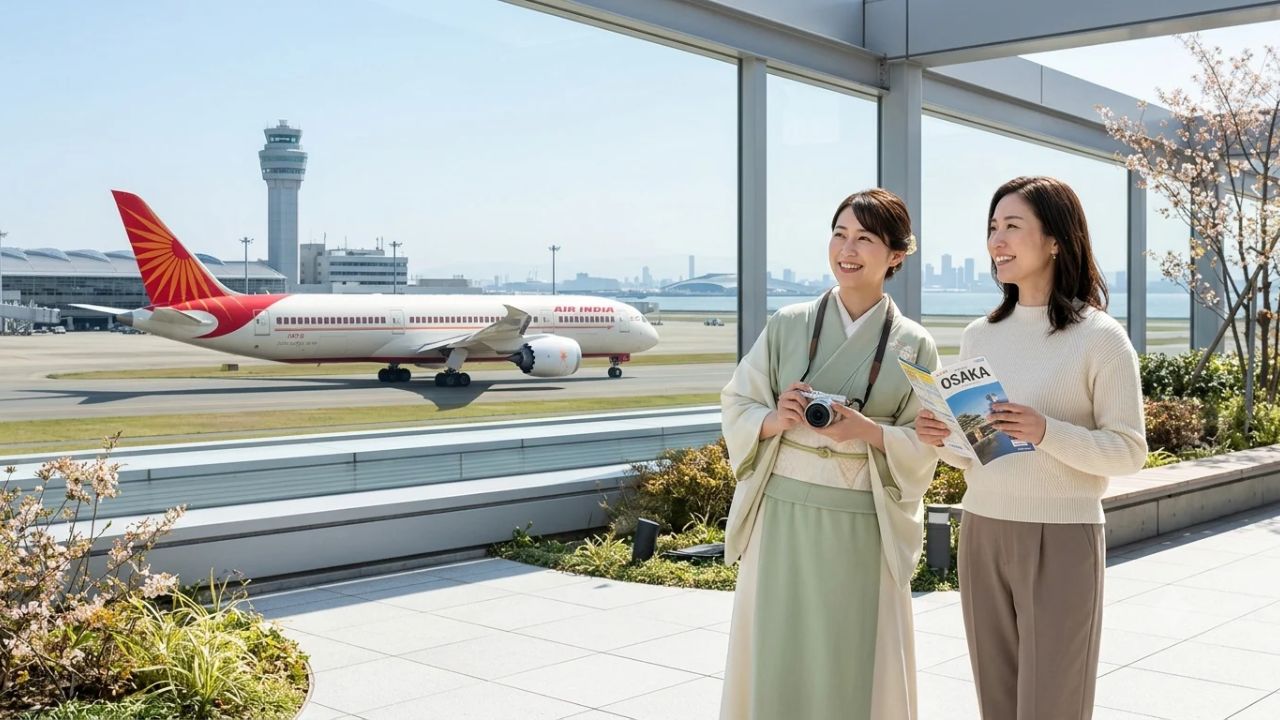
Surging 35.2% year-on-year to reach 315,100 visitors in 2025—an extraordinary 80% leap over pre-pandemic 2019 levels—Indian outbound travel to Japan has triggered the launch of the first-ever direct air bridge connecting South Asia to the Kansai region. Formally confirmed for inaugural operations on 2 February 2027, flag carrier Air India will introduce four weekly non-stop flights between Delhi’s Indira Gandhi International Airport (DEL) and Kansai International Airport (KIX) in Osaka. Operating widebody Boeing 787-8 Dreamliner aircraft, the service establishes Air India as the sole airline operating non-stop passenger services on the route, bypassing intermediate transit hubs across Southeast Asia.
The network expansion marks a strategic milestone under the Tata Group's multi-phase Vihaan.AI fleet transformation and international deployment strategy. By securing a direct commercial entry point into western Japan, the carrier broadens its East Asian footprint far beyond the Kanto plain. Until now, direct air capacity between the two nations concentrated exclusively on Tokyo, where Air India maintains daily flights from Delhi and four weekly services from Mumbai into Tokyo Haneda Airport (HND). Adding Osaka provides corporate executives, independent leisure tourists, and group tour operators direct access to the economic powerhouses of Osaka, Kyoto, Kobe, and Nara without requiring domestic Japanese flight transfers or time-consuming backtrack rail journeys.
Kansai Gateway Economics and Vihaan.AI International Expansion
Air India's long-haul network restructuring has prioritized unserved high-yield direct city pairs where Indian outbound demand previously relied on foreign sixth-freedom carriers. Japan has emerged as one of the fastest-growing holiday and commercial travel destinations for Indian travelers, driven by simplified visa processes, favorable yen exchange rates, and expanding corporate joint ventures between Japanese conglomerates and Indian enterprises.
Historically, Indian travelers bound for Kansai—the cultural and historical heartland of Japan encompassing Osaka, Kyoto, Nara, and Kobe—were forced to transit through intermediary hubs including Bangkok Suvarnabhumi (BKK), Singapore Changi (SIN), Kuala Lumpur (KUL), or Hong Kong (HKG). These connecting itineraries frequently added between five and nine hours of layover time to what should be an eight-hour flight journey. By establishing a non-stop link, Air India eliminates intermediate stops, reduces travel fatigue, and captures both corporate travel budgets and premium leisure bookings.
The choice of Kansai International Airport over Tokyo Narita (NRT) reflects a sophisticated operational balance. While Tokyo Haneda handles high-density diplomatic, government, and corporate travel, western Japan hosts major manufacturing centers, electronic engineering headquarters, pharmaceutical giants, and the cultural monuments that anchor Japanese tourism. Companies like Panasonic, Daikin, Keyence, Kubota, Nintendo, and Sumitomo maintain their primary global headquarters across the Kansai basin. Executives commuting between manufacturing zones in Gujarat, Maharashtra, Haryana, and Kansai gain an immediate point-to-point advantage that bypasses Tokyo's congested domestic transfer terminals.
AIR INDIA EAST ASIA NETWORK EXPANSION: DELHI - OSAKA ROUTE MATRIX
| Operational Metric | Delhi - Osaka (AI360/359) | Delhi - Tokyo (AI306/307) | Mumbai - Tokyo (AI314/315) |
|---|---|---|---|
| Launch Date | 2 February 2027 | Established (Daily) | Established (4x Weekly) |
| Destination Hub | Kansai Int'l (KIX) | Tokyo Haneda (HND) | Tokyo Haneda (HND) |
| Weekly Frequency | 4 flights per week | 7 flights per week (Daily) | 4 flights per week |
| Aircraft Type | Boeing 787-8 Dreamliner | Boeing 787-8 Dreamliner | Boeing 787-8 Dreamliner |
| Total Seat Config | 259 Seats (18J / 241Y) | 259 Seats (18J / 241Y) | 259 Seats (18J / 241Y) |
| Outbound Schedule | DEL 22:50 -> KIX 09:50+1 | DEL 21:15 -> HND 08:45+1 | BOM 20:00 -> HND 07:55+1 |
| Inbound Schedule | KIX 11:50 -> DEL 18:20 | HND 11:30 -> DEL 17:35 | HND 11:10 -> BOM 17:45 |
| Outbound Days | Tue, Thu, Sat, Sun | Monday through Sunday | Mon, Wed, Fri, Sun |
| Inbound Days | Mon, Wed, Fri, Sun | Monday through Sunday | Tue, Thu, Sat, Mon |
Flight Operations Timetable and Boeing 787-8 Fleet Specifications
Air India has scheduled the Delhi–Osaka rotation to maximize overnight productivity. Outbound flight AI360 departs Indira Gandhi International Airport at 10:50 PM local time on Tuesdays, Thursdays, Saturdays, and Sundays, crossing the Bay of Bengal, Southeast Asia, and the East China Sea before touching down at Kansai International Airport at 9:50 AM the following morning. This early morning arrival allows leisure travelers to check into regional hotels by midday and permits corporate executives to conduct a full afternoon of business meetings on arrival day.
The inbound service, flight AI359, operates on Mondays, Wednesdays, Fridays, and Sundays. The aircraft departs Kansai International Airport at 11:50 AM local time, flying westward across continental East Asia to land in Delhi at 6:20 PM local time. This evening arrival provides seamless onward domestic transfer connections across Air India’s extensive hub bank at Delhi Terminal 3, serving travelers heading onwards to Mumbai, Bengaluru, Chennai, Hyderabad, Ahmedabad, Kolkata, and Pune without overnight terminal stays.
The service uses Air India’s long-haul workhorse, the twin-engine Boeing 787-8 Dreamliner. Featuring an advanced carbon-fiber composite airframe, the Dreamliner delivers tangible physiological benefits on medium-to-long-haul routes:
- Cabin Pressure and Humidity: Pressurized at an equivalent altitude of 6,000 feet—significantly lower than the 8,000-foot standard of conventional aluminum airliners—the 787-8 prevents dehydration and reduces jet lag symptoms over eight hours of flight.
- Business Class Cabin (18 Seats): Configured in a forward 2-2-2 layout, the Business Class cabin offers fully flat beds with an 80-inch pitch, electronic seat controls, universal power outlets, USB ports, and personal in-flight entertainment screens.
- Economy Class Cabin (241 Seats): Configured in an industry-standard 3-3-3 arrangement, seats feature an ergonomic 31-to-32-inch pitch, adjustable headrests, personal touchscreens loaded with international and Indian entertainment, and complimentary multi-course hot meal services with regional culinary selections.
- Belly Cargo Capacity: Beyond passengers, the widebody 787-8 provides substantial lower-deck cargo capacity, supporting time-sensitive bilateral trade in precision electronics, auto components, medical equipment, and high-value perishables between India and the Kansai manufacturing corridor.
The Golden Route Open-Jaw Logistics Revolution
The launch of non-stop Delhi–Osaka flights solves the single greatest logistical inefficiency facing Indian tourists touring Japan: backtracking across the country to catch homeward flights.
Japan’s premier tourist corridor, known globally as the "Golden Route," spans Tokyo, Mount Fuji/Hakone, Kyoto, Nara, and Osaka. For decades, international travelers flying from India were restricted to round-trip tickets originating and terminating at Tokyo's airports. A typical 10-day itinerary forced travelers to arrive in Tokyo, explore the capital, ride the Tokaido Shinkansen bullet train westward to Kyoto and Osaka, and then endure an expensive, redundant three-hour return train journey back to Tokyo simply to catch their scheduled return flight.
TRADITIONAL CLOSED-LOOP ITINERARY (RESTRICTIVE & COSTLY):
Delhi (DEL) =====> Tokyo (HND/NRT) -----[Shinkansen Train]-----> Kyoto/Osaka
                        ^                                             |
                        |                                             |
                        +----------------[Backtrack Train Segment]----+
                        *(Wastes 3.5 hours & 14,920 JPY per traveler)*

MODERN OPEN-JAW ITINERARY ENABLED BY AIR INDIA (SEAMLESS & EFFICIENT):
Delhi (DEL) =====> Osaka Kansai (KIX) ----[Sightseeing: Osaka, Kyoto, Nara]
                                                         |
                                                         v
Delhi (DEL) <===== Tokyo Haneda (HND) <-----[One-Way Eastbound Shinkansen]--+
With Air India operating direct flights to both ends of the Golden Route, travelers can now book "open-jaw" (multi-city) tickets. Visitors land directly at Kansai International Airport, explore western Japan's historic districts, board the Tokaido Shinkansen bullet train eastward through Shizuoka and Nagoya to Tokyo, and depart directly from Tokyo Haneda Airport back to Delhi or Mumbai.
This modern routing delivers measurable advantages:
- Elimination of Rail Backtracking: Travelers save roughly 14,920 yen (approximately $100 USD or 8,500 INR) per passenger in one-way Shinkansen bullet train fares by avoiding the redundant Osaka-to-Tokyo return rail leg.
- Reclaiming Holiday Time: Avoiding the return rail journey and associated airport transfers recovers between four and six daylight hours, effectively granting tourists an extra half-day of sightseeing or shopping.
- Optimized Luggage Logistics: Vacationers can take advantage of Japan’s luggage forwarding services (Takuhaibin), dispatching heavy suitcases from their Kyoto or Osaka hotels straight to Tokyo or Haneda Airport, traveling light across the central mountain passes.
- Enhanced Tour Operator Flexibility: Destination management companies can design streamlined, linear group itineraries that reduce hotel switching and lower overall ground package costs.
Kansai Airport Transit Infrastructure and Regional Ground Connectivity
Kansai International Airport (KIX) is an engineering marvel, constructed on a dedicated artificial island in Osaka Bay to permit 24-hour flight operations without overland noise restrictions. Situated 38 kilometers southwest of central Osaka, the airport provides rapid ground transportation connections that distribute arriving travelers across western Japan.
GROUND TRANSIT NETWORKS CONNECTING KANSAI AIRPORT (KIX)
| Column 1 | Column 2 | Column 3 | Column 4 | Column 5 |
|---|---|---|---|---|
| Transit Operator | Service Name | Destination Hub | Travel Duration | Fare Benchmark |
| JR West Rail | Haruka Limited Express | Shin-Osaka Stn | 50 Minutes | ~2,900 JPY |
| JR West Rail | Haruka Limited Express | Kyoto Station | 75 Minutes | ~3,400 JPY |
| JR West Rail | Kansai Airport Rapid | Osaka (Umeda) Stn | 65 Minutes | ~1,210 JPY |
| Nankai Electric | Rapi:t Airport Express | Namba Station | 34 Minutes | ~1,490 JPY |
| Nankai Electric | Airport Express Rail | Namba Station | 44 Minutes | ~970 JPY |
| Ombe Ferry Service | Kobe-KIX Bay Shuttle | Kobe Airport Pier | 31 Minutes | ~1,880 JPY |
| Airport Limousine | Highway Express Bus | Nara Station | 85 Minutes | ~2,100 JPY |
Upon clearing customs and immigration at KIX Terminal 1, international passengers encounter an integrated transit hall connected directly to the railway terminal:
- JR Haruka Express to Kyoto and Shin-Osaka: For visitors heading straight to Japan's cultural capital, the JR Haruka Limited Express provides a non-stop rail connection to Kyoto Station in just 75 minutes. The train stops at Tennoji and Shin-Osaka, allowing instant transfers to the Tokaido and Sanyo Shinkansen high-speed rail lines. International visitors can purchase discounted Haruka e-tickets in advance using foreign passports.
- Nankai Rapi:t to Central Osaka (Namba): Travelers staying in downtown Osaka’s shopping and culinary hubs of Dotonbori, Shinsaibashi, and Minami can board the Nankai Electric Railway Rapi:t express. Featuring distinct retro-futuristic styling and reserved seating, the train connects KIX to Namba Station in 34 minutes.
- Kobe-KIX Bay Shuttle: For travelers heading to the port city of Kobe, a high-speed catamaran hydrofoil ferry crosses Osaka Bay directly from the KIX marine terminal to Kobe Airport Pier in 31 minutes. Foreign tourists receive substantial promotional discounts on ferry tickets upon presenting their overseas passports.
- Digital Ticketing and Contactless Payments: Travelers no longer need to queue at ticket vending machines for physical train tickets. Digital IC transit cards (such as ICOCA, Suica, and Pasmo) can be added directly to Apple Wallet or Google Wallet accounts on mobile phones. Alternatively, JR West and Nankai Railway have equipped station fare gates with contactless EMV card readers, permitting travelers to tap physical Visa, Mastercard, or JCB credit cards directly at turnstiles.
Sixth-Freedom Competitive Dynamics and Transit Bypass
Air India’s entry onto the Delhi–Osaka corridor disrupts the established market share of Southeast Asian sixth-freedom carriers. For decades, foreign airlines have captured the vast majority of Indian travelers flying east of Singapore by providing connecting service through their home hubs.
TRAVEL TIME & ROUTING COMPARISON: DELHI (DEL) TO OSAKA (KIX)
| Operating Carrier | Routing / Hub | Total Elapsed Time | Intermediate Stops | Connection Hassle |
|---|---|---|---|---|
| Air India (AI360) | Non-Stop Direct | 7 Hours 30 Minutes | 0 (Non-Stop) | None (Direct) |
| Singapore Airlines | VIA Singapore SIN | 12 to 15 Hours | 1 Intermediate Stop | Terminal Transfer |
| Thai Airways | VIA Bangkok BKK | 11 to 14 Hours | 1 Intermediate Stop | Security Re-Check |
| Cathay Pacific | VIA Hong Kong HKG | 12 to 16 Hours | 1 Intermediate Stop | Transit Screening |
| Malaysia Airlines | VIA K. Lumpur KUL | 13 to 17 Hours | 1 Intermediate Stop | Hub Connection |
| VietJet / Vietnam | VIA Hanoi / SGN | 14 to 18 Hours | 1 Intermediate Stop | Layover Wait |
The data demonstrates the immense efficiency unlocked by the non-stop route. Air India’s direct flight completes the journey in seven hours and thirty minutes outbound and eight hours inbound. In comparison, connecting flights through Bangkok, Singapore, or Hong Kong require between 11 and 16 hours of total elapsed travel time, exposing travelers to connection risks, missed flights, and luggage handling errors at intermediate airports.
This direct air link creates several market shifts:
- Corporate Route Capture: Corporate travelers and business executives consistently select non-stop flights over connecting options to conserve billable working hours and reduce travel fatigue. Air India is positioned to capture exclusive corporate travel contracts with Japanese multinationals operating across India’s industrial corridors.
- Star Alliance Synergy with All Nippon Airways (ANA): As an active member of the Star Alliance network, Air India coordinates seamlessly with Japanese alliance partner All Nippon Airways. Passengers arriving on AI360 at Kansai can check their baggage through to secondary Japanese regional cities—such as Sapporo (CTS), Fukuoka (FUK), Okinawa (OKA), and Hiroshima (HIJ)—on connecting domestic ANA services.
- Pricing Pressure on One-Stop Carriers: To defend their passenger volumes, Southeast Asian transfer carriers will likely be forced to lower their baseline economy fares between Delhi and Osaka by 15% to 20%. This price competition benefits budget-conscious backpackers willing to trade extended layover times for lower ticket costs, while Air India commands premium pricing on the non-stop service.
Japan eVisa Regulations and Entry Protocols for Indian Nationals
Travel between India and Japan has expanded rapidly due to the Japanese Ministry of Foreign Affairs streamlining visa processing frameworks for Indian passport holders. The deployment of the Japan e-Visa system has eliminated tedious in-person embassy queues and physical passport submissions for standard tourist visits.
JAPAN VISA PATHWAYS FOR INDIAN CITIZENS VISITING IN 2027
| Column 1 | Column 2 | Column 3 | Column 4 | Column 5 |
|---|---|---|---|---|
| Visa Category | Validity Duration | Maximum Stay Allowed | Permitted Entries | Eligible Purpose |
| Single-Entry eVisa | 3 Months from Issue | Up to 90 Days | Single Entry | Leisure Tourism |
| Multiple-Entry VFR | 3 Years | Up to 30 Days/Visit | Multiple Entries | Tourism / Visiting |
| High-Income Multi | 5 Years | Up to 90 Days/Visit | Multiple Entries | Business & Leisure |
Digital Application Process via the Japan e-Visa Portal
Indian citizens residing in India who plan to visit Japan for temporary tourism can apply online through the official Japan e-Visa electronic portal:
- Digital Document Uploads: Applicants must submit high-resolution scans of their valid Indian passport (with at least six months of validity remaining and two blank pages), a recent passport-style photograph with a plain white background, and a detailed daily travel itinerary outlining planned cities and accommodations.
- Proof of Financial Standing: To verify sufficient travel funds, applicants provide official income tax returns (ITR-V / Form 16) for the preceding assessment year, accompanied by certified bank account statements covering the most recent six months.
- Flight Reservations: Applicants must upload confirmed flight reservations demonstrating entry and departure dates. The new open-jaw routing (entering via Osaka KIX and departing via Tokyo HND) is fully recognized and accepted by Japanese immigration examiners.
- Issuance of the Electronic Visa Issuance Notice: Once approved, applicants receive a digital notification. Rather than a physical sticker pasted into the passport, travelers log into the official portal on their smartphones to present the verified digital "Visa Issuance Notice" at airport check-in counters and Japanese border control. PDF printouts or screenshots are strictly rejected by Japanese immigration officials; an active internet connection must be used to display the verified digital badge.
Fast-Track Immigration Clearance via Visit Japan Web
Arriving passengers at Kansai International Airport should complete their border control and customs clearance declarations digitally before departure via the official Visit Japan Web platform:
- Immigration Disembarkation Card: Travelers register personal details, passport numbers, flight numbers, and accommodation addresses in Japan to generate an individual QR code for immigration inspection.
- Customs Declaration Clearance: Registering unaccompanied baggage and personal belongings generates a secondary customs QR code.
- Automated Terminal Gates: Arriving at KIX Terminal 1, travelers scan their electronic passport and digital QR codes at automated e-Gates, reducing airport exit times to under 20 minutes during non-peak arrival windows.
Bilateral Economic Corridors and Kansai Tourism Infrastructure
The launch of non-stop air service between Delhi and Osaka reflects deepening economic, industrial, and diplomatic ties between India and Japan. Grounded in the Comprehensive Economic Partnership Agreement (CEPA) and shared Indo-Pacific trade frameworks, bilateral collaboration has expanded from high-level government diplomacy into deep commercial integration.
Official tourism statistics from the Japan National Tourism Organization (JNTO) highlight the scale of this demographic expansion. Indian visitor arrivals in Japan reached 315,100 travelers in 2025, representing a 35.2% expansion compared to 2024 and standing nearly 80% higher than the 175,900 arrivals recorded in 2019 prior to the global pandemic. This influx is fueled by high-spending independent travelers, family reunion groups, school cultural exchanges, and corporate incentive delegations.
The Kansai region offers diverse attractions suited to this growing travel segment:
- Osaka’s Gastronomic and Urban Core: Known as "Tenka no Daidokoro" (the Nation's Kitchen), Osaka is renowned for its food culture in districts like Dotonbori, Kuromon Ichiba Market, and Shinsekai. High-end retail districts in Umeda and Shinsaibashi cater to international shoppers seeking tax-free luxury goods, precision watches, and cutting-edge consumer electronics.
- Kyoto’s Cultural Sanctuaries: Located just 50 minutes north of Osaka by rail, Kyoto hosts 17 designated UNESCO World Heritage sites, including Kinkaku-ji (the Golden Pavilion), Fushimi Inari-taisha with its thousands of vermilion torii gates, Arashiyama Bamboo Grove, and Kiyomizu-dera.
- Nara’s Ancient Heritage: The ancient eighth-century capital of Nara features free-roaming sacred sika deer in Nara Park and the Todai-ji temple, home to the world's largest bronze Buddha statue.
- Kobe’s Maritime and Modern Heritage: Nestled between the Rokko mountain range and Osaka Bay, Kobe provides hot spring retreats at Arima Onsen, scenic harbourfront dining, and historic foreign merchant residences in Kitano-cho.
Beyond leisure tourism, the Kansai region is a center of industrial innovation. Osaka and Kobe form the primary hub for Japan’s clean energy transition, hydrogen storage research, robotics, and advanced biomedical engineering. The direct Delhi–Osaka flight provides an air corridor supporting research exchanges, technical internships, and corporate joint ventures between Indian IT specialists and Japanese manufacturing enterprises.
Traveler Booking Playbook, Seasonal Windows, and Practical Tips
Securing tickets and planning an expedition across western Japan requires careful timing to align with seasonal climate patterns and booking release cycles.
SEASONAL TRAVEL GUIDE FOR VISITING THE KANSAI REGION
| Entity / Facility | Delays | Cancellations | Details |
|---|---|---|---|
| Travel Season | Calendar Months | Climatic Conditions | Tourism Highlights & Advice |
| Cherry Blossom | Late March to April | Mild (12°C to 20°C) | Peak Sakura blooms; book 6 mo ahead |
| Early Summer | May to June | Warm, pleasant (18°-25°) | Lush green foliage; comfortable walk |
| Summer Festivals | July to August | Hot, humid (28° to 35°C) | Tenjin & Gion Matsuri; fireworks |
| Autumn Foliage | Late Oct to November | Crisp, dry (14° to 22°C) | Vibrant Koyo maple leaves in Kyoto |
| Winter Clear Sky | December to February | Cold, dry (3° to 10°C) | Festive illuminations; low crowds |
Strategic Booking Windows and Ticket Procurement
Air India has initiated progressive seat inventory distribution across its primary booking platforms:
- Direct Digital Booking: Flights are available for reservation through the Air India official website and mobile application. Enrolled members of the Flying Returns (now integrated into the modernized Tata Neu loyalty ecosystem) can earn and redeem tier points and Maharaja Club points on all published fare classes.
- Global Distribution Systems: Authorized travel management companies, corporate booking tools (such as SAP Concur), and online travel portals have integrated AI360 and AI359 into their international ticketing inventories.
- Open-Jaw Multi-City Booking Strategy: When booking multi-city itineraries, travelers should select the "Multi-City" search tab rather than booking two separate one-way tickets. Entering Delhi (DEL) to Osaka (KIX) for the outbound segment and Tokyo Haneda (HND) to Delhi (DEL) for the return segment preserves round-trip pricing discounts while providing open-jaw routing flexibility.
Checked Baggage and Onboard Policies
Air India maintains competitive baggage allowances on its East Asian long-haul routes:
- Economy Class Allowance: Two checked bags weighing up to 23 kilograms (50 pounds) each, alongside one standard cabin bag (up to 7 kilograms) and one personal laptop bag or purse.
- Business Class Allowance: Two checked bags weighing up to 32 kilograms (70 pounds) each, offering expansive capacity for travelers bringing home Japanese ceramics, regional confections, and electronic equipment.
- Dietary and Special Meals: Passengers requiring vegetarian Hindu meals (AVML), Jain vegetarian meals (VJML), or special medical diets should select their meal preferences at least 24 hours prior to scheduled departure through the booking management portal.
Currency Exchange and Local Payment Realities
While Japan has rapidly expanded cashless payment infrastructure, traditional cash remains an everyday necessity across Kansai:
- Cash Reliance: Small culinary stalls in Osaka, traditional tea houses in Kyoto, and admission booths at historic temples often operate on a cash-only basis.
- ATM Withdrawals: International travelers can withdraw Japanese yen directly using Indian debit cards (with international transaction permissions activated) at 7-Bank ATMs located inside every 7-Eleven convenience store and Lawson ATM facilities across the country.
- Consumption Tax Refunds: Overseas tourists staying in Japan under temporary visitor status are exempt from the 10% Japanese consumption tax on purchases exceeding 5,000 yen at licensed tax-free department stores, electronics retailers, and pharmacies upon presenting their physical passport.
Frequently Asked Questions
When do Air India's non-stop flights to Osaka commence operations?
Air India officially begins non-stop passenger service between Delhi (DEL) and Osaka Kansai (KIX) on 2 February 2027, operating four weekly flights on Boeing 787-8 Dreamliner aircraft.
What is the weekly schedule and timing for flights AI360 and AI359?
Flight AI360 departs Delhi at 10:50 PM and reaches Osaka at 9:50 AM next morning (Tue, Thu, Sat, Sun). Return flight AI359 leaves Osaka at 11:50 AM, landing in Delhi at 6:20 PM (Mon, Wed, Fri, Sun).
Can travelers book open-jaw tickets flying into Osaka and out of Tokyo?
Yes. Travelers can fly non-stop from Delhi into Osaka Kansai, explore western Japan and Tokyo via the bullet train, and return home directly from Tokyo Haneda on Air India without backtracking across Japan.
Which passenger cabin configurations are offered on the Boeing 787-8?
The Boeing 787-8 Dreamliner provides 259 total passenger seats in a two-class configuration, featuring 18 fully flat Business Class beds in a 2-2-2 layout and 241 ergonomic Economy Class seats.
Related Travel Guides
- American Airlines Axes Doha, Tijuana, and Santa Maria Routes: Geopolitical Risk and Yield Pressures Reshape 2026 Network
- SriLankan Airlines Named Leading International Carrier at SATA 2026: Colombo's South Asian Hub Strategy and Fleet Dynamics Explored
- Taiwan Deploys NT$10 Million Tourism Subsidies with EVA Air and Klook: Decentralising Foreign Footfall to Southern Scenic Zones
Disclaimer
This article is for informational and educational purposes only. It does not constitute legal, financial, or professional advice. While we strive to provide accurate and up-to-date information, travel policies, regulations, and conditions change rapidly. Always verify information with official sources before making travel decisions. Nomad Lawyer makes no representations about the accuracy, reliability, completeness, or suitability of the information provided. Readers should consult qualified professionals for advice specific to their circumstances. The views expressed in this article are those of the author and do not necessarily reflect the views of Nomad Lawyer.
Naina Thakur
Contributor & Travel Specialist
Travel enthusiast and legal writer covering visa regulations, responsible tourism, and cultural journeys across global destinations.
Learn more about our team →