
RAF Transport Aircraft Completes Extreme Arctic Supply Operations, Resupplying Earth's Northernmost Military Outpost
Breaking airline news and aviation industry updates for 2026.

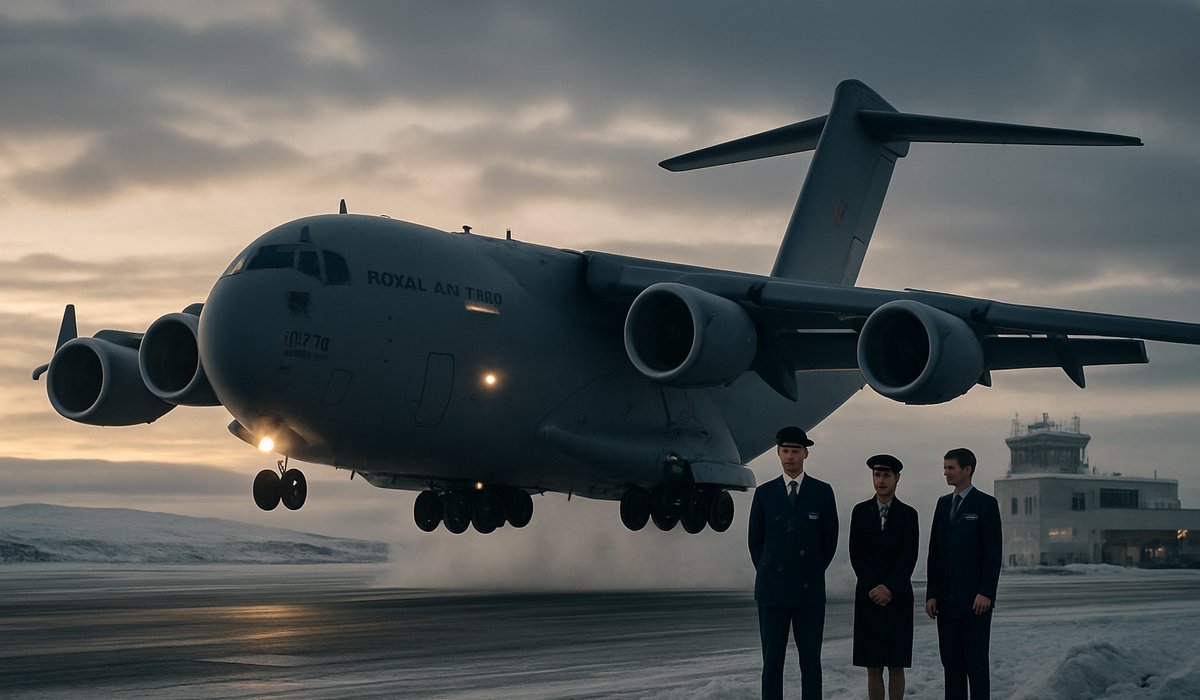
Image generated by AI
RAF Transport Aircraft Completes Extreme Arctic Supply Operations, Resupplying Earth's Northernmost Military Outpost
Royal Air Force C-17 Globemaster III executes eight critical missions to Canadian Forces Station Alert, demonstrating military logistics capabilities in one of the world's most inhospitable environments
Military Logistics Push Into the Arctic Circle
A Royal Air Force Boeing C-17 Globemaster III has concluded an extraordinary series of resupply missions to Canadian Forces Station Alert, the world's most northerly permanently staffed military installation, located deep within the Arctic Circle at more than 82 degrees north latitude in Canada's Nunavut territory.
The heavy-lift transport aircraft, based out of Pituffik airbase in Greenland, successfully completed eight separate cargo runs to the remote outpost situated approximately 1,100 miles beyond the Arctic Circle. The station represents a critical strategic asset for North American sovereignty in the High North, particularly as geopolitical competition intensifies across polar regions.
Unprecedented Supply Chain in Extreme Conditions
The multi-mission deployment underscores the logistical complexities facing modern militaries operating in Earth's most extreme environments. Canadian Forces Station Alert—designated YLT on aviation charts—sits in perpetual or near-perpetual darkness for much of the year, with average winter temperatures plummeting below minus 40 degrees Celsius.
The C-17 Globemaster III, one of the world's most capable military cargo aircraft, proved essential for this operation. The aircraft's ability to land on remote, unprepared airstrips and transport 70 tons of cargo made it ideally suited for sustaining the isolated Arctic garrison. Each mission from Greenland required meticulous planning, specialized cold-weather protocols, and precise coordination between RAF and Canadian military authorities.
Strategic Significance in High North Competition
The Arctic resupply operations reflect broader military concerns about maintaining presence and readiness in polar regions, where Russia has substantially expanded its infrastructure and presence in recent years. Canada and allied nations including the United Kingdom have intensified efforts to strengthen their Arctic capabilities and demonstrate sustained operational commitment to remote northern territories.
The successful completion of these eight supply runs signals enhanced military-to-military cooperation between RAF and Canadian Forces, particularly in challenging terrain where conventional logistics networks prove inadequate. Such operations demand specialized training, equipment, and coordination—elements that remain in short supply across most air arms globally.
Return and Future Operations
Following the conclusion of its Arctic mission sequence, the RAF C-17 Globemaster III returned to the United Kingdom, having validated operational procedures for sustained High North logistics operations. The deployment provides valuable intelligence for future Arctic resupply campaigns and strengthens the operational partnership between NATO allies operating in strategically important polar regions.
FAQ: Arctic Aviation Operations and Military Logistics
What is Canadian Forces Station Alert and why is it strategically important? Station Alert is the world's northernmost permanently inhabited military facility, located at 82+ degrees north in Canadian Nunavut. It serves critical surveillance and sovereignty functions for North American Arctic defense and monitoring.
Why use a C-17 Globemaster for Arctic resupply missions? The C-17 can carry up to 70 tons of cargo, land on unprepared surfaces, and operate in extreme cold-weather conditions—capabilities essential for remote Arctic bases lacking modern airport infrastructure.
How do extreme Arctic conditions affect military logistics operations? Temperatures below minus 40°C, extended darkness, and harsh weather create significant challenges for aircraft operations, crew safety, fuel management, and cargo preservation during Arctic missions.
What is the geopolitical importance of Arctic military operations? Intensified Russian Arctic expansion has prompted NATO allies to strengthen their presence and capabilities in polar regions, making resupply operations like this critical for maintaining strategic positioning.
How often do RAF aircraft conduct Arctic resupply missions? Frequency varies based on seasonal conditions, geopolitical requirements, and logistical needs, though such operations remain specialized and demanding undertakings requiring extensive planning.
Related Travel Guides
- Singapore Airlines 2026: Record 128 Weekly Flights to Europe Boosting London, Madrid, and Paris
- Travel Chaos as Chicago O'Hare Faces 640 Flight Delays and 87 Cancellations, Stranding Passengers Across US, Canada, Germany, and Switzerland
- Severe Aviation Turmoil Hits the US: 469 Flights Axed Across Major Hubs
Disclaimer
This article is for informational and educational purposes only. It does not constitute legal, financial, or professional advice. While we strive to provide accurate and up-to-date information, travel policies, regulations, and conditions change rapidly. Always verify information with official sources before making travel decisions. Nomad Lawyer makes no representations about the accuracy, reliability, completeness, or suitability of the information provided. Readers should consult qualified professionals for advice specific to their circumstances. The views expressed in this article are those of the author and do not necessarily reflect the views of Nomad Lawyer.
Preeti Gunjan
Contributor & Community Manager
A passionate traveller and community builder. Preeti helps grow the Nomad Lawyer community, fostering engagement and bringing the reader experience to life.
Learn more about our team →