
Zurich Airport Departures Guide 2026: Navigating Check-in, Gates A-E, and Skymetro Logistics
Master your departure from Zurich Airport with this comprehensive 2026 guide covering check-in halls 1-3, the Skymetro to Gates E, and critical passport control timelines.

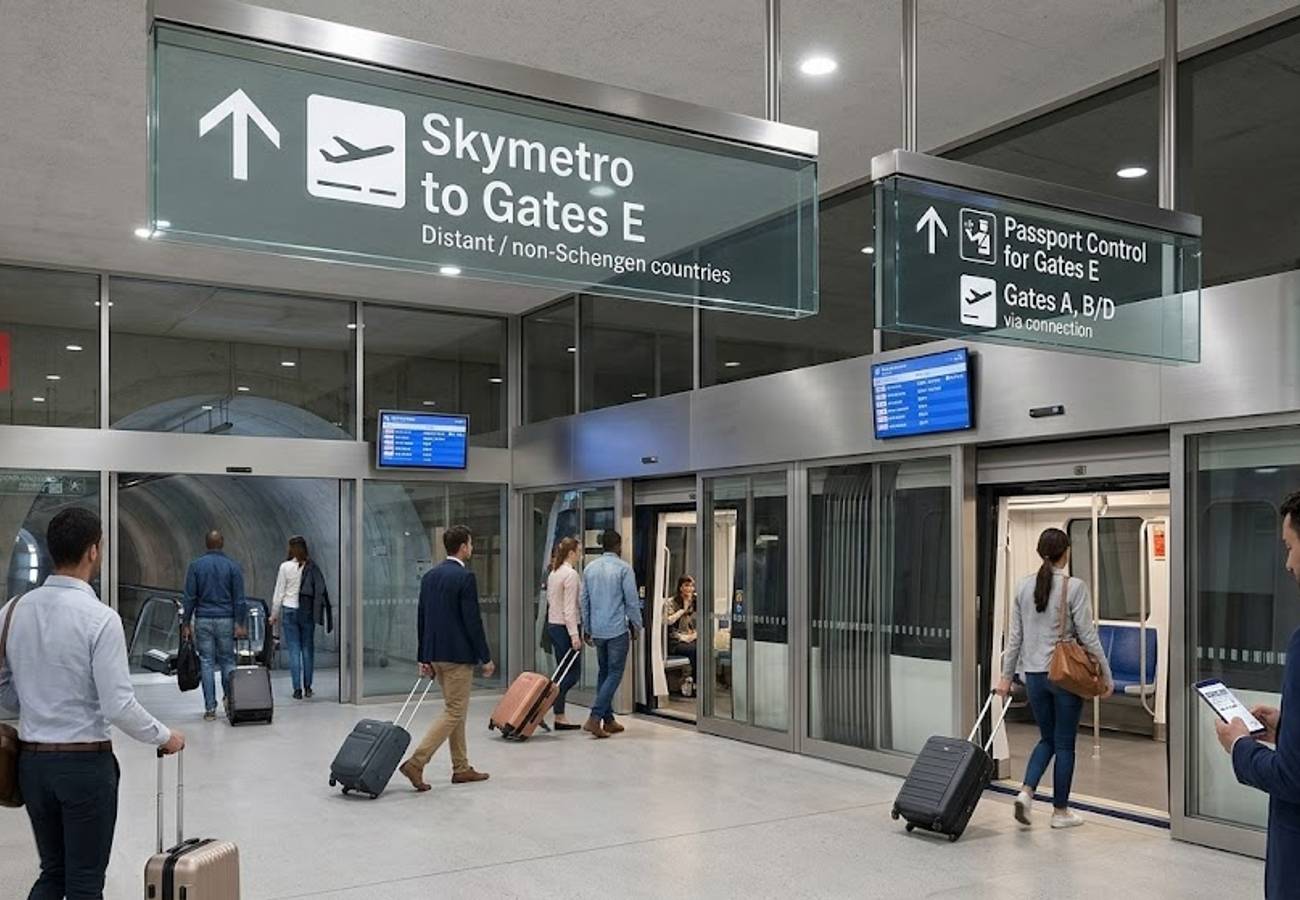
Image generated by AI
Passengers departing from Zurich Airport in 2026 must navigate a strategic layout of three distinct gate piers and three centralized check-in halls to ensure on-time boarding. While the hub is renowned for Swiss efficiency, the separation of Schengen and non-Schengen flows—particularly the transit to the midfield terminal—requires precise timing.
Strategic Layout of the Zurich Airport Terminal Complex
Zurich Airport operates through a primary terminal structure that feeds into three main airside areas: Gates A, Gates B/D, and Gates E. The distribution of flights across these piers is determined by the destination's treaty status and flight distance.
Gates A are exclusively reserved for Schengen Area flights. In contrast, the B/D pier serves a dual purpose; it can be toggled between Schengen and non-Schengen operations depending on the flight's destination. Gates E are located in a separate midfield terminal, accessible only via the underground Skymetro shuttle, and are primarily used for long-haul international routes.
For those arriving at the terminal, check-in operations are divided into three numbered zones: Check-in 1, 2, and 3, located within the Airport Centre above the rail station. Carrier distribution is generally grouped by alliance:
- Check-in 1 and 3: Predominantly used by Star Alliance members, including Swiss and Lufthansa.
- Check-in 2: Typically hosts oneworld and SkyTeam airlines.
The logistical flow moves from these check-in halls through a centralized security screening process into the Airside Center. From this central hub, the walk to Gates A or B/D is relatively brief, usually taking between 5 and 10 minutes. However, passengers assigned to Gates E must factor in the Skymetro transit. While the train ride is approximately 3 minutes, the total journey from security to an E gate typically requires 10 to 15 minutes.
Due to this compact design, the airport maintains a minimum connection time of roughly 40 minutes. While experienced travelers often clear domestic or Schengen transfers in under an hour, departing passengers are advised to maintain a buffer for passport control during peak seasonal surges.
Arrival Timelines and Check-in Protocols
Standard industry recommendations for Zurich suggest arriving 2 hours before departure for European routes and 3 hours for long-haul flights. These windows are critical during peak periods, such as Friday evenings in the summer or winter weekends when ski charter traffic peaks. For instance, a family of four traveling to Spain during school holidays should aim for a 2.5-hour lead time to account for potential bag-drop queues.
Digital transformation has streamlined the process for carriers like Emirates, British Airways, Lufthansa, and Swiss, with online check-in typically opening 24 hours prior to takeoff. Travelers with only carry-on luggage can bypass the counters and head straight to security. However, certain non-Schengen destinations, such as the United States, often necessitate a manual document verification. Passengers on a Swiss flight to New York, for example, usually stop at a dedicated document check kiosk near the security entrance even after checking in digitally.
For those requiring traditional services, staffed counters are available across all three check-in halls. Many major airlines now utilize a hybrid model:
- Self-Service Bag Drop: Common for Edelweiss and Swiss flights, allowing passengers to print tags and scan boarding passes independently.
- Staffed Counters: Still the primary method for smaller airlines and holiday charter services, which may see longer queues.
To alleviate morning congestion, some carriers offer an early bag drop the previous evening. This is particularly useful for early Lufthansa departures, allowing passengers to arrive the next morning with only hand luggage.
Security Screening and Passport Control Logistics
All departing passengers converge at centralized security checkpoints. Wait times vary significantly by time of day:
- Mid-week/Off-peak: Often under 10 minutes.
- Peak Windows (06:30–08:30 or Sunday evenings): Queues can stretch to 20 or 30 minutes.
- Fast Track: Available for elite status holders and business class passengers to bypass these peaks.
Upon clearing security, travelers enter the Airside Center. Those bound for Schengen cities—such as Lisbon, Vienna, or Paris—proceed directly to Gates A or B. The walk to the end of Gates A is roughly 5 minutes, while the B pier may take 7 to 10 minutes.
Non-Schengen travelers, including those heading to North America, the UK, or Asia, must undergo passport control. For D-gate departures, this occurs within the B/D pier via automated eGates or staffed booths. For E-gate departures, passport control must be cleared before boarding the Skymetro.
The implementation of the Entry/Exit System (EES) for third-country nationals has introduced additional steps, including facial imaging and fingerprinting at dedicated kiosks. This process can add 10 to 15 minutes to the transit time during busy long-haul departure windows. Consequently, passengers heading to the midfield terminal are encouraged to allow at least one hour between security clearance and their boarding time.
Navigating the Specifics of Gates A, B/D, and E
Gates A: The Schengen Hub
Primarily serving domestic Swiss flights and short-haul routes to cities like Munich, Milan, or Geneva, Gates A feature a streamlined layout. These areas provide charging stations and "grab-and-go" dining. Due to the high volume of short-haul rotations, gate changes are frequent; passengers should monitor screens closely.
Gates B/D: The Dual-Purpose Pier
The B/D pier is unique because a single physical gate can serve two different purposes. A gate may be designated as "B" for a Schengen flight (e.g., Barcelona) and "D" for a non-Schengen flight (e.g., London Gatwick). Passengers must follow the specific letter on their boarding pass and observe the floor markings that separate the two passenger flows.
Gates E: The Midfield Terminal
Reached via the Skymetro, the E concourse is the primary departure point for long-haul carriers like Singapore Airlines, Emirates, and Swiss. This terminal offers expansive airfield views and a bright, modern environment. Transit within the E terminal is efficient, with most gates located within a 2-to-6-minute walk from the central plaza.
Impact Analysis: The Traveler's Perspective
For the modern traveler, the efficiency of Zurich Airport is a double-edged sword. While the distances are shorter than at hubs like Heathrow or Charles de Gaulle, the strict separation of Schengen and non-Schengen zones means a single mistake in signage can lead to significant delays.
From a logistical standpoint, the Skymetro is a critical bottleneck. While the train is fast, the requirement to clear passport control before boarding means that any delay at the border police booths directly impacts the ability to reach Gates E. Furthermore, the introduction of EES biometric checks transforms the "quick" passport process into a potential time-sink for non-EU citizens.
For those traveling during peak ski or summer seasons, the "efficiency" of the airport is tested. The reliance on self-service bag drops for major carriers helps, but the concentration of passengers in the Airside Center can create congestion that slows down the walk to the gates.
Precise timing and a clear understanding of the B/D gate duality are the keys to a stress-free departure from Zurich.
Related Travel Guides
Disclaimer
This article is for informational and educational purposes only. It does not constitute legal, financial, or professional advice. While we strive to provide accurate and up-to-date information, travel policies, regulations, and conditions change rapidly. Always verify information with official sources before making travel decisions. Nomad Lawyer makes no representations about the accuracy, reliability, completeness, or suitability of the information provided. Readers should consult qualified professionals for advice specific to their circumstances. The views expressed in this article are those of the author and do not necessarily reflect the views of Nomad Lawyer.
Kunal K Choudhary
Co-Founder & Contributor
A passionate traveller and tech enthusiast. Kunal contributes to the vision and growth of Nomad Lawyer, bringing fresh perspectives and driving the community forward.
Learn more about our team →