
Wizz Air's UK Border Alert: EES Chaos at Spain, France, Portugal Airports
UK travellers face unprecedented delays at Spanish, French, and Portuguese airports following the EU's full biometric EES rollout in April 2026. Wizz Air warns of three-hour waits.

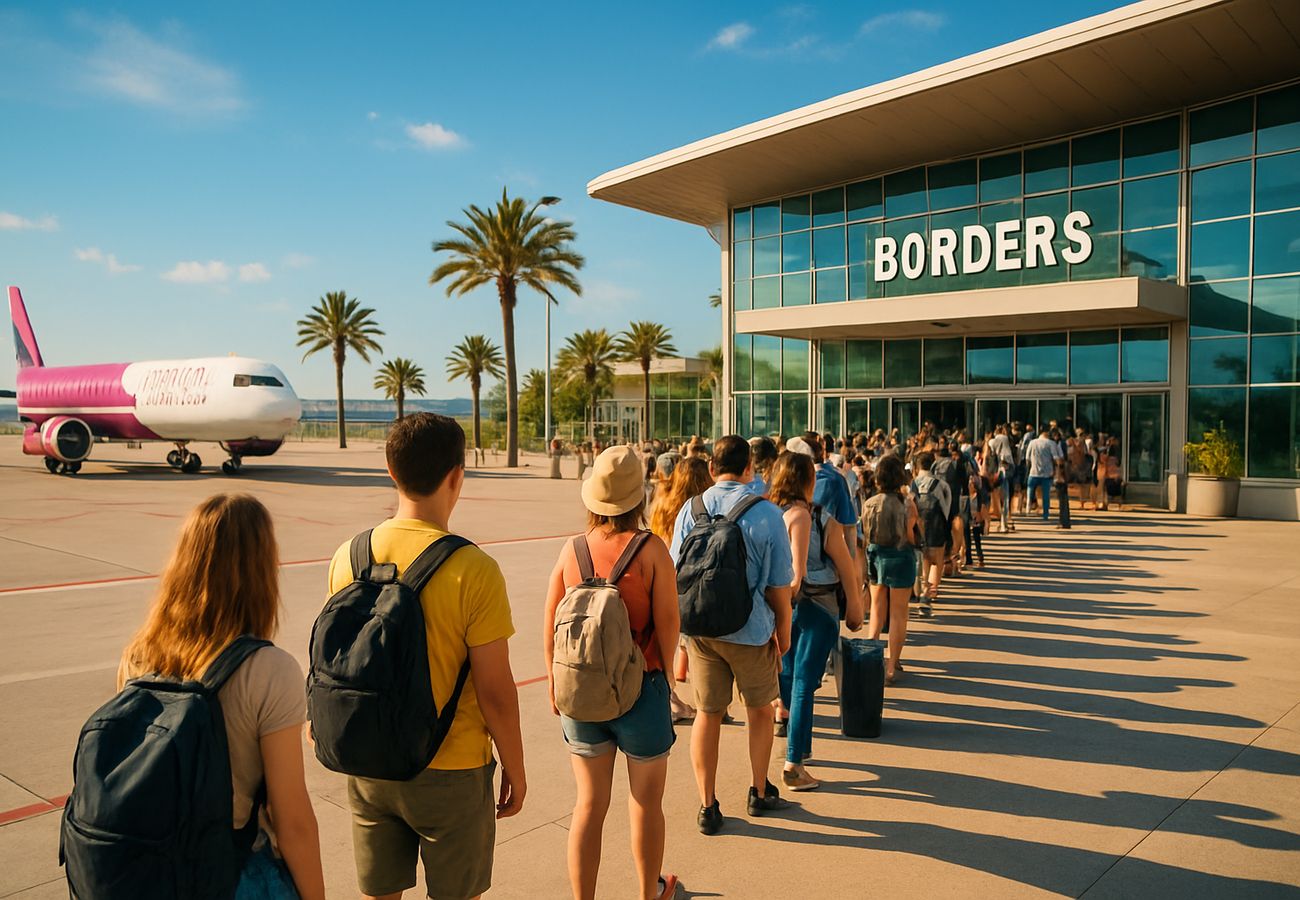
Image generated by AI
It's mid-summer 2026, and European airports are in crisis mode. UK travellers arriving at Spain, France, and Portugal are hitting unprecedented congestion at border control—not from overbooking or staff shortages, but from a controversial new technology that was supposed to make crossing borders easier.
The culprit: the EU Entry/Exit System (EES), which went live at full capacity in April 2026. What sounded good on paper has become a nightmare in practice, with queues stretching past three hours at some of Europe's busiest hubs.
And Wizz Air, one of Europe's largest low-cost carriers, is now openly warning passengers to arrive three hours before departure just to clear border control.
What is the EU Entry/Exit System—And Why Is It Causing Chaos?
The EES replaces the old passport stamping system with mandatory biometric registration. Every non-EU citizen entering or exiting the Schengen Area must now provide facial images and fingerprints. The data gets stored centrally, allowing authorities to track who comes and goes—and catch people overstaying their 90-day limit.
On paper, it's a security upgrade. In reality, it's a bottleneck.
Here's what happens: A UK traveller approaches passport control at Madrid-Barajas, Paris Charles de Gaulle, or Lisbon Airport. They scan their passport. A camera captures their face. A scanner takes their fingerprints. The system cross-references everything. Then they wait for an official to verify the biometric match. This single process takes several minutes per person.
Reddit: "I missed my connecting flight at CDG because I was stuck in the EES queue for 2.5 hours. Wizz Air didn't even warn me." — r/travel
Multiply that by thousands of summer travellers, and you get gridlock.
Peak Season Collided With a Broken System
Summer 2026 was always going to be chaotic for European airports. Spain, France, and Portugal attract millions of international visitors annually—and June through August is their busiest season.
Instead of rolling out EES gradually or with advance staffing, the EU decided on a hard cutover in April. By June, the system was fully operational across all Schengen borders—just as holiday travel ramped up.
The result: Airport staff were overwhelmed. Pre-registration tools existed in theory but weren't widely publicized. Additional border kiosks were hastily deployed, but first-time biometric enrolment is inherently slow.
Travellers reported waits exceeding three hours at secondary checkpoints. Families with children were stranded in queues. Connecting passengers missed flights. Flights themselves were delayed as boarding times shifted to accommodate the bottleneck upstream.
Wizz Air's Desperate Guidance: "Arrive Three Hours Early"
Wizz Air, operating hundreds of daily flights into Spanish, French, and Portuguese airports, couldn't stay silent. The airline issued formal guidance warning UK passengers to arrive up to three hours before departure.
That's on top of the standard two hours already recommended for international flights.
The airline advised passengers to:
- Have travel documents ready and easily accessible
- Carry water, snacks, and phone chargers for extended waits
- Expect biometric queues to take significantly longer than traditional passport control
- Plan connections with substantial buffers
This isn't theoretical—Wizz Air was responding to real incidents of passengers missing flights due to border delays. When a three-hour early arrival becomes necessary just to clear a checkpoint, the operational system has failed.
The Legal Reality for UK Travellers Under EES
Here's what every UK citizen needs to understand: The EES is mandatory, and refusal to comply results in immediate denial of entry.
You cannot opt out. You cannot refuse biometric data collection. The EU implemented this under regulations governing external Schengen border management, with legal force.
The system tracks:
- Passport details
- Facial image
- Fingerprints
- Entry and exit dates
- Nationality
Both entry and exit require biometric verification. This applies to all short-stay visits (up to 90 days in any 180-day period). Overstaying your entitlement triggers automatic alerts and potential fines, travel bans, or deportation proceedings.
From a legal standpoint, the EES transfers border control from manual officer judgment to automated algorithmic verification. That's more objective—but less forgiving if something goes wrong. A biometric mismatch can't be negotiated or explained away to a sympathetic border official. The system either clears you or doesn't.
Airport-Level Mitigation Efforts (And Their Failures)
European airports recognized the crisis immediately. Madrid-Barajas, Charles de Gaulle, and Lisbon ramped up staffing and opened additional biometric lanes. Some airports deployed self-service kiosks where passengers could pre-register biometrics before speaking to an official.
It helped—marginally.
The fundamental problem persists: First-time biometric enrolment is technologically slow. Fingerprint capture requires multiple attempts. Facial recognition sometimes fails on the first try. The system then escalates to manual verification by a border officer—exactly what the "automated" system was supposed to eliminate.
For repeat travellers, processing time dropped. For first-timers (which summer involves plenty of), delays remained substantial.
What Happens Next: Will It Get Better?
EU officials insist the EES will improve. The European Commission's position is clear: This is a security architecture that will enhance tracking and reduce overstays. The initial chaos is attributed to "transition teething problems."
That may be true. Staff training improves. Technology optimizations are deployed. Passenger awareness grows. In 12 months, the system might genuinely function more smoothly.
But right now, in June 2026, it's not working.
Wizz Air and other carriers are managing expectations proactively, which is appropriate. The airline is doing what it can: warning passengers, encouraging early arrival, and advising preparation.
For travellers, the immediate takeaway is stark.
Practical Advice for UK Travellers This Summer
If you're flying to Spain, France, or Portugal between now and September:
- Arrive at the airport three hours before departure (not the standard two)
- Have your passport easily accessible in your carry-on
- Bring water, snacks, and entertainment for extended queues
- Plan connections with at least three hours between flights if possible
- Assume border processing will take 45 minutes to two hours
- Check in online before arriving at the airport to reduce one variable
- Consider arriving a day earlier if your flight is time-critical
And understand that this is temporary operational chaos, not a systematic failure. The EES will settle. But this summer, European border control is understaffed for the technology's processing speed, and you need to plan accordingly.
Reddit: "The system works fine if you've used it before. It's the first-timers causing the backup. British tourists panic and take forever with the biometric capture." — r/Schengen
The Bigger Picture: Technology Rollout and Traveller Impact
The EES story reflects a broader tension in travel: New border technologies are implemented for legitimate security reasons, but their operational rollout often neglects the passenger experience.
From a legal and security standpoint, the EES is sound. It provides centralized tracking, prevents overstays, and assists law enforcement. EU border authorities made reasonable decisions in designing it.
But the implementation—particularly the timing and staffing—was inadequate. A September 2025 launch would have been better than April 2026. Advance publicity and wider pre-registration would have helped. Actual staff capacity should have matched the technology's processing speed.
Instead, we got summer 2026 chaos.
Wizz Air's warnings are a necessary reality check for passengers. The airline isn't exaggerating about three-hour arrivals—it's reflecting what's actually happening on the ground.
Travel planning for Europe just got more complicated, and your buffer time just doubled.
Related Travel Guides
Srinagar Airport Closure Alert: Summer 2026 Travel Disruption
Munich's Autonomous Taxi Revolution: Uber and Autobrains Go Driverless
SITA Acquires Barcelona AI Platform to Transform Global Airline Operations
Disclaimer
This article is for informational and educational purposes only. It does not constitute legal, financial, or professional advice. While we strive to provide accurate and up-to-date information, travel policies, regulations, and conditions change rapidly. Always verify information with official sources before making travel decisions. Nomad Lawyer makes no representations about the accuracy, reliability, completeness, or suitability of the information provided. Readers should consult qualified professionals for advice specific to their circumstances. The views expressed in this article are those of the author and do not necessarily reflect the views of Nomad Lawyer.
Raushan Kumar
Founder & Lead Developer
Full-stack developer with 11+ years of experience and a passionate traveller. Raushan built Nomad Lawyer from the ground up with a vision to create the best travel and law experience on the web.
Learn more about our team →