
Wizz Air Delays Six Abu Dhabi Routes to January 2027 Over Iraqi Airspace Detours: Flight Planning Guide

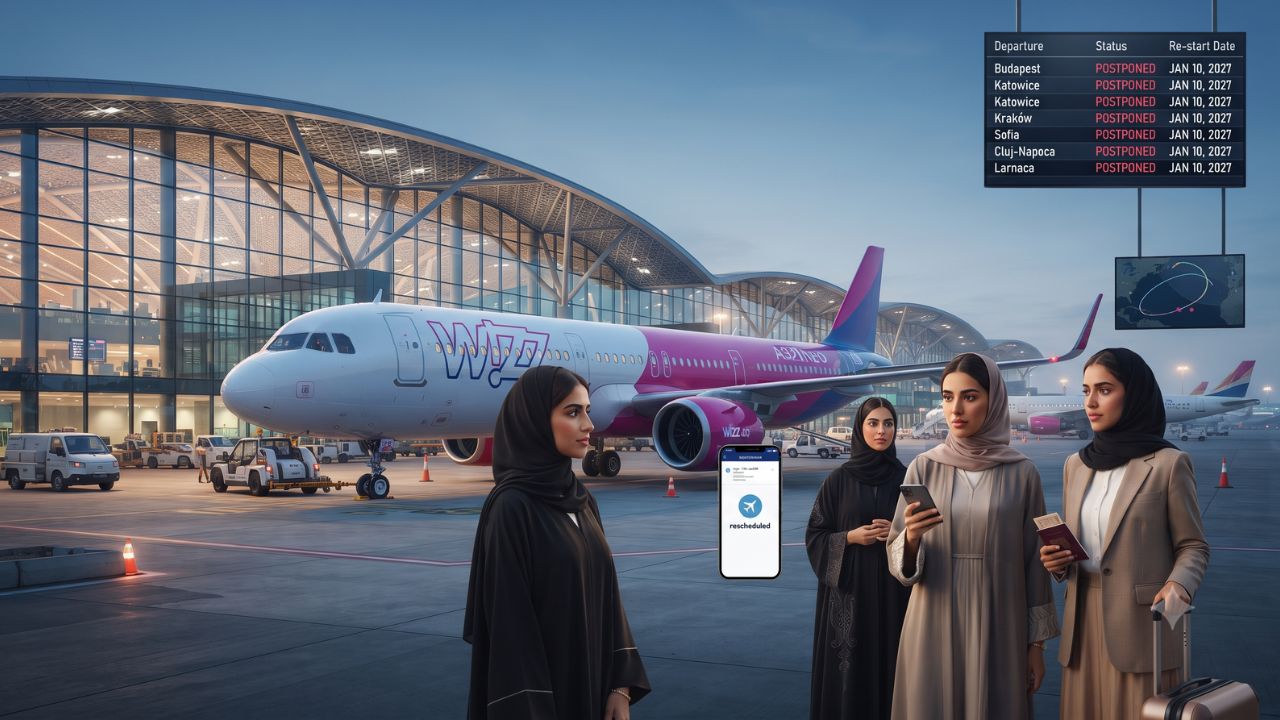
Rerouting narrowbody passenger jets around restricted conflict airspace can add up to 90 minutes of flight time and thousands of kilograms of extra jet fuel, transforming a profitable budget corridor into an unviable operation overnight. Due to active security advisories affecting the Baghdad Flight Information Region (FIR), low-cost carrier Wizz Air has officially postponed the resumption of six key European routes to Zayed International Airport (AUH) in Abu Dhabi. Originally scheduled to restart in late October 2026, the 20 weekly flights connecting the UAE capital with Budapest, Katowice, Kraków, Sofia, Cluj-Napoca, and Larnaca have been pushed back to 10 January 2027.
The suspension illustrates how geopolitical airspace constraints directly reshape low-cost point-to-point tourism. Under the current safety bulletins issued by the European Union Aviation Safety Agency (EASA), civil operators are warned against transiting Iraqi airspace at all flight levels due to air-defense risks, military operations, and drone activity. For Wizz Air's single-aisle Airbus A321neo fleet, flying around closed corridors pushes fuel burn beyond standard reserves, occasionally requiring unplanned technical refuelling stops that disrupt turnaround times.
Route Disruption Breakdown: The Delayed Winter Schedule
The postponement impacts six European city pairs that formed the backbone of Wizz Air's seasonal Central and Eastern European schedule to the Gulf. The flights were originally structured to relaunch in two waves on 25 October and 27 October 2026, offering promotional fares from €24.99 across a broader regional winter plan comprising 12 routes, 49 weekly flights, and approximately 470,000 seasonal seats.
Wizz Air Abu Dhabi Suspended Winter Routes
| City Pair | Airport Codes | Original Restart Date | Planned Weekly Frequency | Revised Resumption Date | Primary Passenger Segment |
|---|---|---|---|---|---|
| Abu Dhabi – Budapest | AUH – BUD | 25 October 2026 | 4 Flights / Week | 10 January 2027 | Central European Leisure & Hungarian Winter Sun |
| Abu Dhabi – Katowice | AUH – KTW | 25 October 2026 | 5 Flights / Week | 10 January 2027 | Silesian Industrial Basin & Polish Holidaymakers |
| Abu Dhabi – Kraków | AUH – KRK | 27 October 2026 | 3 Flights / Week | 10 January 2027 | Southern Poland City Breaks & Cultural Tourism |
| Abu Dhabi – Sofia | AUH – SOF | 27 October 2026 | 3 Flights / Week | 10 January 2027 | Balkan Transit & Bulgarian Winter Tourism |
| Abu Dhabi – Cluj-Napoca | AUH – CLJ | 27 October 2026 | 2 Flights / Week | 10 January 2027 | Transylvania Business & Regional Leisure |
| Abu Dhabi – Larnaca | AUH – LCA | 27 October 2026 | 3 Flights / Week | 10 January 2027 | Eastern Mediterranean Island Transit |
The temporary removal of these 20 weekly rotations creates an operational gap during the peak autumn travel season. However, Zayed International Airport's broader network remains expansive; the facility processed 32.5 million passengers in 2025 (a 12.6% year-on-year increase) across Terminal A, which handles up to 11,000 passengers per hour with capacity for 45 million annual travelers.
What Makes Ultra-Low-Cost Long-Haul Flight Economics Different
The fundamental challenge confronting budget carriers on Mediterranean-to-Gulf routes lies in aircraft utilization and tight fuel planning:
- Single-Aisle Fleet Range Constraints: The Airbus A321neo is highly efficient on direct point-to-point sectors. However, when circumnavigating closed airspace over Iraq, Syria, or Iran, flight paths lengthen significantly. Carrying additional contingency fuel increases overall aircraft weight, increasing fuel consumption per nautical mile.
- Tight Aircraft Rotations: Ultra-low-cost carriers rely on fast 35-to-45-minute gate turnarounds. If an aircraft requires an unscheduled technical refuelling stop in Egypt or Saudi Arabia, the delay cascades through the carrier's daily schedule of over 1,200 flights across 185 airports.
- Point-to-Point Booking Dynamics: Unlike legacy flag carriers offering ticket protection across alliance networks, budget travelers frequently book unbundled, self-connecting itineraries. A sudden schedule postponement forces passengers to renegotiate hotel deposits, desert safaris, and separate inter-island or regional transfers.
Visitor Insider Tips: Managing Travel Plans to Abu Dhabi
Travelers with autumn bookings or those planning winter trips to the United Arab Emirates through Visit Abu Dhabi should consider specific local strategies:
- Monitor Airline Notifications Directly: Check your booking status via Wizz Air's mobile app and the Customer First Compass digital portal. Accept rebooking options for flights departing after 10 January 2027, or request full refunds rather than waiting for automated vouchers if alternative carriers are needed immediately.
- Evaluate Alternative Regional Gateways: If autumn travel dates are inflexible, look for direct flights into Dubai International Airport (DXB) or Sharjah International Airport (SHJ). The public express coach (Route E100 or E101) connects Dubai's Al Ghubaiba and Ibn Battuta stations directly to Abu Dhabi Central Bus Station in 90 minutes for 25 AED.
- Protect Independent Bookings: Review cancellation policies for desert resort stays, Louvre Abu Dhabi timed tickets, and car rentals. Many cultural venues allow free rescheduling up to 24 hours prior to entry when proof of airline disruption is provided.
- Plan Winter Cultural Exploration: Postponing travel until after 10 January 2027 aligns with the UAE's ideal weather window. Daytime temperatures average 22°C to 25°C, making January ideal for walking the Saadiyat Cultural District, exploring the mangroves at Jubail Island, and attending heritage events in Al Ain.
Cultural and Environmental Context: Aviation Corridors and Desert Gateways
The geopolitical shifts in Middle Eastern airspace highlight how modern international tourism depends entirely on delicate international transit corridors. As European and Gulf carriers adjust flight tracks south across Saudi Arabia and Egypt, air traffic control coordination across the Arabian Peninsula has become increasingly complex.
At the same time, Abu Dhabi's tourism strategy emphasizes sustainable cultural heritage alongside infrastructure growth. In Al Ain—a UNESCO World Heritage cultural site featuring ancient falaj irrigation systems and historical date palm oases—conservationists balance increasing visitor flows with groundwater preservation. By consolidating arrival traffic at Terminal A and investing in fuel-efficient fleet modernization, the aviation sector aims to lower carbon emissions per passenger kilometer, even as geopolitical circumstances mandate temporary detours.
FAQ: Visiting Abu Dhabi and Wizz Air Flights 2026–2027
Why were the six Wizz Air routes to Abu Dhabi postponed? The routes were delayed due to security advisories and flight restrictions over Iraqi airspace, which forced longer detours, higher fuel consumption, and potential refuelling stops for single-aisle aircraft.
When will the postponed European flights resume to Abu Dhabi? All six affected routes—Budapest, Katowice, Kraków, Sofia, Cluj-Napoca, and Larnaca—are scheduled to resume regular operations on 10 January 2027.
Can affected passengers claim a refund or alternative routing? Yes. Wizz Air contacts ticket holders directly via email and its digital app to provide options for rebooking on revised dates, routing adjustments, or full monetary refunds.
What is the best alternative way to reach Abu Dhabi this autumn? Travelers can book alternative flights landing at Dubai International (DXB) and take scheduled airport buses or taxis along the E11 highway, reaching central Abu Dhabi within 75 to 90 minutes.
Related Travel Guides
- Abu Dhabi Cultural District Guide: Exploring Louvre Abu Dhabi and Saadiyat Island
- Central and Eastern Europe Budget Airline Travel Hacks and Passenger Rights
- Official Zayed International Airport Real-Time Passenger Flight Information
In modern aviation, the straightest line on a map must always yield to the realities of open skies, reminding travelers that timing is everything when crossing continents.
Disclaimer
This article is for informational and educational purposes only. It does not constitute legal, financial, or professional advice. While we strive to provide accurate and up-to-date information, travel policies, regulations, and conditions change rapidly. Always verify information with official sources before making travel decisions. Nomad Lawyer makes no representations about the accuracy, reliability, completeness, or suitability of the information provided. Readers should consult qualified professionals for advice specific to their circumstances. The views expressed in this article are those of the author and do not necessarily reflect the views of Nomad Lawyer.
Kunal K Choudhary
Co-Founder & Contributor
A passionate traveller and tech enthusiast. Kunal contributes to the vision and growth of Nomad Lawyer, bringing fresh perspectives and driving the community forward.
Learn more about our team →