
Why U.S. Navy F/A-18 Hornets Execute Extreme Nose-Up Carrier Landings: The Physics Behind Aviation's Most Dramatic Touchdown
Breaking airline news and aviation industry updates for 2026.

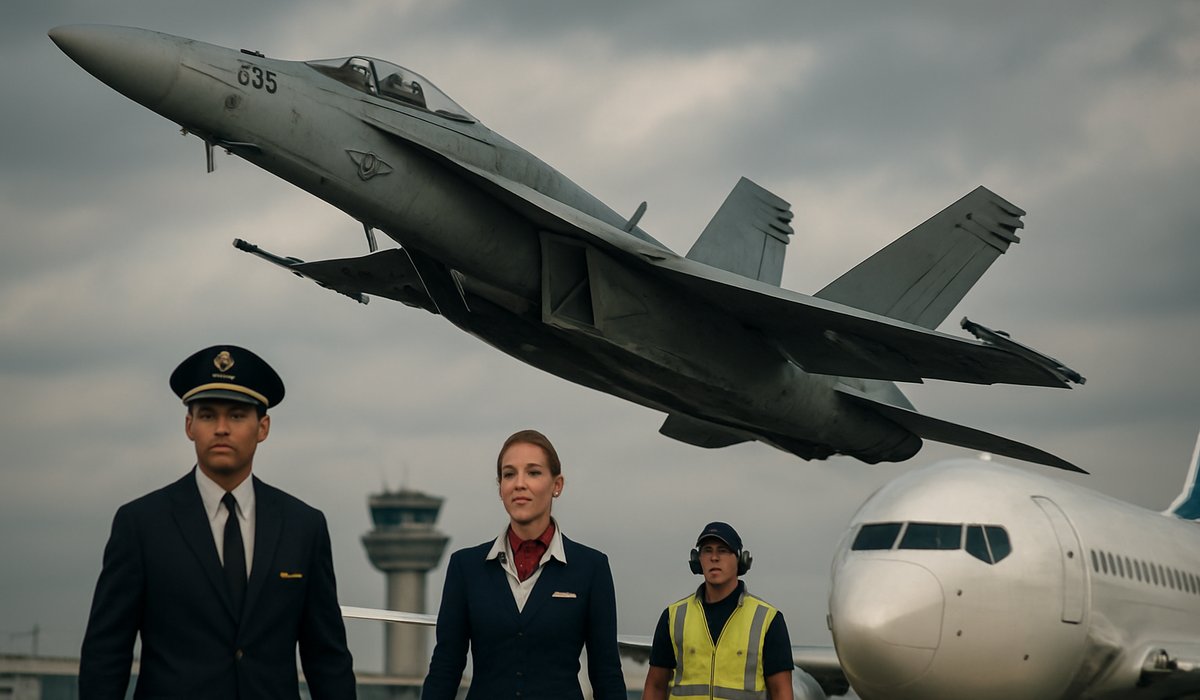
Image generated by AI
Why U.S. Navy F/A-18 Hornets Execute Extreme Nose-Up Carrier Landings: The Physics Behind Aviation's Most Dramatic Touchdown
Understanding the engineering and operational demands that force carrier-based fighter jets into unprecedented angles of attack
The Visual Drama of Deck Operations
The U.S. Navy's F/A-18 Super Hornet has become synonymous with one of aviation's most visually striking maneuvers: the near-vertical nose-up approach during carrier landings. These extreme angles of attack—where the aircraft's nose points dramatically skyward while descending onto a moving flight deck—represent far more than theatrical naval aviation. They are a direct consequence of fundamental physics colliding with the severe constraints of operating from a 4.5-acre floating runway.
Engineering Necessity Meets Operational Demand
All carrier-based fighter jets employ elevated angles of attack during deck recovery operations, but the legacy F/A-18 Hornet has earned particular recognition for the exaggerated pitch angles that characterize its approach. This distinctive maneuver stems from the critical requirement to simultaneously achieve two competing objectives: reducing forward speed sufficiently to land on an abbreviated flight deck while maintaining enough aerodynamic lift to catch the arresting cable system that halts the aircraft.
The original McDonnell Douglas design prioritized this capability during an era when flight control systems relied on less sophisticated automation than contemporary platforms like the F-35C Lightning II. Despite these technological limitations, the Hornet represented a significant advancement in carrier aviation when introduced, incorporating design features specifically optimized for naval operations.
The Physics of Constrained Landing Zones
Operating from a carrier deck imposes geometric and kinetic constraints unlike any land-based airfield. Pilots must dissipate airspeed aggressively while maintaining sufficient lift to remain airborne during the final approach phase. The extreme angle of attack accomplishes this by maximizing lift generation at lower velocities—a fundamental aerodynamic principle that becomes operational necessity aboard ship.
The arresting gear system compounds these demands, requiring precise spatial positioning and speed parameters that supersede conventional landing procedures. Consequently, the Hornet's distinctive high-angle approach has become an iconic identifier of American carrier operations, instantly recognizable in both official documentation and public coverage of naval aviation.
Modern Evolution and Legacy Status
While contemporary naval fighters benefit from advanced fly-by-wire systems and predictive landing aids that moderate pitch angles, the original Hornet's approach profile remains largely unchanged—a testament to the enduring physics governing carrier aviation rather than technological obsolescence. The aircraft continues demonstrating that spectacular-appearing procedures often represent elegant engineering solutions to extreme operational environments.
FAQ: Carrier Aviation and Naval Flight Operations
Q: Why do Navy fighter jets land at such steep angles compared to civilian aircraft? A: Carrier decks are approximately 1,000 feet long versus 10,000+ feet for commercial runways. Extreme angles of attack reduce landing distance while generating sufficient lift at lower speeds.
Q: How does the F/A-18 differ from the F-35C in landing procedures? A: The F-35C features advanced digital flight controls that moderate pitch angles, whereas the legacy Hornet's mechanical systems require steeper approaches to achieve the same aerodynamic objectives.
Q: What is an angle of attack in aviation? A: It measures the angle between the aircraft's nose and the direction of relative wind, directly affecting lift generation and stall characteristics.
Q: Can civilian aircraft use carrier landing techniques? A: No. Civilian aircraft are designed for long runways and employ fundamentally different approach profiles unsuitable for deck operations.
Q: How do pilots train for these extreme-angle carrier landings? A: Naval aviators complete extensive simulator training followed by progressive carrier qualifications under controlled conditions before independent operations.
Related Travel Guides
External Resources
Disclaimer
This article is for informational and educational purposes only. It does not constitute legal, financial, or professional advice. While we strive to provide accurate and up-to-date information, travel policies, regulations, and conditions change rapidly. Always verify information with official sources before making travel decisions. Nomad Lawyer makes no representations about the accuracy, reliability, completeness, or suitability of the information provided. Readers should consult qualified professionals for advice specific to their circumstances. The views expressed in this article are those of the author and do not necessarily reflect the views of Nomad Lawyer.
Preeti Gunjan
Contributor & Community Manager
A passionate traveller and community builder. Preeti helps grow the Nomad Lawyer community, fostering engagement and bringing the reader experience to life.
Learn more about our team →