
US Air Force Maintains Exclusive Grip on F-22 Raptor as Export Ban Shields America's Most Advanced Fighter Jet
Breaking airline news and aviation industry updates for 2026.

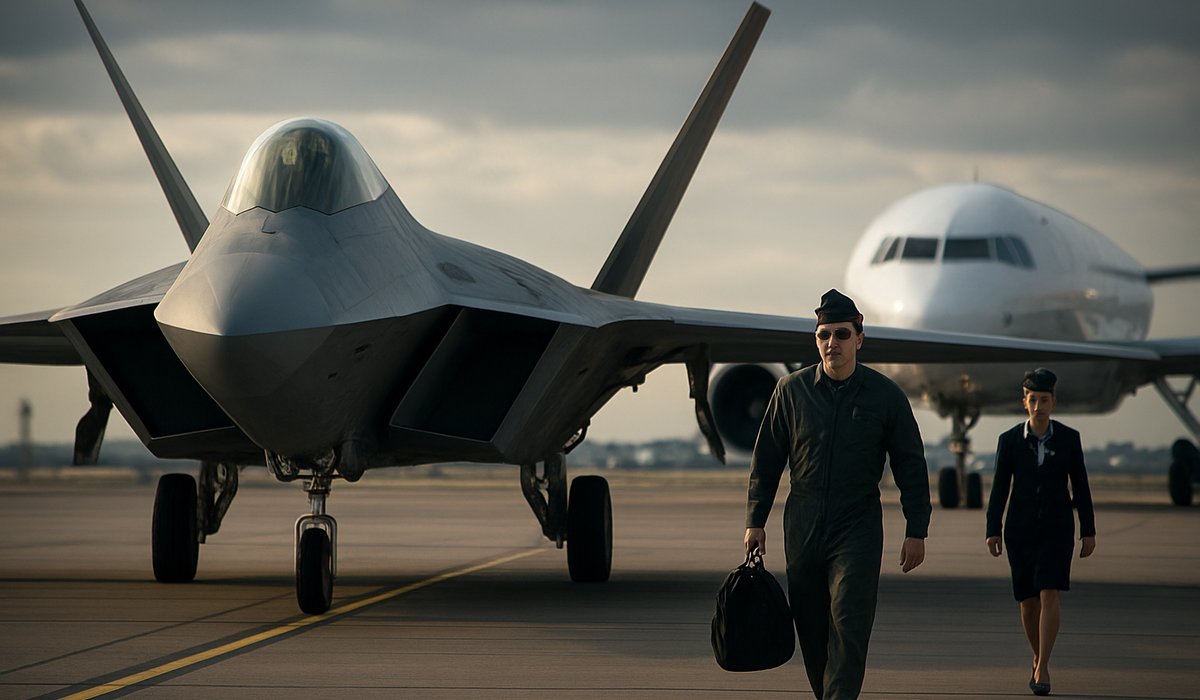
Image generated by AI
US Air Force Maintains Exclusive Grip on F-22 Raptor as Export Ban Shields America's Most Advanced Fighter Jet
The 1998 legislative block that keeps the world's deadliest air superiority aircraft exclusively American
Legislative Safeguard Protects Strategic Advantage
The United States Air Force remains the world's sole operator of the Lockheed Martin F-22 Raptor, a status secured and maintained through decades of export restrictions rooted in Cold War-era strategic thinking. This exclusivity distinguishes the fifth-generation fighter jet fundamentally from its successor platform, the F-35 Lightning II, which was architected from inception for multinational deployment and international sales partnerships.
The architectural difference between these two systems reflects divergent military philosophies. While the F-35 platform was engineered as a collaborative multinational initiative enabling allied nations to operate advanced fighters in integrated defense networks, the F-22 was conceived as a singular instrument of American air superiority—a strategic asset designed to maintain technological dominance without peer competition.
The 1998 Amendment That Changed Everything
The cornerstone of this exclusivity traces back to 1998, when Representative David Obey introduced a pivotal amendment to the Department of Defense Appropriations Act. This legislative measure effectively prohibited the foreign sale or technology transfer of the F-22 fighter system, cementing America's monopoly on the platform's operational capabilities and technological advancements.
Obey's amendment reflected broader concerns about maintaining American military advantage during a period of geopolitical uncertainty. Rather than opening the aircraft to allied nations—a strategy later embraced with the F-35—lawmakers determined that the F-22's advanced stealth technology, sensor fusion capabilities, and air combat systems warranted singular American control.
Strategic Implications and Industry Impact
The export prohibition has shaped the global military aircraft market significantly. While allied nations including Australia, Canada, Germany, Poland, and the United Kingdom have acquired F-35 variants through international partnership agreements, no foreign air force has ever operated the F-22. This restriction represents a deliberate choice by American defense policy to treat certain technological capabilities as exclusively strategic.
The contrast highlights evolving defense procurement philosophies. The F-35 program, encompassing multiple production variants and involving partner nations in development and manufacturing, generates substantial economic benefits through international collaboration. The F-22, conversely, remains concentrated within American industrial and operational ecosystems, limiting export revenue but preserving technological secrecy.
FAQ: Understanding the F-22 Export Restrictions
Q: Why can't the F-35 be exported to all US allies the same way? A: The F-35 was designed specifically for multinational cooperation, featuring export-variant configurations. The F-22, built before this collaborative model, underwent legislative restrictions preventing any international sales.
Q: Has any country attempted to purchase F-22s? A: Multiple allied nations have expressed interest, but the 1998 amendment remains in effect, making sales legally prohibited regardless of buyer status.
Q: Could Congress repeal the F-22 export ban? A: Technically yes, but the legislative block remains politically resilient due to concerns about maintaining American technological superiority.
Q: How many F-22s have been built? A: Approximately 195 aircraft were produced before production ended in 2011, with all remaining operational with the US Air Force.
Q: Is the F-22 still considered the world's best fighter jet? A: The F-22 remains among the most advanced air superiority platforms globally, though newer aircraft continue advancing capabilities in various domains.
Related Travel Guides
Disclaimer
This article is for informational and educational purposes only. It does not constitute legal, financial, or professional advice. While we strive to provide accurate and up-to-date information, travel policies, regulations, and conditions change rapidly. Always verify information with official sources before making travel decisions. Nomad Lawyer makes no representations about the accuracy, reliability, completeness, or suitability of the information provided. Readers should consult qualified professionals for advice specific to their circumstances. The views expressed in this article are those of the author and do not necessarily reflect the views of Nomad Lawyer.
Raushan Kumar
Founder & Lead Developer
Full-stack developer with 11+ years of experience and a passionate traveller. Raushan built Nomad Lawyer from the ground up with a vision to create the best travel and law experience on the web.
Learn more about our team →