
Engineering Marvel: Why the C-5M Super Galaxy Demands 28 Wheels and a Revolutionary Kneeling System
Breaking airline news and aviation industry updates for 2026.

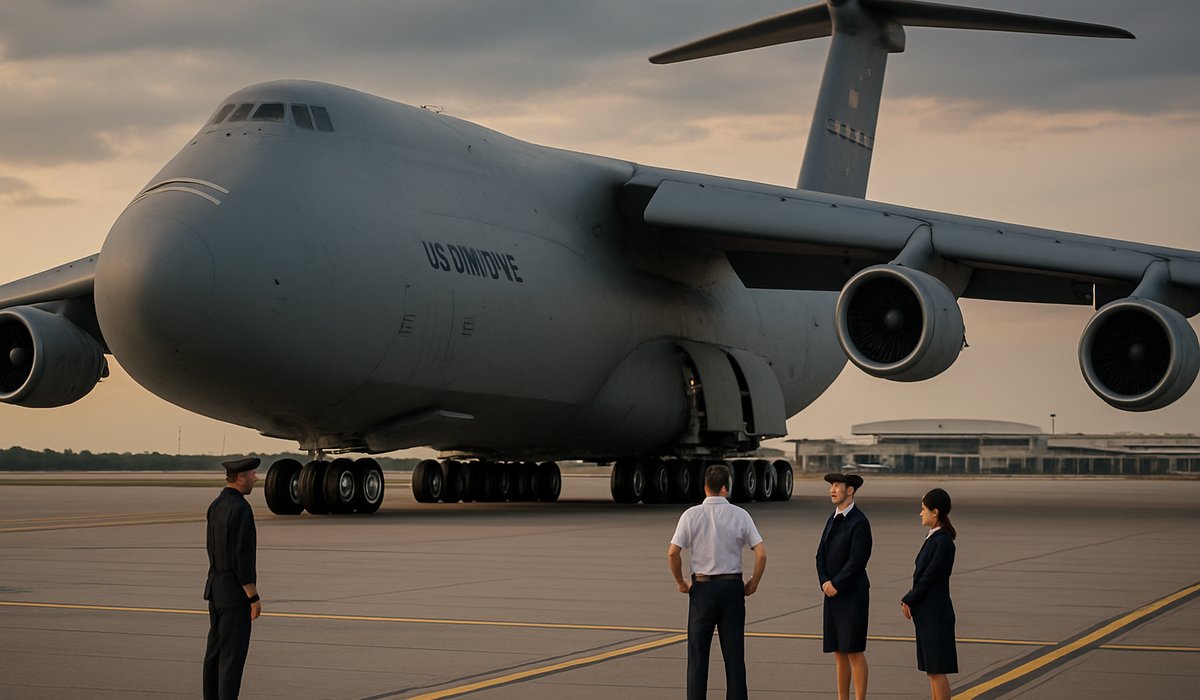
Image generated by AI
Engineering Marvel: Why the C-5M Super Galaxy Demands 28 Wheels and a Revolutionary Kneeling System
The U.S. Air Force's colossal cargo aircraft relies on unconventional landing gear technology to operate from unprepared airfields worldwide
A Colossus Built for Global Military Logistics
The Lockheed Martin C-5M Super Galaxy represents one of aviation's most audacious engineering achievements—a strategic airlift platform so massive that conventional aircraft design principles simply don't apply. With the ability to transport a fully operational main battle tank or fighter jet from continental U.S. bases to forward positions across the globe, this behemoth demands solutions as extraordinary as its operational requirements.
At the heart of this capability lies an engineering paradox: the aircraft's extraordinary lifting power creates extraordinary demands on ground infrastructure that most runways simply cannot support.
The Weight Distribution Challenge
The C-5M can carry a maximum payload of 281,001 pounds (127,460 kilograms)—equivalent to the combined weight of multiple commercial jets' cargo. This staggering capacity would crush conventional landing gear into any standard runway, making the aircraft operationally impractical for the dispersed global deployment scenarios the U.S. Air Force requires.
To solve this problem, Lockheed Martin engineers deployed an unconventional solution: a 28-wheel landing gear configuration that distributes the aircraft's massive weight across an unusually large surface area. By spreading the load across multiple contact points, the Super Galaxy can operate from airfields and forward bases that would buckle under the concentrated pressure of traditional gear systems.
The Kneeling Mechanism: Engineering Innovation
Beyond the wheel configuration, the aircraft features a revolutionary kneeling system that lowers the fuselage toward the ground when parked. This hydraulic mechanism serves multiple critical functions: it reduces the angle of the cargo ramp for easier loading and unloading of heavy military equipment, minimizes stress on the landing gear during prolonged ground operations, and enables ground crews to access upper portions of the aircraft more safely.
The kneeling feature essentially transforms the C-5M into a mobile logistics platform capable of rapid cargo transfer in austere conditions—a capability that defines modern military airlift operations.
Strategic Implications for Global Airlift
This engineering approach reflects broader trends in military aviation: the necessity for strategic platforms to maintain operational flexibility across diverse, often unprepared environments. The C-5M's design enables U.S. military forces to project power globally without depending on established, potentially vulnerable airport infrastructure.
FAQ: Understanding the C-5M Super Galaxy
What is the C-5M Super Galaxy's maximum cargo capacity? The aircraft can transport up to 281,001 pounds (127,460 kilograms) of cargo, including main battle tanks and fighter jets.
Why does the C-5M have 28 wheels? The 28-wheel landing gear system distributes the aircraft's enormous weight across a larger surface area, allowing it to operate from unprepared and austere airfields without damaging runway surfaces.
How does the kneeling mechanism work? Hydraulic systems lower the fuselage when the aircraft is parked, reducing ramp angles for equipment loading and minimizing structural stress during ground operations.
Can the C-5M operate from standard commercial airports? Yes, the wheel configuration and kneeling system enable operations from both conventional runways and austere forward bases, providing unprecedented operational flexibility.
What makes the C-5M strategically important for global airlift? Its capacity to transport heavy military equipment directly to forward-deployed locations reduces dependence on established infrastructure, enabling rapid force projection worldwide.
Related Travel Guides
-
Flight Real Reason: Why Attendants Greet Boarding Passengers
-
Grassroots Campaign Mobilizes $22 Million to Resurrect Spirit Airlines as Community-Owned Carrier
External Resources
Disclaimer
This article is for informational and educational purposes only. It does not constitute legal, financial, or professional advice. While we strive to provide accurate and up-to-date information, travel policies, regulations, and conditions change rapidly. Always verify information with official sources before making travel decisions. Nomad Lawyer makes no representations about the accuracy, reliability, completeness, or suitability of the information provided. Readers should consult qualified professionals for advice specific to their circumstances. The views expressed in this article are those of the author and do not necessarily reflect the views of Nomad Lawyer.
Raushan Kumar
Founder & Lead Developer
Full-stack developer with 11+ years of experience and a passionate traveller. Raushan built Nomad Lawyer from the ground up with a vision to create the best travel and law experience on the web.
Learn more about our team →