
B-2 Spirit's Revolutionary Flying Wing Design Remains Unmatched in Global Military Aviation
Breaking airline news and aviation industry updates for 2026.

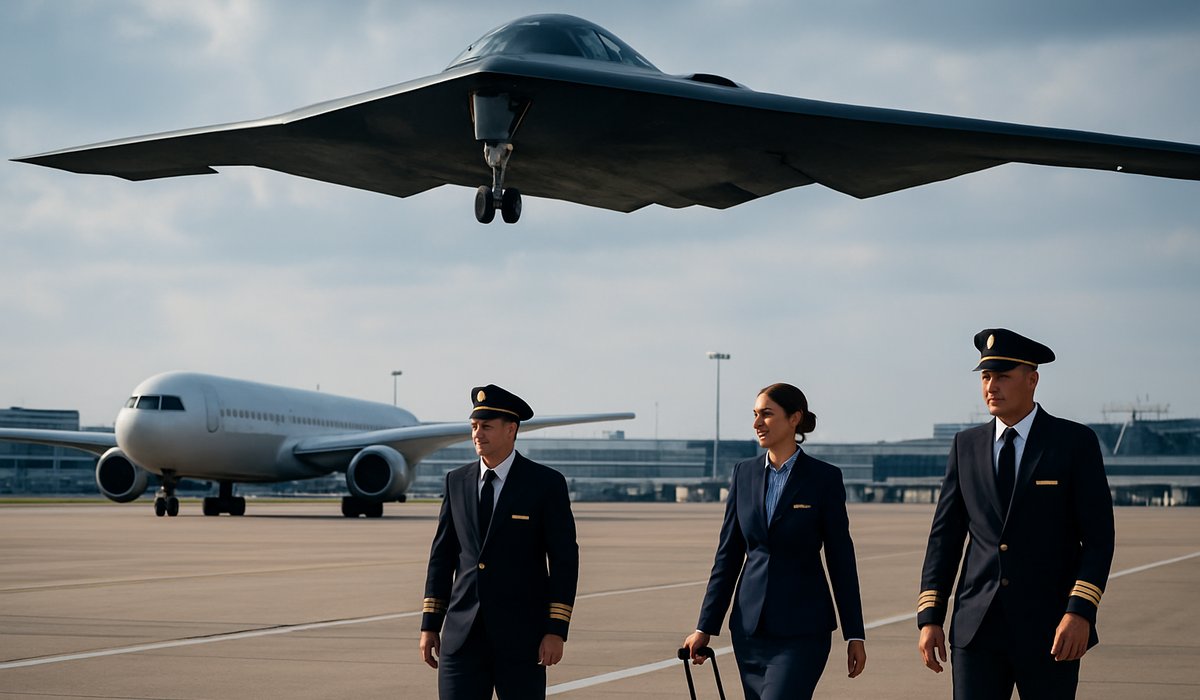
Image generated by AI
B-2 Spirit's Revolutionary Flying Wing Design Remains Unmatched in Global Military Aviation
Three decades after its debut, Northrop Grumman's stealth bomber continues as the world's only crewed tailless aircraft and fifth-generation stealth platform
A Historic Aerospace Breakthrough
The B-2 Spirit made aviation history in 1988 when it was publicly revealed at Air Force Plant 42 in Palmdale, California—a moment that underscored America's technological dominance in military aeronautics. The aircraft represents a singular achievement: no other air force worldwide has successfully developed and deployed a crewed, tailless flying wing design, nor has any nation fielded a fifth-generation stealth bomber comparable to this platform.
Engineering Innovation Without Equal
The tailless flying wing configuration of the B-2 represents a fundamental departure from conventional aircraft design principles. By eliminating the vertical stabilizer and tail section entirely, Northrop Grumman engineers created an airframe where the entire aircraft functions as a lifting surface. This design innovation delivers exceptional aerodynamic efficiency while simultaneously reducing the radar cross-section—a critical advantage in penetrating advanced air defense systems.
The absence of traditional tail surfaces means the B-2 achieves stability and control through distributed control surfaces integrated across the wing surface itself. This architectural approach minimizes the aircraft's electromagnetic signature, making it virtually invisible to conventional detection systems.
Global Military Aviation Gap
Despite decades passing since the B-2's introduction, no rival air force has successfully replicated this achievement. While several nations have pursued stealth technology and advanced bomber programs, none have combined crewed flying wing design with fifth-generation stealth capabilities. Russia's Tu-160 Blackjack remains a conventional design, while China's H-20 program, though shrouded in secrecy, has yet to demonstrate operational capability matching the B-2's maturity.
Enduring Operational Superiority
The B-2 Spirit's technological advantages extend beyond its distinctive silhouette. The integrated design provides superior range, payload capacity, and survivability compared to legacy bombers. Its stealth characteristics allow penetration of defended airspace without fighter escort, fundamentally altering strategic bombing doctrine.
More than three decades after its unveiling, the B-2 remains the gold standard in long-range strike capability and represents an investment in military aviation technology that competitors continue struggling to match.
FAQ: Understanding the B-2 Spirit's Unique Design
Why hasn't any other country built a flying wing stealth bomber? The flying wing design requires extraordinary engineering precision in flight control systems, materials science, and aerodynamic modeling. The technological and financial barriers remain prohibitively high for most nations.
What makes the B-2 a fifth-generation stealth bomber? Fifth-generation classification includes advanced stealth, sensor fusion, supercruise capability, and integrated avionics—attributes the B-2 pioneered for strategic bombers.
How does eliminating the tail improve stealth performance? Vertical stabilizers create distinctive radar signatures. By integrating control surfaces into the wing, the B-2 dramatically reduces its radar cross-section.
Is the B-2 still operational today? Yes, the U.S. Air Force maintains active B-2 squadrons. The aircraft continues receiving modernization upgrades to extend operational life.
Why is the flying wing design so difficult to master? Conventional aircraft use tail surfaces for stability; flying wings require sophisticated flight control systems and computer-assisted stability augmentation to maintain control authority.
Related Travel Guides
Flight Delay Compensation Guide 2026
Understanding Airline Route Changes
Airport Security Process Updated (2026)
External Resources
Disclaimer
This article is for informational and educational purposes only. It does not constitute legal, financial, or professional advice. While we strive to provide accurate and up-to-date information, travel policies, regulations, and conditions change rapidly. Always verify information with official sources before making travel decisions. Nomad Lawyer makes no representations about the accuracy, reliability, completeness, or suitability of the information provided. Readers should consult qualified professionals for advice specific to their circumstances. The views expressed in this article are those of the author and do not necessarily reflect the views of Nomad Lawyer.
Preeti Gunjan
Contributor & Community Manager
A passionate traveller and community builder. Preeti helps grow the Nomad Lawyer community, fostering engagement and bringing the reader experience to life.
Learn more about our team →