
Washington DC Aviation Meltdown Triggers Massive Travel Chaos as American Airlines' QR Code Strategy Fails Amid 34% Flight Cancellations at Reagan National
Breaking airline news: A massive aviation meltdown hits Washington DC as American Airlines' digital QR code strategy catastrophically fails during massive storm-driven flight cancellations.

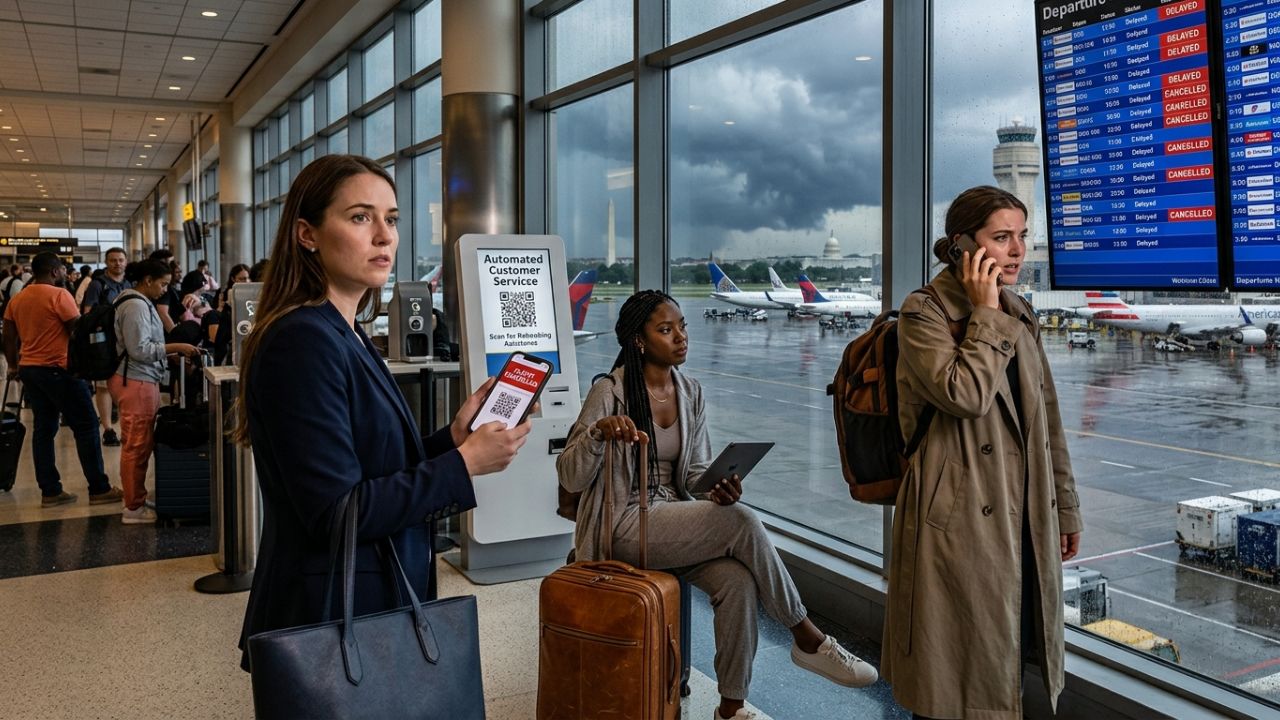
Image representing the severe aviation meltdown at Washington's Ronald Reagan National Airport (DCA), where a massive 34% flight cancellation rate triggered extreme travel chaos. The disruption was heavily exacerbated by American Airlines' controversial decision to replace human customer service staff with QR codes, engineering a catastrophic digital failure during a major crisis. (Image Credit: US Aviation Tracking)
Washington DC Aviation Meltdown Triggers Massive Travel Chaos as American Airlines' QR Code Strategy Fails Amid 34% Flight Cancellations at Reagan National
Severe Thunderstorms and FAA Gridlock Expose the Catastrophic Fragility of Digital-Only Customer Service as American Airlines Strands Thousands of Passengers Without Human Support
The highly controversial industry shift toward automated, digital-first customer service has completely collapsed under the extreme pressure of a massive aviation crisis. According to the absolute latest breaking airline news and highly critical aviation updates, Washington DC’s Ronald Reagan National Airport (DCA) has been completely paralyzed by severe travel chaos. When massive thunderstorms and systemic FAA operational slowdowns violently collided over the US Mid-Atlantic in June 2026, flight schedules collapsed. Within hours, a staggering 34% of flights at DCA were officially cancelled. However, the true catastrophe was not the severe weather, but the brutal, unapologetic failure of airline customer service. As thousands of stranded passengers flooded the terminals, American Airlines explicitly directed desperate travelers to scan QR codes rather than providing staffed service counters. This highly controversial shift toward absolute automation instantly triggered terrifying levels of airport disruptions, exposing the fundamental truth that a QR code cannot resolve complex rebooking emergencies during a system-wide meltdown.
For the traveling public and aviation regulators, this massive DCA meltdown is a horrifying stress test for the future of commercial aviation. American Airlines, utilizing Reagan National as one of its most critical operational bases, saw its regional network violently crumble, with partner PSA Airlines canceling nearly one-third of its entire schedule. While the airline industry relentlessly pushes toward cost-cutting efficiency, replacing dedicated human frontline staff with mobile apps essentially abandons passengers the exact moment they need immediate, dynamic assistance. When gate agents are simultaneously forced to board delayed aircraft and function as defacto tech-support for failing apps, the entire terminal descends into absolute friction. This incident explicitly proves that while airlines attempt to engineer seamless digital recovery systems, the massive volume of flight cancellations during severe weather mathematically requires robust human intervention to prevent total operational collapse.
Section-Wise Breakdown: The Anatomy of a Digital Disaster
The highly detailed operational and recovery tracking data definitively exposes exactly how this storm mutated into a catastrophic customer service failure at DCA:
The Storm that Shattered Reagan National Airport The massive travel chaos was initially triggered by severe thunderstorms violently sweeping across the Mid-Atlantic. This weather event immediately generated a catastrophic ripple effect. When combined with sudden FAA air traffic management slowdowns and highly disruptive weather patterns occurring simultaneously in Dallas, the domestic aviation grid simply shattered. By Friday evening, DCA was absolutely overwhelmed, recording a massive 39% flight delay rate alongside surging cancellations. Because Reagan National is a critical fortress hub for American Airlines, the carrier became the undeniable epicenter of the meltdown. The operational collapse placed unimaginable pressure on an airline that had already systematically dismantled its physical customer support infrastructure in favor of digital automation.
The QR Code Catastrophe: American Airlines Automation Fails The absolute most controversial aspect of this massive disruption was American Airlines’ total reliance on QR code-based self-service support. Over recent years, traditional, fully staffed customer service counters have been aggressively removed from the terminal, heavily replaced by digital rebooking tools accessed via smartphones. Under normal, highly stable operating conditions, expecting passengers to self-manage minor changes via an app is efficient. However, during a massive, acute crisis involving sudden, total route failure, this model violently collapsed. Thousands of stranded, desperate passengers frantically attempted to utilize QR codes that were entirely unable to resolve highly complex, multi-leg rebooking needs. The complete absence of dedicated service desks amplified passenger fury, while the few remaining gate agents were hopelessly overwhelmed by dual responsibilities, destroying boarding efficiency and paralyzing the terminal.
United Airlines Proves the Value of Human Support Providing a stark, massive contrast during the exact same weather crisis, United Airlines explicitly proved the absolute necessity of human intervention. United deliberately operates a hybrid model, heavily relying on distributed support teams and virtual agent access rather than totally eliminating physical assistance points. While United passengers also suffered from inevitable weather delays, their ability to instantly access reachable, human agents allowed for vastly faster passenger re-accommodation. At shared airports like DCA, United passengers explicitly reported massively shorter resolution times compared to the terrifying stranding experienced by American Airlines travelers. This brutal contrast has instantly ignited a massive industry debate regarding the danger of over-automating crisis recovery.
Regulatory Gaps in Airline Customer Service Aviation analysts note that this catastrophic failure explicitly highlights a massive regulatory void. While the US Department of Transportation (DOT) strictly enforces passenger rights regarding refunds and tarmac delays, there is absolutely zero regulation mandating minimum staffing levels for customer assistance during irregular operations. Furthermore, the Federal Aviation Administration (FAA) strictly focuses on air traffic safety, completely ignoring customer service frameworks. This terrifying regulatory gap essentially allows airlines to legally abandon passengers during a crisis, reducing expensive frontline staffing with zero legal consequence, even if the passenger experience violently deteriorates.
Operational Details: The Factual DCA Aviation Meltdown Matrix
To provide exact, factual clarity on the immense scale of the cancellations and the competing recovery strategies, aviation analysts have mapped the specific operational metrics. The following factual matrix details the precise breakdown of the DCA meltdown:
Factual DCA Aviation Meltdown Operational Matrix
| Operational Metric / Airline Strategy | Factual Disruption Detail |
|---|---|
| DCA Total Flight Cancellations | 34% of all flights at Reagan National cancelled |
| DCA Friday Evening Delays | Approximately 39% of flights severely delayed |
| American Airlines (Network) | Cancelled approx. 9% of total operations; 36% delays on mainline flights |
| PSA Airlines (Regional Partner) | Cancelled a massive 31% of its entire regional schedule |
| Primary Disruption Triggers | Mid-Atlantic thunderstorms, FAA slowdowns, Dallas weather disruptions |
| American Airlines Recovery Strategy | QR code-based self-service; minimal in-person staff; overwhelmed gate agents |
| United Airlines Recovery Strategy | Hybrid human-digital support; accessible agents; vastly faster re-accommodation |
Data reflects the confirmed operational delays, cancellation percentages, and specific airline recovery models officially recorded during the June 2026 DCA aviation meltdown. (Source: US Aviation Tracking)
Passenger Impact: Survival Tactics During Mass Cancellations
For the traveling public trapped inside Reagan National, the absolute failure of American Airlines' digital support forced passengers to adopt highly aggressive, multi-channel recovery strategies. Because the QR codes failed to resolve complex itineraries, passengers were forced to simultaneously utilize airline apps, furiously contact phone support, desperately seek assistance at heavily guarded lounges, and barrage social media messaging channels for immediate escalation. This massive DCA meltdown explicitly proves that flexibility and extreme speed of action are now absolute survival tools. If an airline abandons the service desk, passengers must become their own crisis managers.
Industry Analysis: The Tension Between Efficiency and Care
The DCA disruption officially underscores a terrifying, growing tension in global aviation: the brutal conflict between corporate cost efficiency and basic passenger care. American Airlines’ QR code-first model is the ultimate expression of this push toward absolute automation. However, this crisis proves that while AI and predictive rebooking are financially efficient, resilience is still fundamentally human.
Mr. Anup Kumar Keshan, Founder and Editor-in-Chief of Travel And Tour World, provided a highly critical analysis of the event: "Airlines are moving fast toward digital-first operations, but resilience in aviation is still fundamentally human. Without scalable frontline support during disruptions, technology alone cannot sustain passenger trust or operational stability." As airlines furiously attempt to modernize, this event asks the ultimate question: have efficiency gains completely destroyed real-world passenger safety nets?
Conclusion: A Warning to the Automated Airline Industry
The horrifying travel chaos that paralyzed Washington’s Reagan National Airport explicitly confirms that total reliance on digital automation during an aviation crisis is a catastrophic operational failure. While massive thunderstorms and FAA gridlock physically caused the 34% flight cancellations, it was American Airlines’ explicit decision to replace human customer service with QR codes that engineered the true passenger disaster. As United Airlines successfully demonstrated the immense value of hybrid human support, the industry stands at a massive crossroads. If regulators fail to mandate minimum staffing levels during irregular operations, the flying public will remain utterly vulnerable to the next massive, unavoidable wave of airport disruptions. (Source: US Aviation Tracking via Nomad Lawyer)
Key Takeaways
- Massive Terminal Gridlock: Severe thunderstorms and FAA slowdowns triggered a catastrophic 34% flight cancellation rate at Washington DC’s Reagan National Airport (DCA).
- Regional Network Collapse: American Airlines suffered immense disruption, with its regional partner PSA Airlines canceling a massive 31% of its entire schedule.
- Catastrophic Automation Failure: American Airlines explicitly directed desperate, stranded passengers to utilize QR codes rather than providing staffed, physical customer service counters.
- Hybrid Support Victory: United Airlines successfully mitigated the crisis by maintaining accessible human agents, resulting in vastly faster passenger re-accommodation.
- Massive Regulatory Gap: The incident highlights that the DOT and FAA currently enforce absolutely no minimum staffing levels for customer assistance during irregular operations.
✈️ Frequently Asked Questions (Factual Aviation Disruption Data)
What specifically triggered the massive travel disruption at Washington's DCA airport? The severe travel chaos was directly triggered by intense thunderstorms sweeping the US Mid-Atlantic, heavily combined with FAA air traffic management slowdowns and related weather disruptions in Dallas.
What was the exact percentage of flight cancellations at Reagan National Airport? At Reagan National Airport (DCA) alone, a massive 34% of all flights were officially cancelled.
How severely was American Airlines' specific operational network impacted? Across its broader network, American Airlines explicitly cancelled around 9% of total operations and recorded approximately 36% delays specifically on its mainline flights.
How did the storm impact regional connectivity out of DCA? Regional operations suffered catastrophic failure. PSA Airlines, a major regional partner, was forced to cancel a massive 31% of its entire schedule.
What highly controversial customer service strategy did American Airlines utilize during the crisis? American Airlines explicitly relied on a highly controversial QR code-based self-service model, largely replacing traditional staffed customer service counters with digital rebooking tools.
Why did this specific QR code strategy catastrophically fail during the storm? The digital systems violently collapsed under pressure because QR codes were entirely unable to resolve highly complex rebooking needs, while gate agents were simultaneously overwhelmed with dual responsibilities.
How did United Airlines handle the exact same weather crisis differently? United Airlines explicitly utilized a hybrid human-digital support model, relying heavily on distributed support teams and maintaining reachable agents, which allowed for vastly faster passenger re-accommodation.
Is there any federal regulation mandating human customer service staffing during a crisis? No. There is a massive regulatory gap; neither the DOT nor the FAA enforce minimum staffing levels for customer assistance during irregular operations.
🌍 Related Travel Guides & Flight Resources
- Navigate Airport Disruptions Like a Pro Master the art of surviving unexpected travel chaos with our expert strategies.
- Breaking Airline News & Evasion Routes Stay ahead of the delays with real-time aviation updates and route intelligence.
- Global Flight Cancellation Defense Grid Essential legal rights and compensation tactics when your flight goes down.
⚖️ Disclaimer
The flight cancellation percentages, airline operational metrics, and customer service recovery strategies provided in this report are for informational purposes only. The specific aviation variables regarding the massive meltdown at Washington's Ronald Reagan National Airport (DCA)—including the 34% cancellation rate, the 31% regional cancellation rate for PSA Airlines, and the specific QR-code and hybrid recovery strategies utilized by American Airlines and United Airlines—are based on official aviation tracking data recorded as of June 15, 2026. NomadLawyer does not guarantee the absolute accuracy or current validity of the specific operational recovery timelines provided and assumes no liability for unannounced flight cancellations, extreme delays during self-rebooking procedures, or any financial consequences resulting from the use of this analytical content. Passengers navigating severe weather disruptions are strongly advised to utilize multi-channel recovery strategies to secure alternative routing.
Disclaimer
This article is for informational and educational purposes only. It does not constitute legal, financial, or professional advice. While we strive to provide accurate and up-to-date information, travel policies, regulations, and conditions change rapidly. Always verify information with official sources before making travel decisions. Nomad Lawyer makes no representations about the accuracy, reliability, completeness, or suitability of the information provided. Readers should consult qualified professionals for advice specific to their circumstances. The views expressed in this article are those of the author and do not necessarily reflect the views of Nomad Lawyer.
Kunal K Choudhary
Co-Founder & Contributor
A passionate traveller and tech enthusiast. Kunal contributes to the vision and growth of Nomad Lawyer, bringing fresh perspectives and driving the community forward.
Learn more about our team →