
Washington DC Aviation Meltdown Triggers Global Travel Chaos as FAA Ground Stop Paralyzes 300+ Flights Across DCA, Dulles, and BWI
Breaking airline news: A massive FAA ground stop across Washington D.C.'s major airports triggers unprecedented travel chaos, paralyzing over 300 flights for global carriers including United, Delta, and Lufthansa.

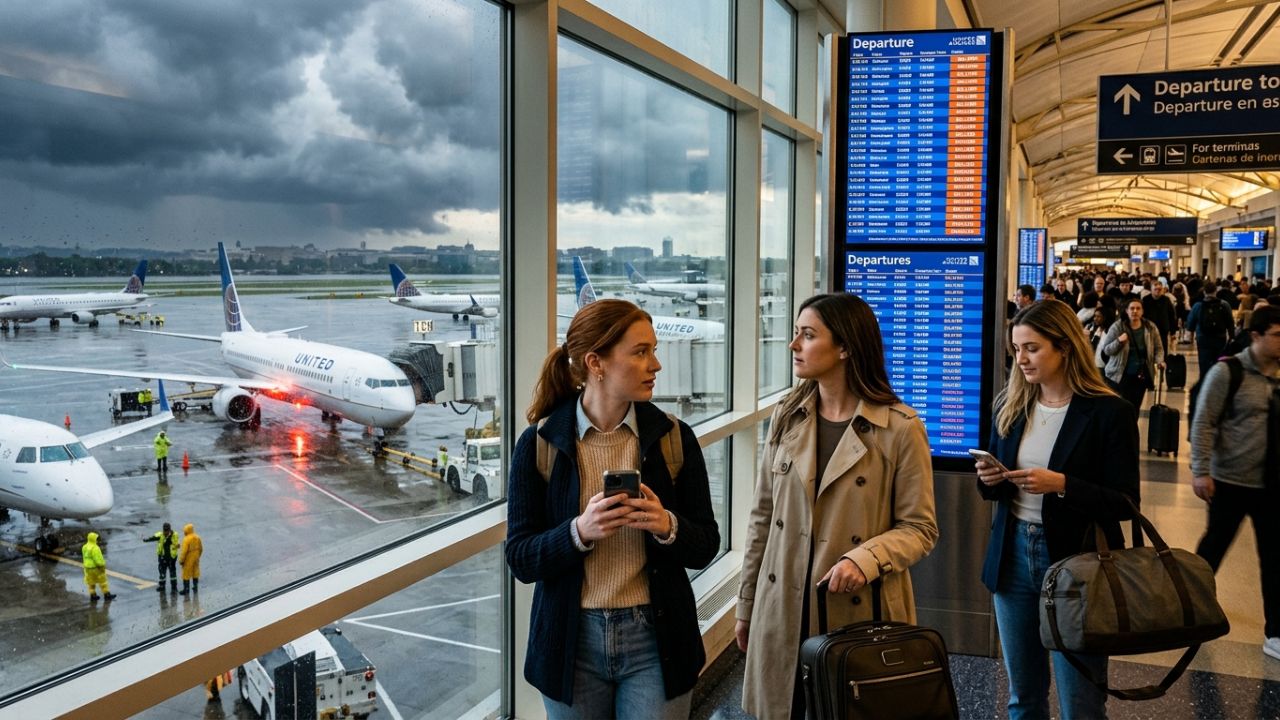
Image representing the catastrophic operational meltdown across the National Capital Region, where severe thunderstorms forced the FAA to trigger a massive ground stop at DCA, Dulles, and BWI, paralyzing over 300 flights and plunging global carriers like United and British Airways into devastating travel chaos. (Image Credit: US Aviation Tracking Network)
Washington DC Aviation Meltdown Triggers Global Travel Chaos as FAA Ground Stop Paralyzes 300+ Flights Across DCA, Dulles, and BWI
Severe Thunderstorms Completely Shatter the National Capital Region's Airspace, Trapping United, Delta, and British Airways in Cascading Operational Gridlock
The incredibly fragile nature of the United States airspace grid was violently exposed during a catastrophic operational collapse in the nation's capital. According to the absolute latest breaking airline news and highly critical aviation updates, Washington D.C. suffered an unprecedented aviation meltdown in June 2026. When a brutal line of severe thunderstorms intersected with the highly complex airspace of the National Capital Region, the Federal Aviation Administration (FAA) was immediately forced to trigger a massive, uncompromising ground stop. This drastic safety intervention simultaneously shut down arrival and departure operations at Ronald Reagan National Airport (DCA), Dulles International Airport (IAD), and Baltimore/Washington International Airport (BWI). The immediate result was catastrophic travel chaos, instantly delaying over 300 flights and violently disrupting the intricate schedules of massive global carriers including United Airlines, American Airlines, Delta Air Lines, British Airways, Lufthansa, Air Canada, and Southwest Airlines.
Because Washington D.C. serves as one of the most vital international gateways in North America, this localized weather event immediately engineered a massive global shockwave. The FAA ground stop trapped thousands of desperate travelers from the United States, the United Kingdom, Canada, Germany, India, Mexico, France, and various Middle Eastern transit hubs inside rapidly congesting terminals. As the localized delays morphed into systemic airport disruptions, operations completely disintegrated. Aircraft were brutally trapped in extensive tarmac holds, international connections were permanently severed, and the highly synchronized flow of global air traffic was brought to a devastating crawl. This event serves as a terrifying confirmation that even brief weather interventions in hyper-congested airspace inevitably trigger massive, multi-day flight cancellations and unrecoverable schedule collapses worldwide.
Section-Wise Breakdown: The Anatomy of the D.C. Airspace Collapse
The highly detailed operational and economic tracking data definitively exposes exactly how this FAA intervention paralyzed the global aviation network:
The FAA Ground Stop at DCA, Dulles, and BWI The sheer intensity of the thunderstorm activity explicitly threatened the operational integrity of the entire Washington D.C. sector, forcing the FAA to prioritize absolute safety by initiating the ground stop. All three major airports (DCA, IAD, and BWI) were thrust into full or partial lockdown. Inbound international flights were forced into aggressive holding patterns, while outbound domestic flights were physically locked at their gates. The core vulnerability of the D.C. region is its highly complicated shared airspace. Governed by incredibly strict FAA separation rules, any severe weather fundamentally shatters the coordinated flow system. When Dulles (IAD) operations are slowed to a crawl, the resultant airport disruptions are widely considered the worst system-wide, engineering a rapid, cascading effect that severely punishes hub airports completely across the United States.
Massive Airline Gridlock: United, American, and Delta Paralyzed The FAA ground stop inflicted massive, unrecoverable operational damage upon the world's largest legacy carriers. While the physical ground stop typically lasts roughly 1 to 3 hours, the recovery period for airline scheduling is agonizingly long. During this event, heavily loaded aircraft were brutally held on blistering tarmacs for hours. This immediate friction violently shattered crew scheduling protocols, causing pilots and flight attendants to legally "time out" before they could depart. United Airlines suffered devastating hub disruption specifically through Dulles, while American Airlines watched its entire East Coast network disintegrate into rolling delays. Furthermore, the massive backlog of trapped aircraft triggered severe repositioning delays, ensuring that the travel chaos would persist for days after the thunderstorms eventually cleared.
The Devastating Economic Shock to DC Tourism Beyond the tarmac, the D.C. aviation meltdown inflicted a massive financial blow directly onto the local tourism and hospitality sectors. Because thousands of domestic and international travelers were trapped inside airports or violently delayed, the local economy bled revenue. Airlines suffered excruciating financial losses driven by massive fuel waste from holding patterns, exorbitant crew overtime costs, and millions in lost cancellation revenue. Simultaneously, the D.C. tourism sector recorded heavily reduced sightseeing time, completely missed museum and tour bookings, and drastically lower same-day spending. The hospitality sector was forced to absorb massive hotel check-in delays, skyrocketing no-show rates, and devastating losses in localized transport and dining revenue.
Flight Details: The Factual Airline Operational Impact Matrix
To provide exact, factual clarity on how this FAA ground stop structurally punished individual carriers, aviation analysts have mapped the specific network failures. The following factual matrix details the precise breakdown of the Washington D.C. disruption:
Factual Airline Operational Impact Snapshot
| Airline | Type of Factual Impact | Primary Operational Effect |
|---|---|---|
| United Airlines | Delays + rerouting | Massive hub disruption specifically via Dulles (IAD) |
| American Airlines | Schedule delays | Severe East Coast network impact |
| Delta Air Lines | Holding patterns | Critical connection disruptions |
| Southwest Airlines | Domestic delays | Short-haul cancellations and route friction |
| British Airways | International delays | Completely missed transatlantic departure/arrival slots |
| Lufthansa | Long-haul disruption | Severe crew & aircraft rescheduling forced by delays |
| Air Canada | Cross-border delays | Massive connection losses via integrated U.S. hubs |
Data reflects the confirmed operational delays and network disruptions officially recorded across major carriers during the severe FAA ground stop at DCA, IAD, and BWI. (Source: US Aviation Tracking)
Passenger Impact: Multi-Leg Nightmares for Global Travelers
For the traveling public trapped within this airspace collapse, the FAA ground stop engineered an absolute nightmare. Because Washington functions as a highly critical international transit node, travelers from the UK, Germany, and India reported the absolute most complex, multi-leg disruptions. Thousands of passengers seeking international connections via Dulles (IAD) completely missed their boarding windows, resulting in devastating overnight layovers. Transatlantic passengers suffered massive rebooking delays, while domestic travelers faced horrifying congestion at alternate U.S. airports as flights diverted. This level of extreme friction forces passengers to frantically seek alternate routes, completely destroying pre-planned itineraries and heavily escalating the psychological toll of modern travel chaos.
Industry Analysis: The Crisis of Flow Control
Aviation analysts closely monitoring the US airspace emphasize that this event exposes a highly dangerous trend. The massive 2026 flight disruptions confirm that mega-hubs are becoming increasingly hypersensitive to weather events. The threat of a multi-airport closure within a single, interconnected region (like the D.C. tri-airport system) forces an over-reliance on rigid FAA flow control. The disruption explicitly proves that while safety remains paramount, current airline scheduling systems absolutely lack the elasticity required to absorb these sudden stops. There is an immediate, critical need for dramatically improved real-time air traffic control monitors and enhanced real-time coordination between airlines and airport authorities to mitigate these devastating recoveries.
Conclusion: A Vulnerable Airspace Network
The massive, 300-flight meltdown across Washington D.C. is a highly definitive warning regarding the fragility of concentrated airspace. When severe thunderstorms forced the FAA to trigger a ground stop across DCA, Dulles, and BWI, the resulting travel chaos proved that the entire global aviation network remains entirely at the mercy of localized weather events. As United, American, Delta, and massive international carriers like Lufthansa and British Airways battle to recover their fractured networks, the economic damage to the airlines and the D.C. tourism sector remains immense. Until structural scheduling resilience is heavily prioritized, travelers attempting to transit through the National Capital Region must remain fiercely prepared for sudden, catastrophic airport disruptions. (Source: US Aviation Tracking via Nomad Lawyer)
Key Takeaways
- Massive Ground Stop: The FAA initiated a highly restrictive ground stop across DCA, IAD, and BWI due to severe thunderstorms in the National Capital Region.
- Widespread Gridlock: The safety intervention instantly delayed over 300 flights, paralyzing both inbound and outbound operations for major global carriers.
- Global Passenger Impact: The disruption devastated international itineraries, heavily impacting travelers from the US, UK, Canada, Germany, India, Mexico, France, and the Middle East.
- Severe Airline Damage: Carriers like United, Delta, and British Airways suffered massive fuel waste, crew scheduling disruption, and severe aircraft repositioning delays.
- Cascading Chaos: The complex, shared airspace of the D.C. region means that a temporary 1 to 3-hour ground stop forces massive, multi-day recovery periods for airline networks.
✈️ Frequently Asked Questions (Factual Aviation Disruption Data)
Why were flights from Washington D.C. officially disrupted? Severe thunderstorms caused a significant safety concern, forcing the FAA to impose a massive ground stop that completely shut down operations at DCA, IAD, and BWI.
Which specific airlines were impacted the most by this FAA ground stop? The severe disruption primarily paralyzed operations for United Airlines, American Airlines, Delta Air Lines, British Airways, Lufthansa, Air Canada, and Southwest Airlines.
What is the usual duration of these specific FAA ground stop delays? While the actual FAA ground stops generally last for about 1 to 3 hours, the cascading operational friction guarantees that severe delays persist long after standard operations resume.
How did the ground stop specifically impact United Airlines? United Airlines suffered massive delays and rerouting, resulting in highly severe hub disruption specifically cascading through Dulles International Airport (IAD).
Which specific international travelers reported the most severe disruptions? Aviation tracking indicated that Indian, German, and UK travelers officially reported the most complex, highly frustrating multi-leg disruptions due to the international hub failure.
What specific operational problems did the airlines face beyond the initial delay? Airlines suffered immense financial and operational damage including massive fuel waste from holding patterns, extreme crew overtime costs, aircraft positioning losses, and severe cancellation revenue loss.
Why is the Washington D.C. airspace considered highly vulnerable to delays? The region features one of the most complicated airspace systems in the U.S. due to the shared airspace between DCA, IAD, and BWI, extremely high traffic density, and complex FAA separation rules.
What immediate actions should travelers take during an active FAA ground stop? Passengers are highly advised to constantly check airline apps for updates, attempt to rebook early, aggressively request alternate routes from nearby airports, and verify refund eligibility.
🌍 Related Travel Guides & Flight Resources
- Navigate Airport Disruptions Like a Pro Master the art of surviving unexpected travel chaos with our expert strategies.
- Breaking Airline News & Evasion Routes Stay ahead of the delays with our real-time aviation updates and route intelligence.
- Global Flight Cancellation Defense Grid Essential legal rights and compensation tactics when your flight goes down.
⚖️ Disclaimer
The flight cancellation metrics, airport ground stop durations, and economic impact analyses provided in this report are for informational purposes only. The specific aviation variables regarding the severe FAA ground stop at Washington D.C.'s DCA, IAD, and BWI airports—including the 300+ delayed flights, the specific operational impacts on carriers like United and British Airways, and the cascading global delays—are based on data officially recorded during the June 2026 thunderstorms. All data has been officially sourced from US aviation tracking networks as of June 15, 2026. NomadLawyer does not guarantee the absolute accuracy or current validity of the operational recovery timelines provided and assumes no liability for unannounced flight cancellations, extreme tarmac holds, missed international connections, or any financial consequences resulting from the use of this analytical content. Passengers navigating through the National Capital Region during severe weather season are strongly advised to utilize highly flexible ticketing.
Disclaimer
This article is for informational and educational purposes only. It does not constitute legal, financial, or professional advice. While we strive to provide accurate and up-to-date information, travel policies, regulations, and conditions change rapidly. Always verify information with official sources before making travel decisions. Nomad Lawyer makes no representations about the accuracy, reliability, completeness, or suitability of the information provided. Readers should consult qualified professionals for advice specific to their circumstances. The views expressed in this article are those of the author and do not necessarily reflect the views of Nomad Lawyer.
Kunal K Choudhary
Co-Founder & Contributor
A passionate traveller and tech enthusiast. Kunal contributes to the vision and growth of Nomad Lawyer, bringing fresh perspectives and driving the community forward.
Learn more about our team →