
Aviation Updates: Vietnam Airlines VN66 Deploys A350 to Caracas Amid Catastrophic Earthquake Travel Chaos
Following devastating earthquakes in Venezuela, Vietnam Airlines launches an emergency A350 relief flight, pulling aircraft from peak summer rotations and testing global logistics.

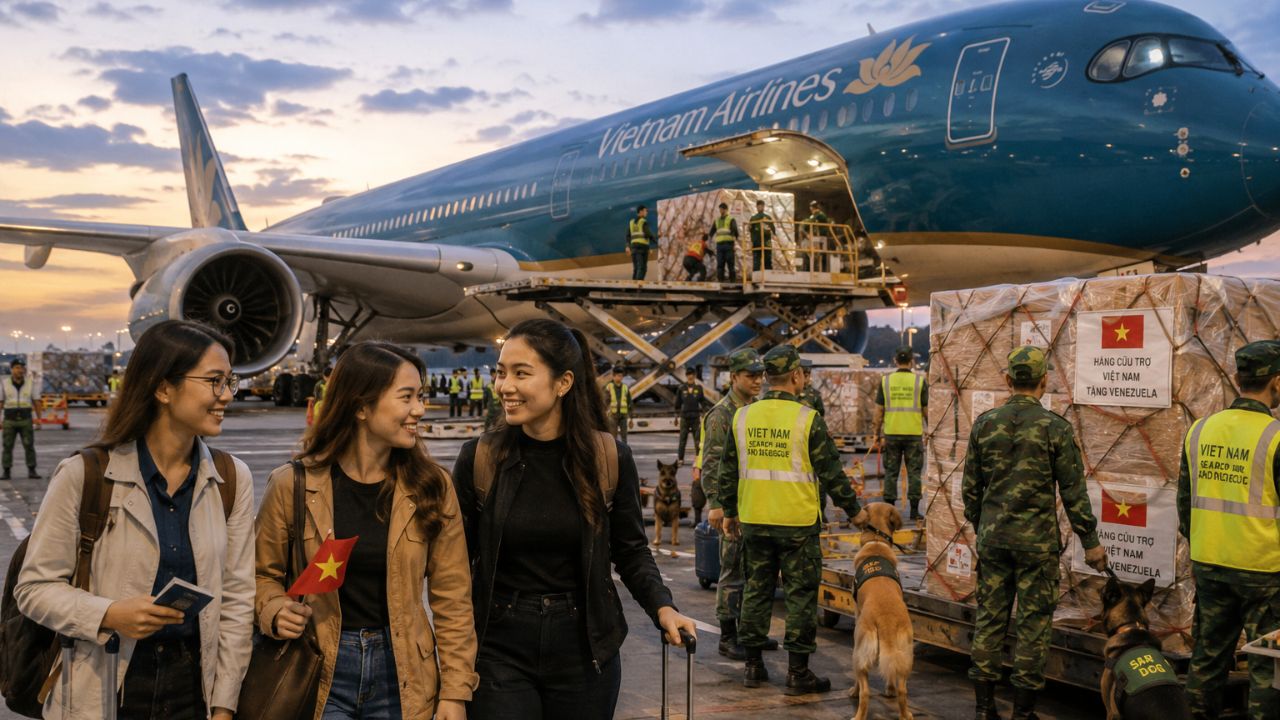
Image generated by AI
Aviation Updates: Vietnam Airlines VN66 Deploys A350 to Caracas Amid Catastrophic Earthquake Travel Chaos
As catastrophic dual earthquakes completely shatter infrastructure across northern Venezuela, Vietnam Airlines has forcefully pivoted from commercial transit to crisis logistics, deploying a massive Airbus A350 on an emergency relief mission across the globe to combat life-threatening travel chaos.
Image generated by AI
As urgent airline news platforms and highly critical aviation updates continuously monitor the collapsing infrastructure in South America, a massive humanitarian airbridge has officially opened from Asia. Following the devastating earthquakes that struck Venezuela on 24 June 2026, Vietnam Airlines executed a massive emergency deployment, launching special flight VN66 directly from Hanoi to Caracas. The operation pulled a vital wide-body Airbus A350 away from peak commercial summer rotations, transforming the flag carrier into an aggressive, rapid-response logistical weapon. Carrying search-and-rescue dogs, massive relief payloads, and specialized urban extraction personnel, the mission highlights how national airlines are forced to navigate severe airport disruptions to deliver life-saving aid. However, for the global travel sector, the sudden removal of a high-capacity wide-body jet from scheduled routes heavily raises the threat of rolling commercial schedule changes and sudden flight cancellations, injecting severe operational friction and potential travel chaos into Vietnam's booming inbound tourism market.
Expanded Overview: The Venezuelan Seismic Collapse
When analyzing the massive logistical requirements of this emergency flight, the sheer scale of the disaster on the ground is terrifying.
On 24 June 2026, Venezuela was violently struck by two massive seismic events, classified by UNICEF as 7.5- and 7.2-magnitude earthquakes. The extreme tremors absolutely devastated Caracas and the surrounding states of Aragua, Carabobo, Falcón, La Guaira, and Miranda. With an estimated 1.8 million people—including 680,000 children—plunged into an immediate survival crisis, standard commercial aviation into the country was paralyzed by severe airport disruptions. Because local roads, hospitals, and power grids were physically destroyed, foreign aviation became the only viable lifeline. The primary focus for Venezuelan airspace is no longer tourism recovery; it is strictly dedicated to life-saving access and the massive delivery of emergency medical support.
Section-Wise Breakdown: The Hanoi Mobilization and Paris Intercept
Executing a mission of this extreme distance required flawless, highly accelerated operational planning.
The emergency flight originated at Noi Bai International Airport in Hanoi, operating under the callsign VN66. By selecting the Airbus A350, Vietnam Airlines aggressively utilized the aircraft’s massive 144-cubic-meter belly-hold capacity, which can handle a maximum loading capacity of 39 tonnes. Because a direct flight from Southeast Asia to northern South America pushes the absolute limits of commercial aviation range, the flight plan legally required a highly strategic technical stop. The aircraft routed through Paris Charles de Gaulle Airport for urgent refueling, complex crew swaps, and engineering servicing before launching across the Atlantic.
Section-Wise Breakdown: The Simón Bolívar Arrival
The final descent into the disaster zone required navigating heavily compromised airspace.
Upon arriving at Simón Bolívar International Airport serving Caracas, the aircraft successfully delivered a massive humanitarian payload. The specialized manifest included exactly 124 highly trained personnel drafted from Vietnam’s Ministry of National Defence and Ministry of Public Security. Crucially, the aircraft transported 10 search-and-rescue dogs explicitly trained for collapsed urban structures, alongside approximately 25 tonnes of specialized emergency rescue gear. To execute this complex delivery, the A350 carried a reinforced support team of 23 personnel, including pilots, cabin crew, and dedicated engineers, proving that crisis aviation requires drastically modified operational profiles compared to standard passenger flights.
Flight Details: Vietnam Airlines Flight VN66 Operational Profile
The exact operational telemetry outlining this highly critical humanitarian deployment, detailing the specific aircraft assignment, the exact payload weights, and the technical routing, has been consolidated into the mandatory matrix below.
Vietnam Airlines Flight VN66 Operational Profile (2026)
| Operational Element | Verified Detail |
|---|---|
| Operating Airline | Vietnam Airlines |
| Flight Number | VN66 |
| Aircraft Type | Airbus A350 |
| Departure Airport | Noi Bai International Airport (Hanoi) |
| Departure Time | 00:45 on 29 June 2026 |
| Technical Stop | Paris Charles de Gaulle Airport |
| Destination Airport | Simón Bolívar International Airport (Caracas) |
| Scheduled Arrival | 12:10 local time on 29 June 2026 |
| Personnel Carried | 124 (Defence and Public Security units) |
| Rescue Dogs | 10 |
| Relief Payload | Approx. 25 tonnes |
| Flight Crew & Support | 23 personnel |
Passenger Impact: Commercial Schedule Friction
For international travelers holding commercial tickets with Vietnam Airlines, this heroic emergency mission introduces immediate operational volatility.
Vietnam is currently experiencing massive inbound tourism momentum, officially recording 10.6 million foreign arrivals in the first five months of 2026, with air travel accounting for 82.3 percent of that total. During this intense peak summer period, physically removing a massive Airbus A350 from the commercial fleet to execute the VN66 mission absolutely forces the airline to execute rapid network rebalancing. Tour operators and corporate travel managers must aggressively monitor their itineraries, as aircraft substitutions, sudden flight-time adjustments, and potential rolling flight cancellations may occur as the airline scrambles to cover the missing wide-body capacity.
Industry Analysis: The Strategic Value of Wide-Body Fleets
Aviation economists explicitly highlight that the VN66 mission perfectly demonstrates the dual-purpose nature of national flag carriers.
While commercial fleets are primarily judged on tourism seat capacity and premium cabin demand, their true strategic value is measured during global crises. An aircraft like the Airbus A350 provides the payload flexibility, extreme long-range performance, and advanced environmental control systems required to transport sensitive live animals (rescue dogs) and heavy industrial rescue gear simultaneously. When foreign diplomacy demands rapid, intercontinental humanitarian intervention, a heavily capitalized national airline serves as the ultimate logistical weapon, capable of bridging continents overnight.
Conclusion: Balancing Crisis Logistics with Commercial Stability
Ultimately, the deployment of Vietnam Airlines flight VN66 from Hanoi to Caracas is a monumental display of rapid-response aviation capability. By aggressively flying an Airbus A350 carrying 124 rescue personnel and 25 tonnes of cargo directly into a disaster zone, Vietnam has proven its massive logistical reach. However, as extreme seismic events and geopolitical crises continue to trigger severe airport disruptions globally, national carriers are increasingly forced to balance international humanitarian obligations against commercial schedule stability. For the global travel trade, this incident is a critical reminder: in an era of unpredictable travel chaos, tracking an airline's emergency deployments is just as vital as monitoring its passenger schedules.
Key Takeaways
- Emergency Relief Deployment: Vietnam Airlines executed special flight VN66 from Hanoi to Caracas to deliver disaster relief following two massive 7.5- and 7.2-magnitude earthquakes in Venezuela.
- The Aircraft Utilized: The airline deployed a wide-body Airbus A350, utilizing a technical stop at Paris Charles de Gaulle Airport before continuing across the Atlantic.
- Massive Rescue Payload: The aircraft carried 124 Vietnamese defence and security personnel, 10 urban search-and-rescue dogs, and approximately 25 tonnes of specialized humanitarian equipment.
- Accelerated Timeline: The flight launched from Noi Bai International Airport at 00:45 on 29 June 2026, with a scheduled same-day arrival in Caracas at 12:10 local time.
- Commercial Repercussions: Pulling a wide-body A350 from peak summer rotations may force Vietnam Airlines to execute aircraft substitutions and flight adjustments, potentially impacting tourists traveling to Vietnam.
FAQ: Vietnam Airlines VN66 Venezuela Mission 2026
Why did Vietnam Airlines fly an A350 to Venezuela? Vietnam Airlines operated special flight VN66 to deliver 124 specialized rescue personnel, 10 search dogs, and 25 tonnes of humanitarian aid following the catastrophic 7.5- and 7.2-magnitude earthquakes that struck Venezuela on 24 June 2026.
Did the flight go directly from Hanoi to Caracas? No, because of the extreme distance between Southeast Asia and South America, the Airbus A350 required a mandatory technical stop at Paris Charles de Gaulle Airport for refueling and crew changes.
Will this relief flight affect regular Vietnam Airlines commercial flights? Yes, pulling a high-capacity wide-body aircraft from the commercial fleet during the peak summer travel season may require the airline to implement schedule adjustments, aircraft substitutions, or potential flight cancellations on its regular routes.
Related Travel Guides
Avianca Bogota Valencia Venezuela Route Travel Chaos 2026
Etihad Airways Abu Dhabi Dhaka Inaugural Flight Travel Chaos 2026
South America Regional Flight Disruption Survival Guide 2026
Disclaimer: This article is strictly for informational and aviation crisis logistics analysis purposes. The specific flight telemetry for VN66, exact aircraft deployment (Airbus A350), payload weights (25 tonnes), personnel figures (124 staff and 23 crew), and earthquake magnitude data (7.5 and 7.2 as reported by UNICEF) are based on official diplomatic and airline announcements available at the time of publication. Emergency humanitarian operations, specific airport infrastructure status (including Simón Bolívar International Airport), and consequent commercial airline schedule adjustments are incredibly volatile and subject to immediate, unannounced modification. Passengers holding commercial tickets with Vietnam Airlines must explicitly verify exact flight statuses, potential aircraft substitutions, and itinerary changes directly with the carrier prior to traveling to the airport.
Disclaimer
This article is for informational and educational purposes only. It does not constitute legal, financial, or professional advice. While we strive to provide accurate and up-to-date information, travel policies, regulations, and conditions change rapidly. Always verify information with official sources before making travel decisions. Nomad Lawyer makes no representations about the accuracy, reliability, completeness, or suitability of the information provided. Readers should consult qualified professionals for advice specific to their circumstances. The views expressed in this article are those of the author and do not necessarily reflect the views of Nomad Lawyer.
Preeti Gunjan
Contributor & Community Manager
A passionate traveller and community builder. Preeti helps grow the Nomad Lawyer community, fostering engagement and bringing the reader experience to life.
Learn more about our team →