
Indochina Integrated: How Vietnam Airlines, Laos, and Cambodia Are Unlocking Multi-Country Travel in 2026

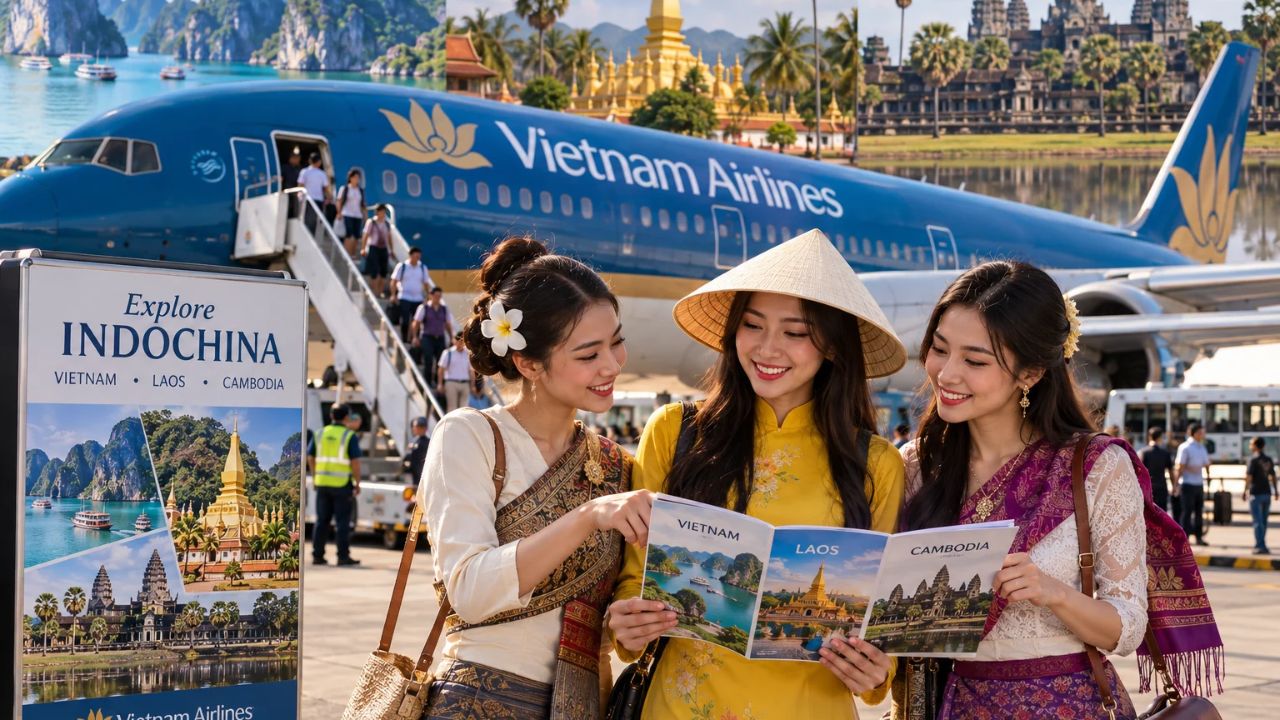
Bilateral agreements signed in October 2026 unite Vietnam, Laos, and Cambodia into an integrated multi-country travel circuit.
While over 83 percent of foreign visitors traveling into eastern mainland Southeast Asia touch down exclusively in Vietnam, barely a fraction continue inland across the Mekong basin without facing fragmented itineraries and separate flight bookings. That historical barrier is now giving way to an integrated regional travel network. On 8 and 9 October 2026, during high-level bilateral business forums held in Vientiane and Phnom Penh during an official visit by Vietnam’s prime minister and a senior government delegation, Vietnam Airlines finalized two far-reaching cooperation pacts with regional partners. By partnering directly with the Lao Association of Travel Agents (LATA) in Laos and the Cambodia Airport Investment Corporation (CAIC) in Cambodia, the national flag carrier is moving to connect Vietnam’s surging inbound arrival pipeline directly with the heritage corridors of its two western neighbors.
The Indochina Expansion: Unifying Three Nations Through Coordinated Aviation
The timing of this tripartite tourism drive is driven by record-breaking inbound demand. Official border figures reveal that Vietnam welcomed nearly 17.7 million international visitors between January and September 2026, representing a 14.5% year-on-year increase compared to the first nine months of 2025. Air connectivity served as the central engine of that expansion: roughly 14.7 million travelers arrived by air, accounting for 83.2% of all international entries across the nine-month period.
Northeast Asian markets continue to dominate these volumes, led by mainland China and South Korea, alongside steady long-haul arrivals from Japan, Australia, the United States, and across Western Europe. While these inbound figures illustrate Vietnam’s independent appeal, they also expose an untapped opportunity. Long-haul travelers spending ten to twenty days in Southeast Asia rarely want to limit their holiday to a single country. However, organizing onward connections into Laos or Cambodia has historically meant juggling uncoordinated regional carriers, disparate ticketing desks, and unpredictable transit layovers.
The newly signed agreements aim to convert existing passenger arrivals into linked regional itineraries. Under the partnership with LATA, cooperation will focus on developing joint tourism programmes, establishing unified agency distribution channels, and educating overseas tour operators on combined routes. Instead of selling Vietnam in isolation, travel sellers in North America, Europe, and Australia will have direct access to coordinated packages linking Vietnamese beach hubs with the ancient temples of Laos.
Across the Cambodian border, the agreement signed with CAIC—the developer behind Phnom Penh's new Techo International Airport—concentrates on aviation infrastructure and flight frequencies. The partners are evaluating how current air frequencies between Phnom Penh, Siem Reap, Hanoi, and Ho Chi Minh City can be optimized or expanded, alongside feasibility studies for new direct routes. The scope of collaboration extends into shared operational expertise, including airport operations, passenger handling standards, flight safety protocols, and digital transformation.
Flight Capacity and Multi-Country Transit Corridors Across Indochina
Rather than starting from a blank slate, the multi-nation initiative builds on an established Vietnam Airlines network that already runs regular scheduled services connecting Vietnam with major urban and cultural hubs in Laos and Cambodia.
| Travel Corridor & Route Network | Weekly Flights | Jan–Sep 2026 Passengers | Key Gateways Served | Strategic Operational Focus |
|---|---|---|---|---|
| Vietnam – Laos Services | 12 weekly flights | 103,500 passengers | Hanoi, Ho Chi Minh City ↔ Vientiane, Luang Prabang | Cultural circuits, eco-lodges, joint agency sales with LATA |
| Vietnam – Cambodia Services | 25 weekly flights | 262,400 passengers | Hanoi, Ho Chi Minh City ↔ Siem Reap, Phnom Penh | Heritage tourism, Techo International Airport frequency studies |
| Vietnam Inbound International (Total) | Multi-daily long-haul | 14,700,000 air arrivals | Hanoi (HAN), Ho Chi Minh City (SGN), Da Nang (DAD) | 83.2% of 17.7M total foreign arrivals (+14.5% YoY growth) |
| Combined Indochina Linkages | 37 regional flights | 365,900 combined transit | Direct transit through HAN & SGN hubs | Coordinated baggage transfer, combined booking codes |
Between Vietnam and Laos, Vietnam Airlines operates two key routes serving the capital city of Vientiane and the royal temple city of Luang Prabang, providing a combined 12 flights per week. These services transported approximately 103,500 passengers during the first nine months of 2026.
Links with Cambodia are even more extensive. Four scheduled routes connect Hanoi and Ho Chi Minh City directly with Siem Reap and Phnom Penh, providing a combined 25 weekly departures. Over the January-to-September period of 2026, these Cambodian services carried approximately 262,400 passengers. With Vietnam Airlines’ international network spanning deep into Asia, Europe, Australia, and North America, overseas guests can route through Hanoi or Ho Chi Minh City before continuing seamlessly into Lao or Cambodian destinations on a unified ticket.
What Makes Indochina Different: Geography, Culture, and Contrasting Rhythms
For seasoned travelers, the geographical proximity of Vietnam, Laos, and Cambodia often conceals just how profoundly distinct their cultural textures and daily rhythms remain. An integrated three-country itinerary does not repeat experiences; it creates a striking sequence of contrasts.
Vietnam brings high-energy urban life and thousands of kilometers of coastline. From the motorcycle currents of Hanoi’s Old Quarter and the street-food stalls of Ho Chi Minh City to the karst formations documented by the Vietnam National Authority of Tourism, the country pulses with commerce and coastal geography.
Cross the Annamite Range into landlocked Laos, however, and the tempo shifts completely. Life along the upper Mekong River moves to the measured rhythm of Theravada Buddhist practice. In Luang Prabang, recognized globally by the UNESCO World Heritage Centre, French colonial timber shutters open onto quiet lanes where saffron-robed monks walk at dawn, and misty limestone peaks look down on quiet river junctions.
Cambodia offers yet another distinct world, defined by the monumental grandeur of the Khmer Empire. In Siem Reap, the stone towers of Angkor Wat, Bayon, and Ta Prohm stand as colossal architectural achievements surrounded by dense jungle canopies. Further south, the capital of Phnom Penh, supported by initiatives from the Ministry of Tourism of Cambodia, showcases riverside promenades, the Royal Palace, and a rapidly developing dining and arts district that honors traditional arts while embracing modern design.
Visitor Insider Tips: Timing, Overland Connectors, and Border Logistics
Traveling through three countries in one journey requires practical foresight regarding climate, documentation, and local transport options:
- Optimal Travel Windows: The ideal season for an all-Indochina journey runs from November through February, when dry, cooler weather prevails across northern Vietnam, the Lao highlands, and the plains of Siem Reap. If you visit between March and May, expect intense pre-monsoon heat in Cambodia and central Laos.
- Airport Gateways and Transit Hubs: Use Hanoi (Noi Bai International Airport) as your entry hub if your priority is heading directly to Luang Prabang or northern Vietnam. Use Ho Chi Minh City (Tan Son Nhat International Airport) if your initial focus is Siem Reap, Phnom Penh, or the Mekong Delta.
- Visa Logistics Across Borders: Vietnam offers a 90-day electronic visa for most nationalities. Cambodia provides both e-Visas and visa-on-arrival facilities at international airports, alongside the mandatory digital Cambodia e-Arrival card. Laos offers an official eVisa service for major airports (Vientiane and Luang Prabang) as well as visa-on-arrival facilities. Always carry clean US dollar notes in pristine condition for visa stamps and emergency cash.
- Temple and Monastic Etiquette: In Luang Prabang, observe the morning almsgiving ceremony (Tak Bat) from a discreet distance across the street; avoid flash photography and do not interrupt the monks. In Cambodia, strict dress codes apply across Angkor archaeological parks: shoulders and knees must be completely covered with modest clothing, not merely wrapped with loose scarves.
- Local Transport Combinations: Pair regional flights with local scenic routes. For example, fly into Luang Prabang, take the high-speed rail to Vientiane, fly to Ho Chi Minh City, and connect onward to Siem Reap by air. This avoids punishing 12-hour overland minivan drives over mountain roads.
Cultural and Environmental Context: Balancing Heritage Preservation with Visitor Numbers
The ambition to funnel a larger share of Vietnam's 17.7 million international arrivals into neighboring countries introduces urgent heritage and environmental considerations. Both Luang Prabang and Siem Reap have long faced delicate balances between visitor revenue and conservation pressures.
In Luang Prabang, the influx of mass tourism has frequently inflated residential rents in the historic peninsula, prompting local families to relocate to outer suburbs and threatening the living heritage of ancient neighborhoods. Responsible tourism initiatives are now encouraging visitors to spend time in rural villages outside the center, patronizing community-run weaving cooperatives and low-impact eco-lodges along the Nam Khan River.
In Cambodia, the stone structures of Angkor require constant protection from excessive footfall and groundwater depletion. Tourism authorities have introduced regulated walking routes and invested in electric shuttle transport to reduce vehicular emissions around temple complexes. By coordinating flights and tour distributions across three nations, regional planners hope to promote longer, slower stays rather than rushed, high-density group tours that overwhelm fragile heritage centers.
FAQ: Visiting Vietnam, Laos, and Cambodia in 2026
Can I travel between Vietnam, Laos, and Cambodia on a single tourist visa?
No. Each nation maintains its own independent immigration authority. You must secure separate visas or e-visas for Vietnam, Laos, and Cambodia prior to boarding or upon arrival at designated border posts.
What is the most efficient way to fly between the three countries?
Book integrated itineraries through Vietnam Airlines using Hanoi or Ho Chi Minh City as your transit hub. Direct flights connect these cities to Luang Prabang, Vientiane, Siem Reap, and Phnom Penh multiple times weekly.
How much time is needed for a multi-country Indochina trip?
Plan a minimum of 14 to 18 days. This allows four to five days for Vietnam's highlights, four days for Luang Prabang and Vientiane, and four to five days for Siem Reap and Phnom Penh without exhausting transit days.
What currency should I carry across the three countries?
Carry Vietnamese Dong (VND) in Vietnam and Lao Kip (LAK) in Laos. In Cambodia, both US Dollars and Cambodian Riel (KHR) circulate freely, though clean, undamaged US banknotes are required for high-value transactions.
A coordinated flight schedule can connect air corridors across the Mekong, but the true spirit of Indochina reveals itself only to those who pause long enough to listen to the temple bells of Luang Prabang and the quiet morning rustle of the Siem Reap forest.
Related Travel Guides
Vietnam Tourism Surge: 17.7 Million Arrivals in First 9 Months Outpaces Regional Rivals
Cambodia Green Season Travel Guide: Sihanoukville and Coastal Off-Peak Escapes
Luang Prabang and the Upper Mekong: The Slow Travel Cultural Guide
Disclaimer
This article is for informational and educational purposes only. It does not constitute legal, financial, or professional advice. While we strive to provide accurate and up-to-date information, travel policies, regulations, and conditions change rapidly. Always verify information with official sources before making travel decisions. Nomad Lawyer makes no representations about the accuracy, reliability, completeness, or suitability of the information provided. Readers should consult qualified professionals for advice specific to their circumstances. The views expressed in this article are those of the author and do not necessarily reflect the views of Nomad Lawyer.
Raushan Kumar
Founder & Lead Developer
Full-stack developer with 11+ years of experience and a passionate traveller. Raushan built Nomad Lawyer from the ground up with a vision to create the best travel and law experience on the web.
Learn more about our team →