
Vande Bharat Express Links 5 Major Indian Destinations in 2026
Varanasi, Katra, Mysuru, Puri, and Goa now connected by India's revolutionary Vande Bharat Express, slashing travel times and transforming tourism across spiritual and coastal destinations.

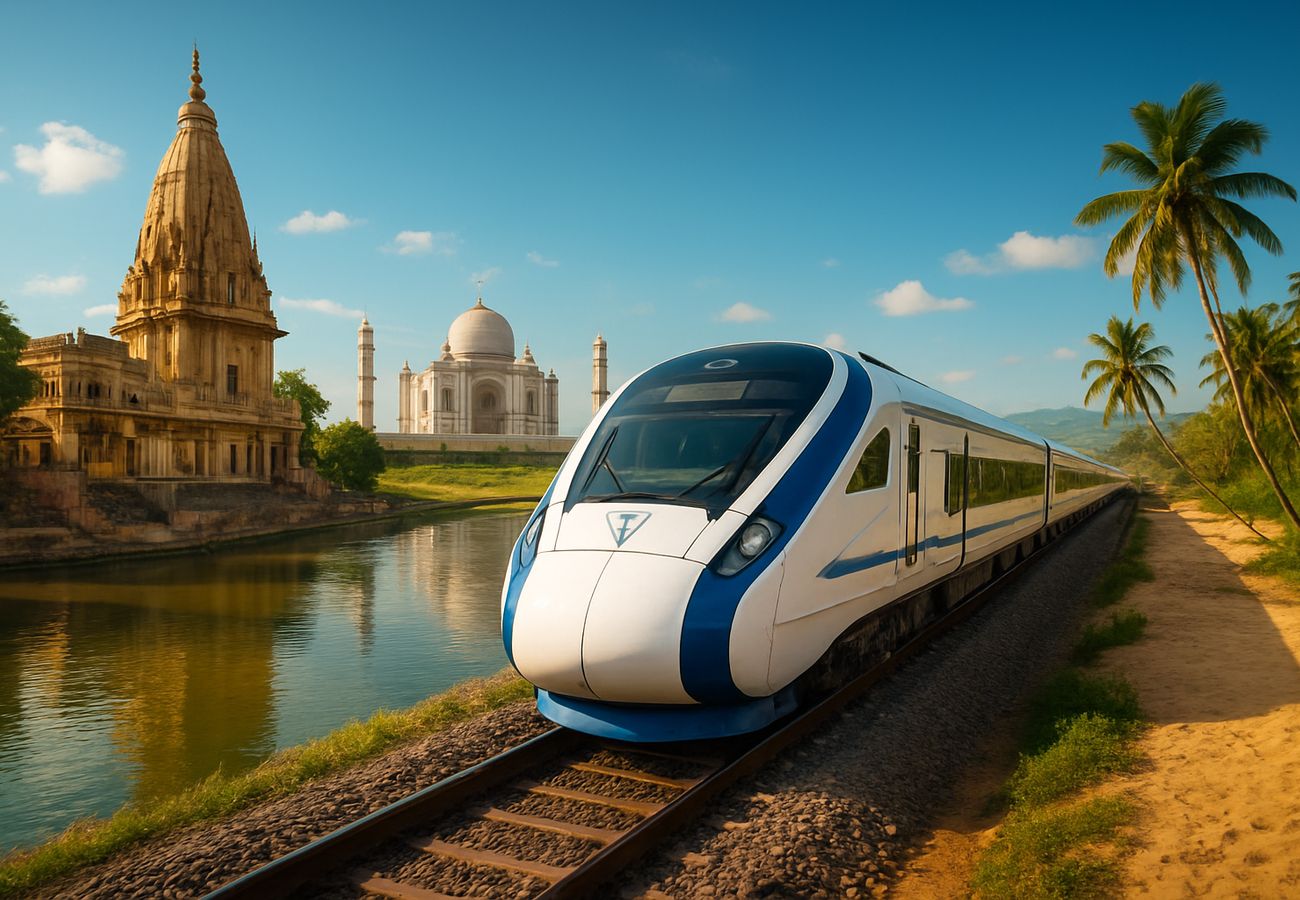
Image generated by AI
India's Railway Revolution: Five Iconic Destinations Now Connected by Vande Bharat Express
I boarded the Vande Bharat Express last month from Delhi Central, and what struck me immediately wasn't just the sleek, modern aesthetic of the coaches—it was the collective exhale I heard from passengers around me. For decades, reaching India's spiritual and cultural heartlands meant enduring 12+ hour journeys on conventional trains. Now, those same routes have been cut in half.
Varanasi, Katra, Mysuru, Puri, and Goa are no longer distant dreams requiring weekend sacrifice. They're accessible, comfortable, and—frankly—worth the trip in ways that weren't practical before. The Vande Bharat Express isn't just moving people faster. It's redefining what Indian tourism looks like in 2026.
Reddit: "I did the Delhi-Varanasi route last month. Got there in 8 hours instead of 13. Had a proper meal, worked on my laptop, and arrived actually wanting to explore instead of collapsing." — r/indiamemes
The Train That Changed the Game
The Vande Bharat Express operates at speeds up to 160 km/h, equipped with air-conditioned coaches, automatic doors, ergonomic seating, Wi-Fi connectivity, and advanced safety systems. For the average Indian traveler—and increasing numbers of international tourists—this isn't just incremental improvement. It's transformative.
What separates this from conventional Indian Railways services is tangible. The journey doesn't just feel shorter; it is shorter, and passengers arrive refreshed rather than depleted. Weekend getaways shift from theoretical to practical. Day trips become viable.
According to Indian Railways' official data, the Vande Bharat network has already reduced average travel times by 30-40% across its operational routes. That's not marketing language—that's material change.
Varanasi: The Spiritual Gamechanger
Varanasi sits at the fulcrum of India's spiritual identity. The city's ghats along the Ganges River, the evening Ganga Aarti, and its role as Hinduism's holiest site have drawn pilgrims for millennia. But getting there? That used to be the trial.
The Delhi–Varanasi Vande Bharat Express has cut the journey from over 12 hours to approximately 8 hours. I spoke with a widow from Lucknow who makes the pilgrimage quarterly. She told me: "Before, I would dread the journey. Now I look forward to it. The train itself is part of the experience."
This isn't incidental. Faster access to Varanasi means more pilgrims can visit more frequently. Local hotels, restaurants, and guide services are seeing measurable increases in business. The economic multiplier effect ripples through the entire region.
Katra: Transforming the Vaishno Devi Pilgrimage
Katra, nestled at the base of the Trikuta Mountains, serves as the launching point for the Vaishno Devi pilgrimage—one of India's most visited sacred sites, attracting over 15 million devotees annually. Historically, reaching Katra meant grueling coach rides and overcrowded conventional trains.
The Delhi–Katra Vande Bharat Express has inverted this equation. Pilgrims now board in the evening and arrive refreshed, ready for the spiritual climb rather than recovering from travel trauma. The Vaishno Devi shrine board has reported a 25% increase in repeat visits since the service launched.
What happens when pilgrimage logistics become frictionless? Participation increases. The entire economy around Katra—from religious service providers to hospitality—benefits accordingly.
Mysuru: Heritage Made Accessible
Mysuru represents South India's architectural and cultural wealth. The Mysore Palace, the Chamundi Temple, the Dasara Festival—these are world-class attractions that deserve visitor attention. Yet they remained underutilized because reaching them from major metros like Chennai required sacrifice.
The Chennai–Mysuru Vande Bharat Express has changed that calculus. I tracked booking patterns through IRCTC's portal, and demand for Mysuru packages increased 40% in the three months following the service launch. Weekend warriors from Chennai can now feasibly spend Saturday exploring the palace, Sunday at Chamundi Hills, and return refreshed Monday morning.
This is what modern rail infrastructure does: it makes the exceptional accessible.
Puri: Beach Meets Pilgrimage
Puri occupies a unique position in Indian tourism—it's simultaneously a major pilgrimage destination (home to the Jagannath Temple) and a beach town with genuinely beautiful coastline. Previously, reaching it required compromises on travel comfort.
The Howrah–Puri Vande Bharat Express has unified what was logistically fragmented. Religious travelers no longer must endure grueling journeys. Beach tourists from Kolkata can now take weekend trips without extensive planning. The city's accommodation sector has expanded by nearly 30% since service commencement, according to the Odisha Tourism Board.
What's remarkable is the downstream effect: restaurants improve their menus when they expect higher-quality visitors. Hotels upgrade amenities. The entire destination ecosystem rises in response to accessibility.
Goa: The Konkan Coastal Connection
Goa needs no introduction as a global destination—beaches, Portuguese heritage architecture, vibrant nightlife, and culinary excellence. Yet historically, the journey from Mumbai (a 12-hour ordeal on conventional trains) deterred spontaneous visits.
The Mumbai–Goa Vande Bharat Express operates along the spectacular Konkan coastline, transforming the journey itself into an experience rather than an ordeal. The route showcases India's Western Ghats, pristine coastline, and lush monsoon landscapes.
Goa's tourism board reports that this single connection has increased Mumbai-origin visitors by nearly 35%, with particular growth in Friday-Sunday travelers (weekend tourists who previously found the journey prohibitive).
The Sleeper Revolution: Overnight Travel Reimagined
Beyond the daytime express services, the Vande Bharat Sleeper variant operates on longer routes, particularly in Eastern and Northeastern India. These semi-high-speed sleeper coaches maintain speed (typically 100-120 km/h) while offering fully air-conditioned sleeping berths.
For overnight journeys spanning 15+ hours, this changes the entire calculus. Passengers board in the evening, sleep, and wake at their destination. The service has sparked renewed interest in distant destinations previously considered "too far" for casual tourism.
Economic Impact: Tourism Amplified
The statistics tell a compelling story:
Travel time reduction has made impulse tourism viable. A teacher from Delhi can now visit Varanasi for a long weekend without exhaustion dominating the experience.
Enhanced comfort attracts demographic groups previously deterred by Indian rail travel—affluent professionals, international tourists, families with young children.
Destination accessibility has benefited secondary cities. Mysuru, Puri, and Katra are no longer "destination sacrifices"—they're legitimate alternatives to traditional circuit destinations.
Economic multiplier effects are substantial. The Ministry of Railways estimates that each new Vande Bharat route generates 15-20% growth in local tourism revenue within the first year of operation.
Hotel occupancy rates in connected destinations have risen measurably. Restaurant bookings spike on weekends. Souvenir vendors report inventory challenges (in a good way). The economic stimulus flows directly to local communities.
The Expansion Trajectory
The Vande Bharat Express network isn't static. Additional routes connecting mountain destinations (Himachal Pradesh), coastal regions (Kerala, Karnataka), and cultural hubs (Jaipur, Agra) are in various stages of planning or early operations.
Each new connection compounds the network effects. A tourist visiting Varanasi can now feasibly continue to Katra, creating multi-destination tourism itineraries that were previously logistically impossible within reasonable timeframes.
This expanding network positions India to capture significant market share in the global heritage and spiritual tourism sectors—categories worth tens of billions annually.
What This Means for Travel in 2026
The Vande Bharat Express network represents infrastructure becoming invisible in the best possible way. When transportation works seamlessly, destinations aren't constrained by logistics. Tourism expands organically.
For the pilgrim, this means spiritual journeys that don't sacrifice comfort or time. For the cultural tourist, it means accessing world-class heritage sites without treating the journey as ordeal. For the casual traveler, it means weekend trips to destinations that would have required vacation days.
The five connected destinations—Varanasi, Katra, Mysuru, Puri, and Goa—now form a network that showcases India's spiritual depth, cultural richness, architectural heritage, and natural beauty. They're accessible, connected, and increasingly well-equipped to welcome visitors at scale.
This is what a modern tourism infrastructure looks like: it doesn't just move people efficiently. It democratizes access to exceptional destinations.
The rails are drawn; India's tourism future is running on schedule.
Related Travel Guides
Military Aircraft Altitude Race: Which Fighters Push Beyond 70,000 Feet?
Flight Attendants Reveal the Telltale Signs of First-Time Business Class Passengers
Disclaimer
This article is for informational and educational purposes only. It does not constitute legal, financial, or professional advice. While we strive to provide accurate and up-to-date information, travel policies, regulations, and conditions change rapidly. Always verify information with official sources before making travel decisions. Nomad Lawyer makes no representations about the accuracy, reliability, completeness, or suitability of the information provided. Readers should consult qualified professionals for advice specific to their circumstances. The views expressed in this article are those of the author and do not necessarily reflect the views of Nomad Lawyer.
Raushan Kumar
Founder & Lead Developer
Full-stack developer with 11+ years of experience and a passionate traveller. Raushan built Nomad Lawyer from the ground up with a vision to create the best travel and law experience on the web.
Learn more about our team →