
Vancouver Airport Chaos: Air Canada Rouge, Jazz, WestJet Cancel 8 Flights, Delay Hundreds Across North America and Asia
Vancouver International Airport ground to a halt as three major Canadian carriers cancelled 8 flights and reported 31 delays, disrupting routes to 40+ cities across Canada, the US, Europe, and Asia-Pacific.

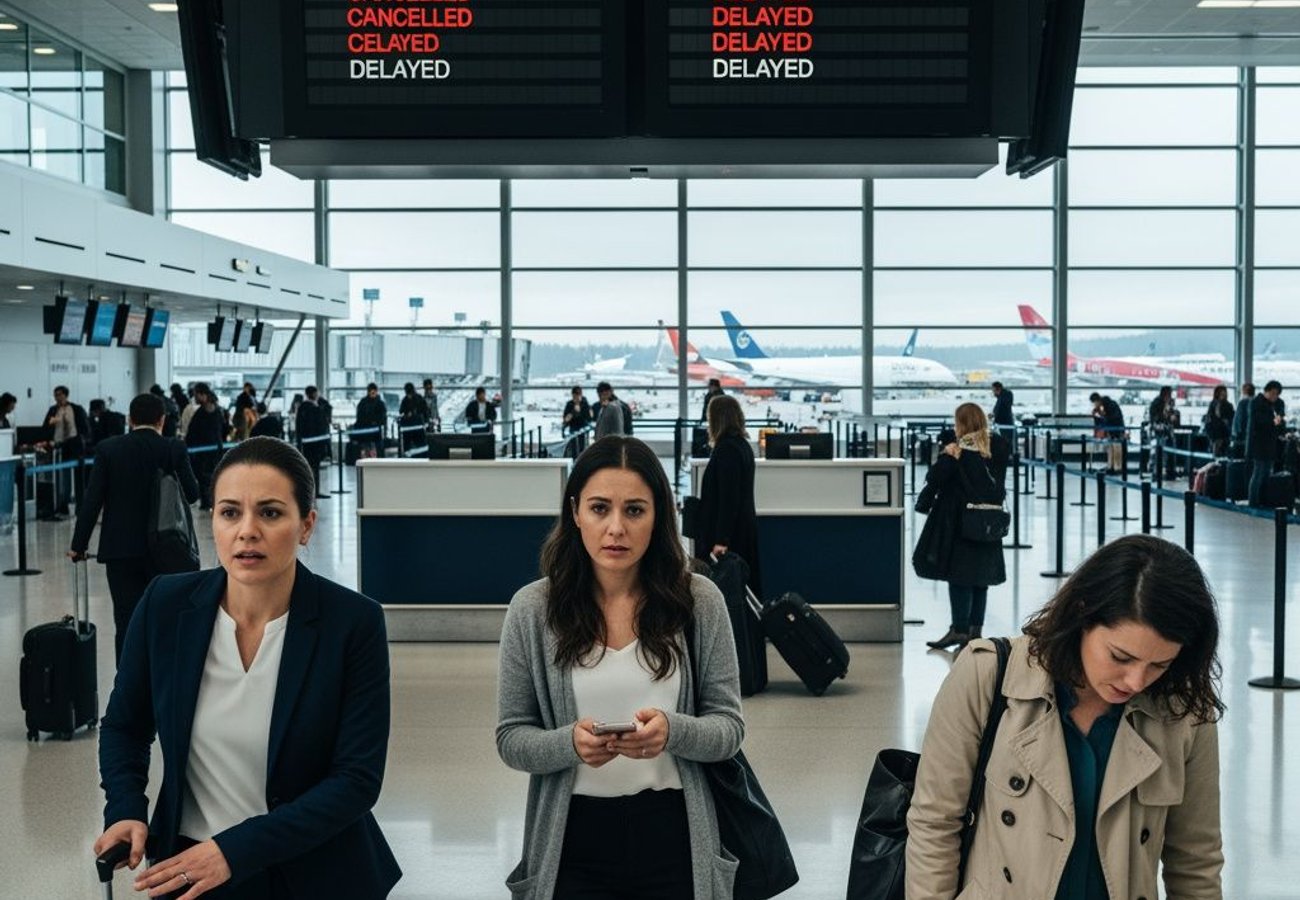
Image generated by AI
The Day Vancouver's Busiest Gateway Ground to a Halt
Vancouver International Airport (YVR) became the epicenter of a cascading aviation crisis on June 19, 2026, when three major Canadian carriers simultaneously disrupted operations. Air Canada Rouge, Jazz Aviation, and WestJet cancelled a combined 8 flights and reported 31 additional delays across their networks. The fallout wasn't confined to British Columbia—it rippled across 40+ cities spanning Canada, the United States, Germany, Japan, China, and Hong Kong.
By midday, the airport's departure boards told the story: cancelled flights, gate reassignments, and growing crowds of frustrated passengers searching for answers. The disruption exposed a critical vulnerability in North American aviation infrastructure: how quickly operational failures at a single major hub can paralyze interconnected global networks.
The Scale of the Disruption: More Than Just One Airport
What began as a localized problem at YVR rapidly metastasized into a continental crisis. According to real-time data from FlightAware, the disruption affected an staggering geographic footprint:
Canadian cities impacted: Vancouver, Calgary, Edmonton, Montreal, Toronto, Winnipeg, Ottawa, Victoria, Kelowna, Nanaimo, Castlegar, Quesnel, Williams Lake, Prince George, Whitehorse, Smithers, Prince Rupert, Sandspit, Tofino, Penticton, Yellowknife, Cranbrook, Saskatoon, and Trail.
US destinations affected: Los Angeles, San Francisco, Seattle, Denver, Chicago, Minneapolis–Saint Paul, Dallas–Fort Worth, Houston, Washington D.C., Boston, Charlotte, Cincinnati, Las Vegas, San Diego, and Sacramento.
International routes disrupted: Frankfurt and Munich (Germany), Tokyo and Osaka (Japan), Shanghai and Chengdu (China), Hong Kong, Manila (Philippines), Taipei (Taiwan), and Nadi (Fiji).
The geographic sprawl underscores a harsh reality: when Canada's second-busiest airport stumbles, the shockwaves travel across ocean basins and continental divides.
Flight Cancellations: Where the Pain Was Concentrated
| Airport | Airline | Cancelled Flights | Delayed Flights |
|---|---|---|---|
| Vancouver (YVR) | Air Canada Rouge | 3 | 4 |
| Vancouver (YVR) | Jazz Aviation | 3 | 19 |
| Vancouver (YVR) | WestJet | 2 | 8 |
Air Canada Rouge absorbed the heaviest operational strain with 3 cancellations and 4 delays at YVR. Jazz Aviation—a regional carrier operating under Air Canada's banner—recorded the worst performance with 3 cancellations and 19 delays, indicating systemic coordination problems between the two carriers. WestJet reported 2 cancellations and 8 delays, rounding out the trio's operational meltdown.
Calgary International Airport (YYC) emerged as the second-most affected facility, with 5 cancellations across reporting periods. Kelowna (YLW) recorded 1 cancellation, while Los Angeles International (LAX) experienced disruptions despite being thousands of kilometers away—a testament to how deeply integrated North American aviation networks have become.
Reddit: "I was stuck at YVR for 12 hours watching the departure board update every 20 minutes. No airline staff would commit to a rebooking time. Absolute chaos." — r/canadiantravel
What Happened to Your Flight? The Real-Time Reality
For travelers caught in the crossfire, the experience was less about operational mechanics and more about raw frustration. Passengers discovered their flights cancelled through airline apps, terminal announcements, or the grim realization that their flight wasn't on the departure board.
The cascading effect created a prisoner's dilemma: early cancellations freed up gate capacity and reduced congestion, but left passengers stranded. Delayed flights created uncertainty—would you depart in 30 minutes or 3 hours? Airlines offered rebooking, but alternative flights filled instantly as the network collapsed under pressure.
International passengers suffered most acutely. A cancelled flight from Vancouver to Tokyo meant not just a missed departure, but potential hotel cancellations, missed meetings, and disrupted itineraries spanning the Pacific.
What to Do When Your Flight Gets Cancelled: A Survival Guide
If you're caught in a disruption like Vancouver's, here's your action plan:
Stay Informed in Real Time
The moment you learn of a cancellation, check three simultaneous channels: your airline's app, your email inbox, and FlightAware (which often updates faster than carrier systems). Don't rely on a single source—carriers sometimes delay public announcements while processing rebooking internally.
Contact the Airline Immediately
Visit the service desk if you're already at the airport. If you're at home, call customer service or use the airline's online chat system before airport queues form. Early contact often yields better rebooking options because airlines assign seats to aircraft in real time, and earlier callers get better options.
Know Your Legal Rights
This is where nomadlawyer.org readers should pay close attention: your rights depend entirely on jurisdiction. In the European Union, passengers are entitled to compensation up to €600 for flight cancellations (depending on flight distance and circumstances). In Canada and the US, protection is far weaker—carriers are generally obligated to rebook you on the next available flight, but cash compensation is rare unless the airline explicitly violated regulations.
Check your airline's specific policy before booking future flights. Some carriers offer automatic compensation; most will fight every claim.
Explore Alternative Transport
If rebooking delays exceed 24 hours, consider ground alternatives. VIA Rail operates transcontinental service across Canada. Regional buses and rental cars become viable for distances under 800 kilometers. Airlines know this—expect them to prefer inconvenient rebooking over cash refunds.
Document Everything
Photograph the departure board showing your cancellation. Retain all communications with the airline. Screenshot your booking confirmation and cancellation notice. If you pursue a compensation claim later, this paper trail becomes essential evidence.
The Bigger Picture: Network Fragility in Modern Aviation
The Vancouver disruption wasn't an anomaly—it was a symptom. Modern airlines operate with razor-thin margins and load factors exceeding 85 percent. When one aircraft is removed from service, it cascades: crews become misaligned with aircraft, connecting passengers miss downstream flights, and the error propagates across the network.
Jazz Aviation, a regional carrier, performed worst on the day. Regional carriers operate on even tighter margins than their legacy counterparts, making them particularly vulnerable to disruption. A single grounded aircraft can strand 70+ passengers and trigger a dozen downstream cancellations.
The fact that disruptions reached as far as Shanghai, Tokyo, and Hong Kong reveals another truth: Canadian airports and carriers have become critical nodes in transpacific connectivity. A malfunction at YVR sends shockwaves across the Pacific.
What Airlines Say vs. What Actually Happened
Carriers rarely provide transparent explanations for operational disruptions. The industry standard response: "operational challenges" or "weather-related delays" (even when weather isn't involved). In this case, no specific cause was publicly disclosed.
This opacity creates frustration. Passengers deserve to know: Was this mechanical? Staffing? Air traffic control delays cascading from elsewhere? Safety protocols correctly grounding an aircraft? The silence breeds conspiracy theories and erodes confidence.
The June 2026 Context: A Busy Travel Season
June is peak travel season in North America. Schools shut down, families embark on vacations, and business travel remains elevated post-pandemic. YVR typically handles 40,000+ passengers daily during peak months. A disruption affecting 40+ cities means thousands of travelers experienced cascading chaos.
Airlines knew this. Peak season is when network resilience matters most—and on June 19, 2026, the Canadian carriers' networks failed.
What Comes Next: Preventive Measures
The aviation industry will debate the Vancouver disruption's causes internally. Regulators may review operational protocols. But for travelers, the lesson is grimmer: major disruptions will happen again.
Build redundancy into your travel plans during peak season. Book flights early in the day (if a cancellation occurs, more alternative flights exist). Avoid tight connections. Maintain travel insurance covering disruptions. Consider flying through secondary hubs when primary gateways show weakness.
The system works—until it doesn't. On June 19, 2026, at Vancouver International Airport, it didn't.
Network resilience isn't about preventing disruptions—it's about containing them before they metastasize.
Related Travel Guides
Disclaimer
This article is for informational and educational purposes only. It does not constitute legal, financial, or professional advice. While we strive to provide accurate and up-to-date information, travel policies, regulations, and conditions change rapidly. Always verify information with official sources before making travel decisions. Nomad Lawyer makes no representations about the accuracy, reliability, completeness, or suitability of the information provided. Readers should consult qualified professionals for advice specific to their circumstances. The views expressed in this article are those of the author and do not necessarily reflect the views of Nomad Lawyer.
Raushan Kumar
Founder & Lead Developer
Full-stack developer with 11+ years of experience and a passionate traveller. Raushan built Nomad Lawyer from the ground up with a vision to create the best travel and law experience on the web.
Learn more about our team →