
US Flight Cancellations and Delays Spike Across Boston, New York, and Chicago
Over 321 flights cancelled and 2,189 delayed across the US as thunderstorms and runway construction trigger ground delays at JFK, Newark, Boston, and O'Hare.

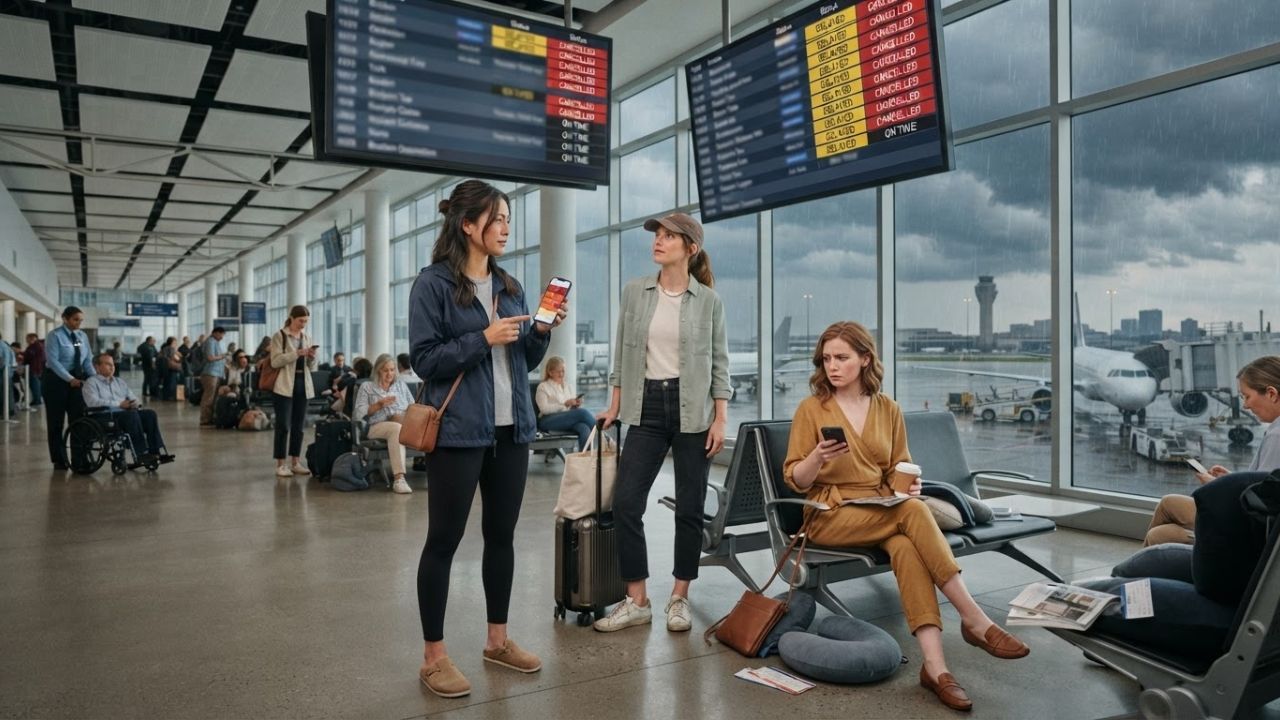
Image generated by AI
With 321 flight cancellations and 2,189 delays reported across the United States, ground-delay programs at JFK, Newark Liberty, Boston Logan, and Chicago O’Hare are causing cascading disruptions for travelers navigating severe weather and runway closures.
The Local Trend: Cross-Country Airspace Bottlenecks and Severe Weather Ground Delays
Commercial aviation across major United States air corridors faced heavy friction following a surge in operational delays and schedule disruptions. Real-time aviation tracking logged 2,189 flight delays and 321 cancellations nationwide. The disruptions stem from a compounding mix of late-summer convective thunderstorms along the Northeast corridor, runway construction programs in New England, and marine low-ceiling cloud layers in Northern California.
Federal Aviation Administration (FAA) traffic management initiatives triggered ground-delay programs across key international gateways. In the Tri-State New York metro area, John F. Kennedy International Airport (JFK) and Newark Liberty International Airport (EWR) saw severe convective storm holds averaging 113 minutes and 102 minutes respectively, while LaGuardia Airport (LGA) managed expanding departure delays.
Major Hub Impact: Airport Delays and Cancellations
Flight disruptions concentrated heavily across high-volume transit hubs:
- Chicago O’Hare (ORD): Recorded 262 flight delays and 48 cancellations, leading national hubs in total schedule disruptions.
- Boston Logan (BOS): Reported 247 delays and 60 cancellations, operating under an FAA ground-delay program with average holds of 97 minutes caused by active runway construction.
- New York LaGuardia (LGA): Handled 148 delays and 98 cancellations, experiencing average departure delays of 30 minutes that grew as weather systems moved through the New York airspace.
- Newark Liberty (EWR) & New York JFK: EWR logged 147 delays and 16 cancellations (102-minute average ground delay), while JFK registered 146 delays and 70 cancellations (113-minute average ground delay).
- San Francisco (SFO): Reported 135 delays and 5 cancellations, with inbound traffic slowed by a 50-minute average ground delay linked to dense coastal low ceilings.
- Regional Gateways: Ronald Reagan Washington National (DCA) reported 94 delays and 18 cancellations; San Diego (SAN) recorded 77 delays and 3 cancellations (32-minute volume delay); Charlotte/Douglas (CLT) logged 56 delays and 10 cancellations; and Orlando (MCO) marked 56 delays and 10 cancellations.
Nationwide Flight Disruption Data Profile (September 2026)
| Airport Gateway | Flight Delays | Flight Cancellations | Primary Causal Factor & Program Status |
|---|---|---|---|
| Chicago O'Hare (ORD) | 262 Delays | 48 Cancellations | High airport volume & airspace congestion |
| Boston Logan (BOS) | 247 Delays | 60 Cancellations | Runway construction (97-min avg ground delay) |
| New York LaGuardia (LGA) | 148 Delays | 98 Cancellations | Departure management & weather (30-min delays) |
| Newark Liberty (EWR) | 147 Delays | 16 Cancellations | Thunderstorm activity (102-min avg ground delay) |
| New York JFK (JFK) | 146 Delays | 70 Cancellations | Thunderstorm activity (113-min avg ground delay) |
| San Francisco (SFO) | 135 Delays | 5 Cancellations | Low cloud ceilings (50-min avg ground delay) |
| Reagan National (DCA) | 94 Delays | 18 Cancellations | Northeast corridor regional convective weather |
| San Diego (SAN) | 77 Delays | 3 Cancellations | Airport volume & spacing (32-min avg delay) |
| Charlotte/Douglas (CLT) | 56 Delays | 10 Cancellations | Regional hub connector flight scheduling |
| Orlando International (MCO) | 56 Delays | 10 Cancellations | Florida weather & connecting aircraft delays |
Airline Fleet Disruptions: Regional Feeders Face High Cancellation Rates
Regional carriers providing feeder connections to mainline fleets bore the highest cancellation loads:
- Republic Airways and Endeavor Air: Both regional operators tied for the highest cancellation counts nationwide with 80 cancellations each; Republic recorded 114 delays, while Endeavor logged 50 delays.
- JetBlue Airways: Logged 46 cancellations and 143 delays, heavily impacted by ground programs at its primary Boston and JFK hubs.
- Mainline Carriers: United Airlines posted the highest delay tally at 235 delays with 27 cancellations; Southwest Airlines recorded 229 delays with just 1 cancellation; American Airlines registered 225 delays and 17 cancellations; and regional affiliate SkyWest logged 205 delays and 16 cancellations.
Destination Specialist Local Insider Tips
Travelers affected by cascading airport delays can protect their itineraries with these actionable recommendations:
- Switch to Nearby Secondary Airports via Same-Day Rebooking: If stranded by JFK or LaGuardia cancellations, ask customer service agents to protect your seat on flights departing Newark (EWR), White Plains (HPN), or Philadelphia (PHL).
- Utilize Amtrak Northeast Regional or Acela Between BOS and NYC: When Boston Logan or New York flights face 2- to 3-hour ground delays, cancel the flight portion for an automatic refund and book Amtrak rail service connecting Boston South Station directly to New York Moynihan Train Hall.
- Monitor the FAA Air Traffic Control System Command Center: Access real-time ground-stop notices and ground-delay programs directly at nasstatus.faa.gov before driving to the airport.
- Request Automatic DOT Cash Refunds for Significant Delays: Under Department of Transportation rules, passengers whose flights are cancelled or significantly altered are entitled to a full cash refund to the original form of payment if they decline alternative rebooking.
- Secure Lounge Access During Extended Ground Stops: In airports facing ground holds like BOS, JFK, or ORD, utilize airline day passes or credit card priority lounge networks to access quiet work desks, food, and dedicated rebooking desks away from crowded gate areas.
Future Outlook
As summer transitions to autumn, cross-country travel networks remain vulnerable to localized convective storm activity and ongoing airport infrastructure renovations. By monitoring live FAA airspace portals, understanding passenger refund rights, and leveraging regional rail alternatives, travelers can mitigate unpredictable flight disruptions.
Related Travel Guides
Disclaimer
This article is for informational and educational purposes only. It does not constitute legal, financial, or professional advice. While we strive to provide accurate and up-to-date information, travel policies, regulations, and conditions change rapidly. Always verify information with official sources before making travel decisions. Nomad Lawyer makes no representations about the accuracy, reliability, completeness, or suitability of the information provided. Readers should consult qualified professionals for advice specific to their circumstances. The views expressed in this article are those of the author and do not necessarily reflect the views of Nomad Lawyer.
Raushan Kumar
Founder & Lead Developer
Full-stack developer with 11+ years of experience and a passionate traveller. Raushan built Nomad Lawyer from the ground up with a vision to create the best travel and law experience on the web.
Learn more about our team →