
Convention-Driven Hotel Economics: How New York, Chicago, Atlanta, and Dallas Reshape US Business Travel

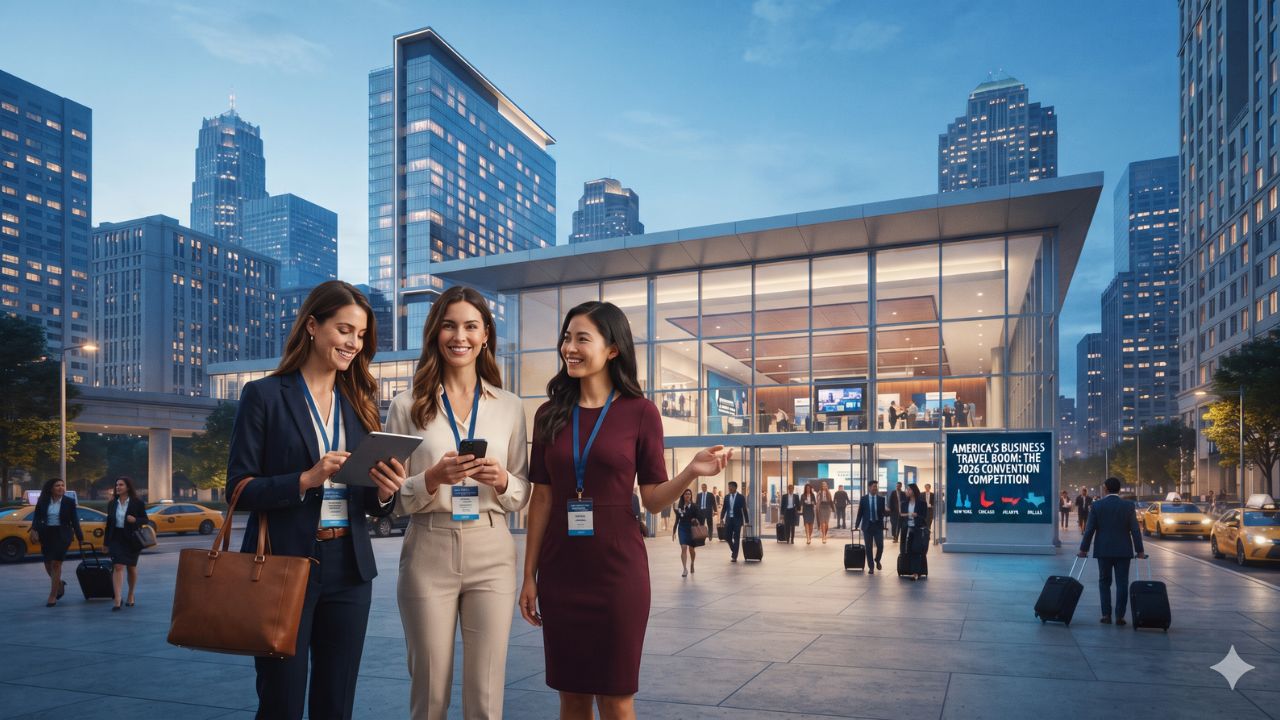
While nationwide US hotel occupancy slipped 1.2% to 62.3% and revenue per available room contracted to $100.02, New York City commanded an average daily room rate of $333.71, exceeding the national benchmark by more than $173. The stark divergence captured in 2025 hospitality performance data illustrates how major convention and business travel epicenters are decoupling from broader commercial lodging softness.
Across the United States, commercial hotel operators monitored by the American Hotel & Lodging Association (AHLA) face an uneven lodging climate defined by a 0.3% annual drop in nationwide RevPAR against an average daily rate (ADR) of $160.54. In response, four premier convention powerhouses—New York, Chicago, Atlanta, and Dallas—are deploying radically different assets: Manhattan's unyielding pricing leverage, Chicago's massive 2.6-million-square-foot exhibition floor, Atlanta's global air connectivity, and Dallas's $1.77 billion forward convention pipeline.
The Four-City Matrix: Footprints, Air Hubs, and Room Revenues
The competition among tier-one convention destinations exposes divergent municipal models for monetizing delegate foot traffic.
In New York City, CoStar metrics show 2025 hotel occupancy held firm at 84.1%, delivering a RevPAR of $280.71. Backed by the expanded 850,000-square-foot Javits Center on Manhattan’s West Side, the city welcomed 65 million total visitors (52.4 million domestic, 12.5 million international), generating $55.6 billion in direct visitor spending and $84.7 billion in total economic impact. During high-density gathering months like September 2025—when Fashion Week, the US Open, and the United Nations General Assembly converged—citywide hotel occupancy reached 86.6%. The New York State Comptroller’s July 2026 audit noted room inventory grew 16.7% between 2014 and 2024, with 5,778 additional rooms across 24 hotel projects in the pipeline through 2028.
Chicago counters through massive physical capacity. McCormick Place provides 2.6 million square feet of exhibition space, including 1.2 million square feet on a single contiguous level, 173 meeting rooms, approximately 600,000 square feet of assembly space, and seating for 18,000 delegates. According to Choose Chicago, the central business district filled 11.9 million hotel room nights in 2025, an increase of 2.3% year on year, driving record hotel revenue of $2.9 billion and a RevPAR of $168.15. Leisure room demand reached an all-time peak of 8.2 million room nights. During the summer peak (June through August 2025), downtown properties logged 3.56 million room nights (+4.3%) and $949 million in revenue (+0.8%), though group-specific room bookings contracted 3.7%, proving that leisure travel shielded hotel books from corporate softness.
Atlanta builds its convention thesis around transit efficiency and physical flexibility. The Georgia World Congress Center spans more than four million square feet of total event space, including 1.5 million square feet of contiguous exhibition halls, 98 breakout rooms, and two grand ballrooms. Direct connectivity to Hartsfield-Jackson Atlanta International Airport (ATL)—which handled 106.3 million passengers in 2025 (-1.6%)—gives regional events international reach. Closer to the tarmac, the Georgia International Convention Center adds 150,000 square feet of exhibit space connected directly via the automated ATL SkyTrain.
Dallas is executing a multi-year redevelopment program. While the current Kay Bailey Hutchison Convention Center offers 753,965 square feet of programmable space (529,250 square feet of exhibit area) flanked by the 1,001-room Omni Dallas Hotel, the city is constructing a 2.1-million-square-foot master complex set for 2030. The future campus will feature 750,000 square feet of exhibit space, 180,000 square feet of meeting rooms, and a 105,000-square-foot ballroom. The city’s FY2025 tourism report confirmed 1.3 million future room nights booked, locking in 69 definite conventions for 2029 and beyond, representing $1.77 billion in projected economic impact.
Comparative Overview: Exhibition Footprint and Hotel Dynamics
The structural differences between the four primary convention markets highlight how venue capacity intersects with lodging performance.
| Metro Destination | Flagship Exhibition Venue | Dedicated Exhibit Space | 2025 Hotel Performance & Demand | Primary Hub Airport & 2025 Passenger Traffic | Strategic Hospitality Horizon |
|---|---|---|---|---|---|
| New York City | Javits Center (Manhattan West Side) | 850,000 sq ft flexible space | 84.1% occupancy; $333.71 ADR; $280.71 RevPAR | JFK (62.6M) + multi-airport system | 5,778 new rooms in pipeline through 2028 |
| Chicago | McCormick Place | 2.6M sq ft total (1.2M sq ft contiguous) | 11.9M CBD room nights; $2.9B revenue; $168.15 RevPAR | Chicago O'Hare (84.9M, +6.0% YoY) | Group demand dipped 3.7%; leisure shields downtown hotels |
| Atlanta | Georgia World Congress Center (GWCC) | 1.5M sq ft contiguous (4M+ sq ft total campus) | Xenia Portfolio: 67.3% occ; $256.49 ADR; $172.65 RevPAR | Hartsfield-Jackson (106.3M, -1.6% YoY) | GICC SkyTrain links directly to airport terminals |
| Dallas | Kay Bailey Hutchison Convention Center | 529,250 sq ft (Expanding to 750k sq ft in 2030) | 1.3M future room nights booked; $1.77B convention pipeline | Dallas Fort Worth (85.7M, -2.5% YoY) | 2.1M sq ft 2030 campus redevelopment underway |
The aviation data demonstrates critical route shifts. While Atlanta and Dallas Fort Worth registered minor passenger declines (-1.6% and -2.5% respectively), Chicago O'Hare expanded 6.0% to 84.9 million passengers in 2025, restoring flight frequencies that make Midwest convention itineraries cost-competitive.
The Delegate Cost Curve: Room Blocks, Surcharges, and Urban Mobility
Corporate event attendance triggers distinct budget realities depending on municipal market dynamics:
- New York's Block Creep: Room blocks negotiated at Manhattan convention hotels often exceed $350 per night before state and city occupancy taxes. Corporate travelers increasingly book secondary business districts—such as Downtown Brooklyn or Financial District properties—utilizing the 7 Subway extension directly to the 34th Street–Hudson Yards station at Javits.
- Chicago's Commute Balancing: Staying immediately adjacent to McCormick Place offers convenience but limited after-hours dining. Delegates balancing corporate entertainment frequently book properties along the Loop and Michigan Avenue, factoring in a 10-to-15-minute taxi or Green Line transit ride.
- Atlanta's Airport Corridor Advantage: Short-format association delegates can lodge at College Park hotels surrounding the Georgia International Convention Center, cutting ground transit costs entirely via the free SkyTrain while accessing downtown Atlanta via MARTA rail in 20 minutes.
Expert Analysis: Group Elasticity and the Inflation of Business Travel
The divergence between overall hotel occupancy and group room demand signals an important transition in corporate travel procurement.
For travelers booking these convention hubs, the direct consequence is extreme midweek rate compression. In cities like Chicago, while total central business district room nights rose 2.3% to 11.9 million, the 3.7% decline in negotiated group room demand indicates that corporate travel managers are bypassing official convention room blocks to hunt for lower non-refundable retail rates online.
The pricing pressure this creates means hotel sales directors face diminishing power to enforce strict minimum-stay attrition clauses on conference organizers. Instead, properties are unbundling event amenities—charging separate fees for high-speed conference Wi-Fi, fitness facilities, and luggage storage—to defend net margins.
Furthermore, airport connectivity dictates corporate attendance. With O'Hare growing by 6.0% to 84.9 million passengers, Chicago preserves extensive direct mainline connectivity from secondary US cities, keeping round-trip airfares lower for mid-tier trade associations. Conversely, in New York, where hotel ADRs remain fixed at a premium $333.71, trade shows experience shorter delegate lengths of stay, as companies reduce their on-site delegation sizes from five executives down to two to manage overall travel expenditures.
Key Takeaways
- $333 NYC Rate Benchmark: New York led the nation’s major urban centers with an $333.71 ADR and 84.1% hotel occupancy in 2025, generating $55.6 billion in direct visitor spending.
- Chicago Room Night Record: Chicago’s central business district filled a record 11.9 million room nights and $2.9 billion in lodging revenue, despite a 3.7% dip in group business demand.
- McCormick Place Scale: Chicago offers the largest single facility with 2.6 million square feet of exhibit space, followed by Atlanta's GWCC campus spanning more than four million total square feet.
- Dallas 2030 Transformation: Dallas is constructing a 2.1-million-square-foot convention district for 2030, having already booked 1.3 million future room nights representing $1.77 billion in economic impact.
- Airport Traffic Contrasts: Atlanta processed 106.3 million air passengers in 2025, DFW handled 85.7 million, while Chicago O'Hare grew 6.0% to 84.9 million travelers.
FAQ: US Convention Travel & Hotels 2026
Which US city has the highest convention hotel room rates?
New York City commands the highest rates among major US convention hubs, averaging a daily room rate of $333.71 and an 84.1% occupancy rate in 2025.
What is the largest convention center in the United States?
McCormick Place in Chicago is the largest convention venue in the US, featuring 2.6 million square feet of exhibit space, including 1.2 million square feet on a single level.
When will the new Dallas convention center open?
The redeveloped 2.1-million-square-foot Kay Bailey Hutchison Convention Center in Dallas is scheduled for completion in 2030.
How does Atlanta connect its airport to convention facilities?
Hartsfield-Jackson Atlanta International Airport connects directly to the Georgia International Convention Center via the free ATL SkyTrain and links to downtown's GWCC via MARTA rail.
Related Travel Guides
- New York Screen Tourism and Film Production Surge Guide 2026
- US Christmas Lights Showdown: New York, Nashville, Branson, and Philadelphia 2026
- US Convention Hotel Rates and Business Travel Guide Reddit 2026
In the high-stakes arena of business travel, the destinations that succeed do not merely offer vast exhibition floors—they deliver seamless transit, predictable lodging costs, and value long after the hall lights dim.
Disclaimer
This article is for informational and educational purposes only. It does not constitute legal, financial, or professional advice. While we strive to provide accurate and up-to-date information, travel policies, regulations, and conditions change rapidly. Always verify information with official sources before making travel decisions. Nomad Lawyer makes no representations about the accuracy, reliability, completeness, or suitability of the information provided. Readers should consult qualified professionals for advice specific to their circumstances. The views expressed in this article are those of the author and do not necessarily reflect the views of Nomad Lawyer.
Raushan Kumar
Founder & Lead Developer
Full-stack developer with 11+ years of experience and a passionate traveller. Raushan built Nomad Lawyer from the ground up with a vision to create the best travel and law experience on the web.
Learn more about our team →