
US and Cambodia Sign Historic Open Skies Treaty After 12 Years of Aviation Diplomacy
A landmark Open Skies agreement between the US and Cambodia has dismantled transpacific flight caps, unlocking new passenger routes and massive cargo logistics.

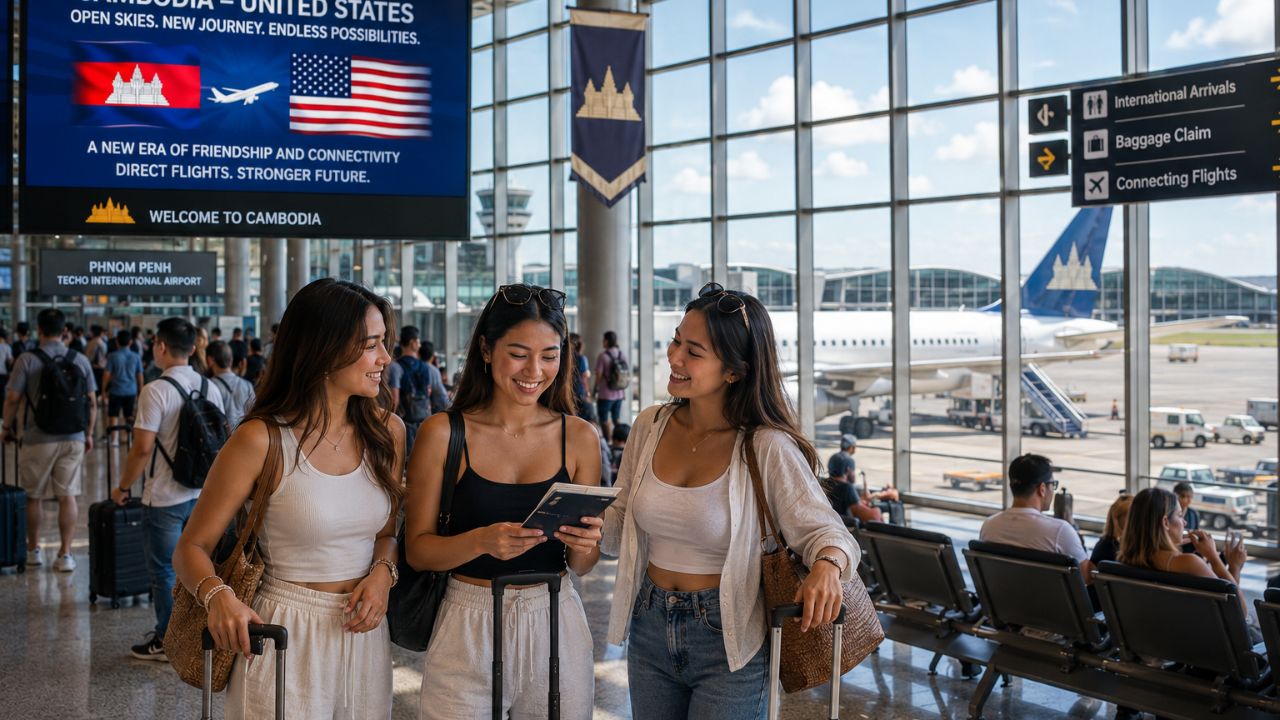
Image generated by AI
[Washington, July 3] — The United States and Cambodia have officially executed a landmark bilateral Air Transport Agreement, fundamentally rewriting the legal architecture governing transpacific flight corridors. Finalized in Washington, D.C. by the Minister-in-Charge of Cambodia’s State Secretariat of Civil Aviation and the United States Deputy Secretary of State, the treaty culminates 12 years of intense diplomatic negotiations. This Open Skies framework immediately integrates Cambodia into a massive global network alongside nearly 140 other American aviation partners, stripping away antiquated state intervention and allowing commercial airlines to independently set routes, frequencies, and pricing.
For the international travel market, the immediate dismantling of operational caps means airlines can launch highly optimized, direct flight paths bypassing traditional third-country transit hubs. Transpacific travelers bound for Southeast Asia will soon benefit from decentralized route architectures, landing directly at premium gateways like Siem Reap Angkor, coastal Sihanoukville, or the newly minted Techo International Airport in Phnom Penh.
Financial Backing Accelerates Airport Infrastructure
The regulatory breakthrough perfectly aligns with massive structural investments within the Cambodian aviation sector. Parallel to the diplomatic signing, the U.S. International Development Finance Corporation approved a massive $100 million financial commitment to accelerate the development of state-of-the-art terminal infrastructure at Techo International Airport. This influx of capital guarantees that Phnom Penh possesses the physical capacity required to process the anticipated surge of widebody transpacific aircraft.
Elite Cargo Privileges Unlock Southeast Asian Logistics
Beyond passenger transit, the treaty delivers a colossal structural victory for global supply chains. A critical provision of the accord grants mutual seventh-freedom traffic rights for all-cargo flight operations. This elite logistical privilege legally empowers commercial freighters to run continuous shipping routes between the United States and a third independent nation, utilizing terminal space in Phnom Penh as a base without ever returning to their home territories.
This regulatory freedom drops at a highly lucrative turning point for the local market. Official regional transport boards report that international air cargo volumes moving through Cambodian runways recently experienced an explosive 34 percent year-over-year increase, reaching nearly 39,000 tonnes. Furthermore, Air Cambodia’s recent multi-billion-dollar acquisition of fuel-efficient Boeing aircraft positions the national carrier to immediately dominate these newly legalized freight corridors.
Key Facts Breakdown
- Diplomatic Milestone: US and Cambodia sign an Open Skies Air Transport Agreement after 12 years of negotiations.
- Global Network: Cambodia joins nearly 140 American Open Skies partners.
- Infrastructure Funding: The U.S. International Development Finance Corporation commits $100 million to Techo International Airport.
- Cargo Operations: Mutual seventh-freedom traffic rights granted for all-cargo flights.
- Surging Volume: Cambodian international air cargo volumes hit nearly 39,000 tonnes (34% YoY increase).
- Export Dominance: The United States currently absorbs roughly 40% of all Cambodian outgoing goods.
Why This Matters
Our analysis of the treaty's technical provisions indicates that the true value of this Open Skies agreement lies within its aggressive cargo deregulation. The granting of seventh-freedom rights effectively transforms Phnom Penh into a massive, unregulated logistical staging ground for American commercial exporters. Because the United States already serves as Cambodia’s largest single export destination—absorbing 40 percent of all its outgoing goods—this treaty allows logistics giants to bypass congested hubs in Hong Kong and Singapore entirely. When a $100 million US-funded terminal expansion collides with Air Cambodia's massive Boeing fleet acquisition and zero state-imposed flight caps, it proves that Washington is actively engineering Cambodia into its primary commercial distribution powerhouse for the Southeast Asian economic zone.
Industry Outlook
Market trends suggest that international logistics entities and commercial exporters will instantly flood Cambodian aeronautical directors with formal requests for terminal slot allocations at Techo International Airport. While commercial passenger airlines will require several months to physically route aircraft into Siem Reap and Sihanoukville, cargo freighters will likely initiate reciprocal interim operations immediately. Moving forward, rival Southeast Asian transit hubs must aggressively review their own landing fees and operational restrictions, as Cambodia’s newly deregulated runways now offer a significantly cheaper, high-velocity bridge for global transpacific trade.
Related Travel Guides
- Investindustrial Joins WTTC as Global Member to Accelerate Private Capital Influence
- Global Air Travel Demand Drops 2.2% in May
- US Aviation Faces Historic Gridlock as America 250 Triggers FAA’s Busiest July 4th
- Trans-Tasman Aviation Chaos: 900 Flights Grounded
- Canadian Aviation Gridlock: 880 Flights Disrupted
Disclaimer
This article is for informational and educational purposes only. It does not constitute legal, financial, or professional advice. While we strive to provide accurate and up-to-date information, travel policies, regulations, and conditions change rapidly. Always verify information with official sources before making travel decisions. Nomad Lawyer makes no representations about the accuracy, reliability, completeness, or suitability of the information provided. Readers should consult qualified professionals for advice specific to their circumstances. The views expressed in this article are those of the author and do not necessarily reflect the views of Nomad Lawyer.
Kunal K Choudhary
Co-Founder & Contributor
A passionate traveller and tech enthusiast. Kunal contributes to the vision and growth of Nomad Lawyer, bringing fresh perspectives and driving the community forward.
Learn more about our team →